Construction glossary · MEP
What is hydronic piping in construction?
Hydronic piping in construction is the piping that circulates water for heating and cooling: chilled water (CHW) from the chiller to cooling coils, heating hot water (HHW) from the boiler, and condenser water (CW) between the chiller and the cooling tower. It is taken off in linear feet (lf) by pipe size, material, and service, with insulation, valves, hangers, and specialties carried as follow-on lines. On the drawings it lives on the mechanical piping plans and riser diagrams.
Updated June 2026 · Reviewed by the Ruh construction team
How hydronic piping is supported
Estimating mep scope this week? Watch Ruh take off a real plan in 30 minutes.
Book a walkthroughHydronic piping is the circulatory system of a chilled and hot water HVAC plant, and on a commercial mechanical estimate it is often the largest labor line in the bid. The scope lives on mechanical piping plans, riser diagrams, and the plant flow diagram, with materials in Division 23 specs: typically Schedule 40 black steel (welded or grooved) on larger sizes and Type L copper or press-fit systems on smaller branches. The mechanical contractor's pipefitters own it, separate from the sheet metal side of the house. Every run is really several estimate lines: the pipe in lf by size and material, fittings (counted or carried as a percentage of pipe labor), hangers and supports, insulation in lf by size and thickness, and valves and specialties (balancing valves, isolation valves, air vents, strainers) as counts. New estimators forget two things: supply and return run in pairs, so a 100 ft routing is 200 lf of pipe, and chilled water insulation needs a continuous vapor barrier, because a pipe running around 44 degrees F sweats through any gap and ruins ceilings.
Hydronic piping is measured in linear feet by size, material, and service, because a foot of 8 in welded steel and a foot of 1 in copper are completely different costs. The estimator scales horizontal runs from the piping plans, pulls vertical runs from the riser diagram using floor-to-floor heights, and keeps CHW, HHW, and condenser water separated. Insulation rides along as its own lf quantity by pipe size and thickness, with vapor barrier jacketing on chilled water. Valves, specialties, pumps, expansion tanks, and air separators are counted each off the plans and the flow diagram. Fittings are either counted individually on plant work or carried as an allowance on distribution runs. The cost drivers are size mix, material, joining method (weld, groove, press), and working height.
Worked example
Take a chilled water riser off the riser diagram for a six-story building with 13 ft floor-to-floor heights. Supply and return run side by side, so every vertical foot counts twice. Floors 1 through 3 are 6 in pipe: 3 floors x 13 ft = 39 lf, times 2 pipes = 78 lf of 6 in. Floors 4 through 6 reduce to 4 in: 39 lf x 2 = 78 lf of 4 in. The plant room adds 20 lf of 8 in mains, times 2 = 40 lf. At illustrative installed rates of $95 per lf for 8 in, $75 for 6 in, and $58 for 4 in: 40 x $95 = $3,800, 78 x $75 = $5,850, and 78 x $58 = $4,524, a pipe subtotal of $14,174. Insulation with vapor barrier at an illustrative average of $12 per lf across all 196 lf adds $2,352, for $16,526 on the riser before valves, fittings beyond the allowance, or the floor-by-floor takeoffs.
Try Ruh on a real bid. 100% money-back guarantee if you are not satisfied.*
*Scoped delivery, terms apply. Read the guarantee terms
How Ruh handles hydronic piping
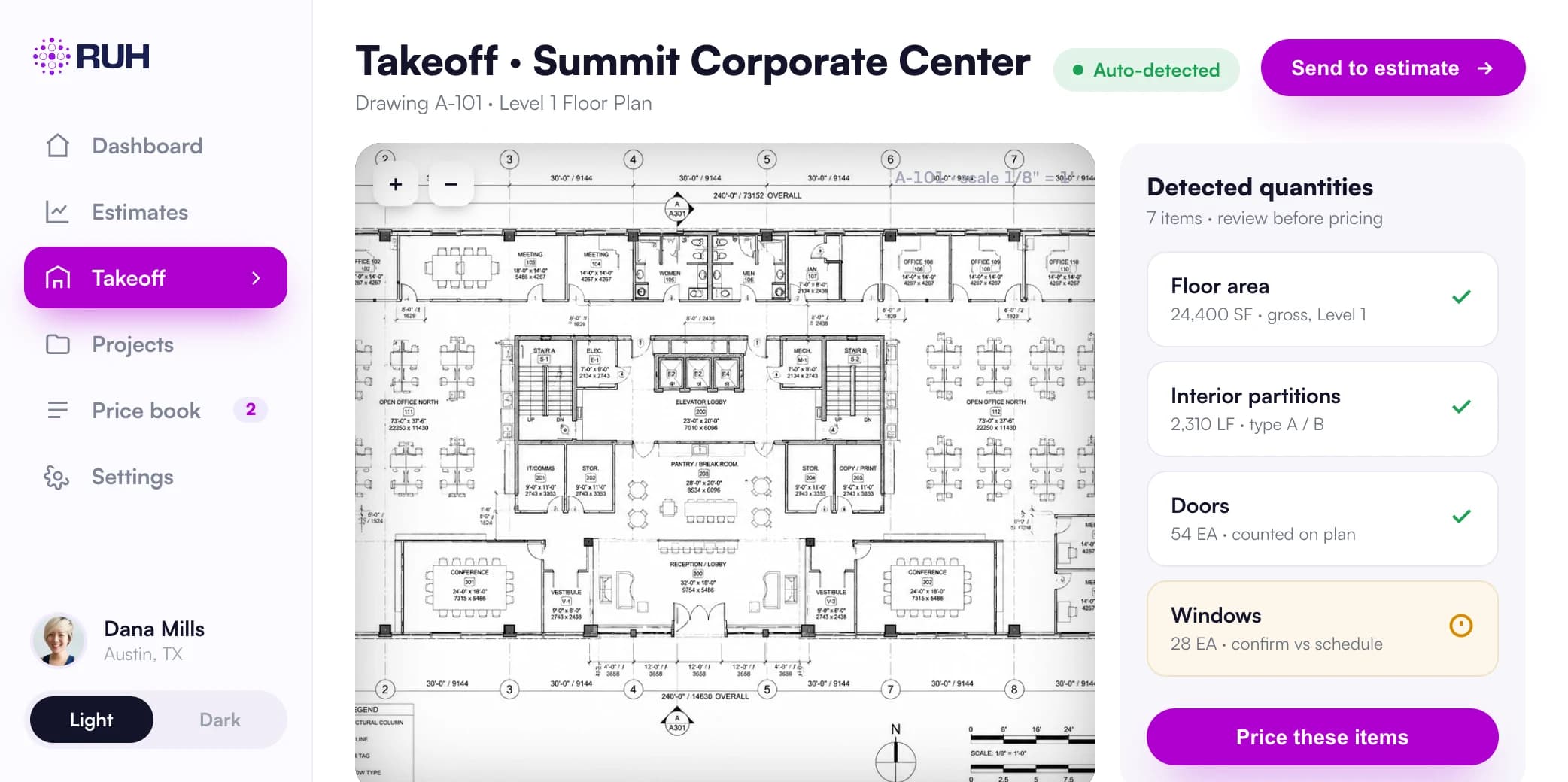
Ruh measures hydronic piping off the contractor's plans and riser diagrams, keeping the lf separated by size, material, and service, and carrying insulation and valve counts with it, then prices the takeoff on the contractor's own price book. The estimator reviews the draft line by line, checks the size breaks and fitting allowances, and signs off on the final quantities.
See AI construction takeoff and estimating softwareHydronic piping: frequently asked questions
What is the difference between chilled water and condenser water piping?+
Chilled water runs cold, commonly around 44 degrees F supply, from the chiller to the cooling coils and back, and it must be insulated with a continuous vapor barrier or it sweats and stains ceilings. Condenser water runs warmer, between the chiller and the cooling tower, and is often left uninsulated indoors. Same pipe materials, very different insulation lines on the estimate, so keep the services separated in the takeoff.
What pipe materials are used for hydronic systems?+
US commercial work typically uses Schedule 40 black steel on larger sizes, joined by welding or grooved mechanical couplings, and Type L copper or press-fit systems on smaller branch sizes. Some specs allow PEX or other plastics in limited services. The joining method matters as much as the material for labor cost, since a welded joint, a grooved coupling, and a press connection carry very different installation times.
How do estimators handle fittings, valves, and hangers on hydronic piping?+
Valves and specialties (isolation, balancing, check valves, strainers, air vents) are counted each off the plans and flow diagram, because they are priced items the supplier will quote. Fittings on plant room work are usually counted individually since they dominate the labor there; on long distribution runs many estimators carry a percentage allowance instead. Hangers follow the pipe at the spacing the specs require, priced into the per-lf labor or as a separate count.
Still measuring by hand? Your next takeoff can run while you review this one.
See it on your plansRelated terms
Keep going: read the full guide or explore AI construction takeoff and estimating software.
See Ruh price a bid from your own drawings.
AI takeoff and estimating on your price book, your estimator signs off.
Figures on this page are illustrative. Construction estimates depend on project-specific conditions, source documents, market pricing, and professional judgment. Ruh's AI assists the estimator and does not replace professional review: your team reviews, validates, and approves every estimate, bid, and pricing decision.