100% money-backBook a walkthrough

Construction glossary · MEP

What is junction box in construction?

A junction box in construction is an enclosed metal or nonmetallic box where electrical conductors are spliced, pulled, or tapped, keeping every connection protected and accessible as the National Electrical Code requires. On commercial projects most junction boxes are never drawn individually; they follow the conduit runs, so estimators count them as each (ea) by size and type, derived from the routing rather than read straight off the plans. Common types are 4 in square boxes on branch circuits and larger dimensioned pull boxes on feeders.

Updated June 2026 · Reviewed by the Ruh construction team

Houses wire splicesSized by box fill rulesCounted from the e-plan

How junction boxes are counted

+ 12 more24 EAJunction boxelectrical plan

Estimating mep scope this week? Watch Ruh take off a real plan in 30 minutes.

Book a walkthrough
Definition

A junction box is where the electrical trade makes and protects splices, changes direction, or breaks a long conduit pull into manageable segments. In the documents, device boxes hide behind every receptacle and switch symbol on the power plans, while true junction and pull boxes mostly do not appear at all: the electrical subcontractor (Division 26) places them based on conduit routing and code rules. Two NEC concepts drive the count. First, a raceway run is limited to 360 degrees of total bends between pull points, so any run with more than four quarter bends generates a box the drawings never showed. Second, the box fill rules in NEC 314.16 tie the number of conductors to box volume, which pushes crowded boxes up to the next size. New estimators get this wrong by counting only what is drawn, then wondering why the electrician's bid carries hundreds more boxes than their takeoff. The fix is to derive boxes from the conduit takeoff: experienced electrical estimators carry a box allowance per fixture drop, per device, and per length of run, and they write that assumption down where a reviewer can see it.

How it is measured

Junction boxes are counted each (ea), broken out by size and type: 4 in square and 4 11/16 in square boxes for branch circuits, octagon boxes at fixture drops, and dimensioned pull boxes (12x12x6 and up) on feeder runs. Exterior and wet locations carry NEMA rated enclosures as separate line items. Because most boxes are not drawn, the count is derived: one box per lighting fixture drop, one behind each device, and a pull box wherever a run exceeds 360 degrees of bends or a practical pulling length. Cost drivers are box size, cover and support hardware, mounting height (lift work is slower), and environment. The quantities live alongside the conduit takeoff, usually as an ea count per conduit size and routing zone.

Worked example

Worked example

A tenant improvement lighting plan shows 46 fixtures fed through ceiling junction boxes, and the branch conduit takeoff totals 1,200 lf of 3/4 in EMT plus three 180 ft homeruns back to the panel. Boxes: one 4 in square box per fixture drop = 46. Each homerun carries six 90 degree bends, which is 540 degrees, over the 360 degree limit between pull points, so each needs one pull box: 3 more. Carry 49 boxes. At an illustrative installed cost of $32 per box (box, cover, support, and labor), 49 x $32 = $1,568. Sanity check against the conduit: total run is 1,200 + (3 x 180) = 1,740 lf, and 1,740 / 49 is roughly one box every 36 lf, a believable density for a lighting branch system. A fill check confirms the size: a 4 in square box 1.5 in deep provides 21.0 cu in, and at 2.25 cu in per 12 AWG conductor that allows nine conductors.

100%

Try Ruh on a real bid. 100% money-back guarantee if you are not satisfied.*

*Scoped delivery, terms apply. Read the guarantee terms

Start with a walkthrough
How Ruh handles it

How Ruh handles junction box

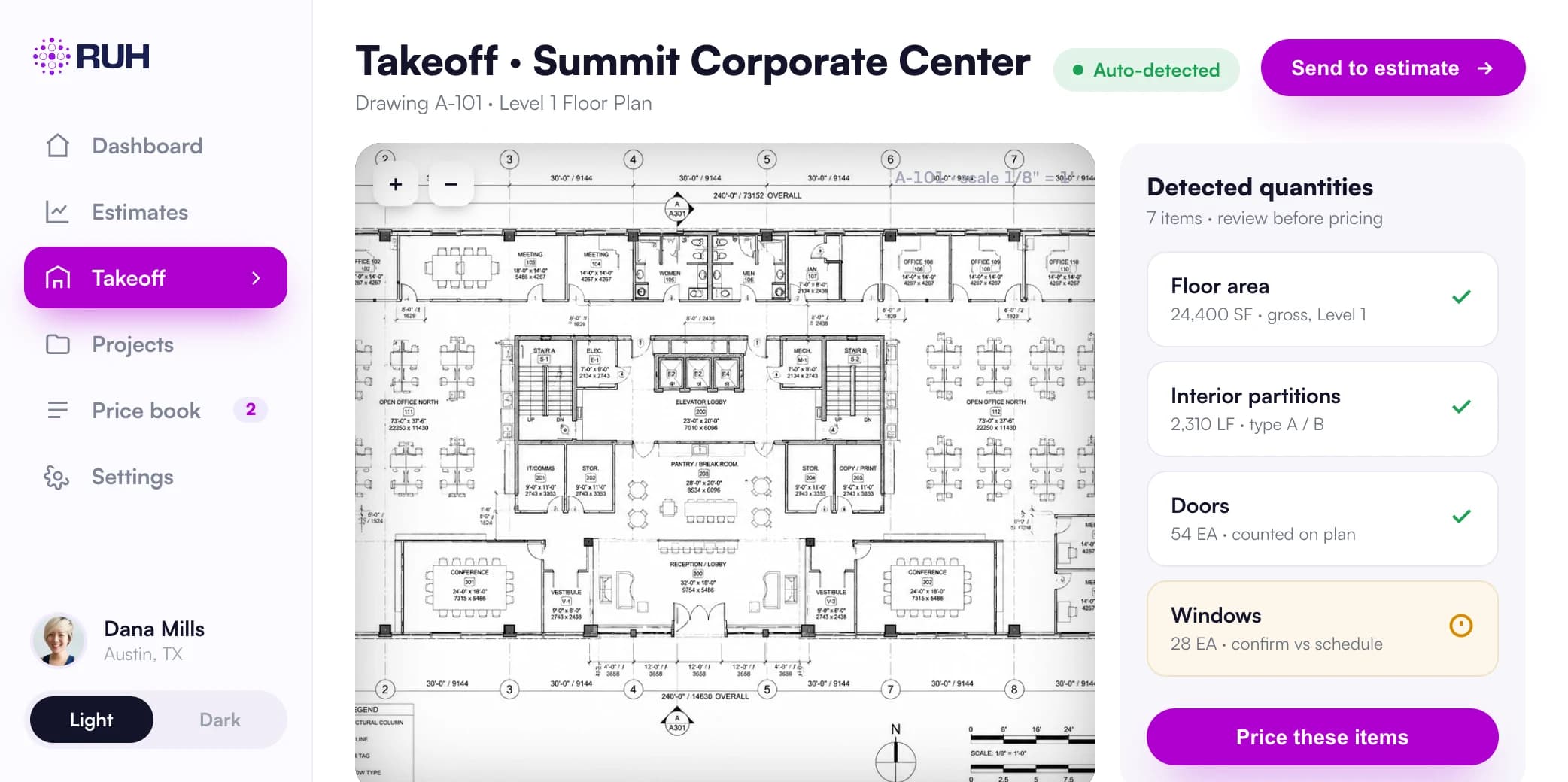
Ruh reads the power and lighting plans, takes off the conduit runs and the boxes they imply, and prices each box type against the contractor's own price book rather than generic cost data. The estimator gets a draft with box counts visible as their own line items, reviews the routing assumptions behind them, and signs off before the number goes into the bid.

See AI construction takeoff and estimating software

Junction box: frequently asked questions

How many junction boxes does the NEC allow on one circuit?+

The NEC does not limit how many junction boxes a circuit can have. What it regulates is each box itself: fill limits under 314.16 that tie conductor count to box volume, accessibility (boxes cannot be buried behind drywall with no access), and proper support. The practical limit is workmanship and labor cost, since every box is a splice point that takes time to make up and a future failure point to troubleshoot.

What is box fill and why does it matter in an estimate?+

Box fill is the NEC 314.16 calculation that matches the number and size of conductors, devices, and clamps in a box to the box's cubic inch volume. It matters to the estimate because a crowded box must be upsized, and a deeper 4 in square box or a 4 11/16 in box costs more in material and sometimes mounting labor. Estimators who carry one generic box price across the whole job miss that creep on dense circuits.

Why does my junction box count differ from the symbols on the drawings?+

Because most junction and pull boxes are means and methods: the engineer shows devices and homeruns, and the electrician decides the routing, which creates boxes at bends, pull points, and fixture drops the drawings never show. Two qualified bidders can legitimately carry different counts because they plan different routing. The takeoff should state its box allowance assumptions so a reviewer can trace where the count came from.

Still measuring by hand? Your next takeoff can run while you review this one.

See it on your plans

Related terms

Keep going: read the full guide or explore AI construction takeoff and estimating software.

The MEP estimating cheat sheet
Every unit, waste factor, and conversion on one page. Free PDF.

See Ruh price a bid from your own drawings.

AI takeoff and estimating on your price book, your estimator signs off.

Figures on this page are illustrative. Construction estimates depend on project-specific conditions, source documents, market pricing, and professional judgment. Ruh's AI assists the estimator and does not replace professional review: your team reviews, validates, and approves every estimate, bid, and pricing decision.