
Construction glossary · MEP
What is refrigerant piping in construction?
Refrigerant piping in construction is the ACR copper line set that carries refrigerant between the outdoor unit and the indoor coil of an air conditioning or heat pump system, made up of a small liquid line and a larger, insulated suction line. Estimators take it off in linear feet per circuit, pulling the line sizes from the equipment manufacturer's tables rather than scaling them off the drawings. The joints are brazed, and the work belongs to the mechanical contractor's piping scope.
Updated June 2026 · Reviewed by the Ruh construction team
How refrigerant lines are run
Estimating mep scope this week? Watch Ruh take off a real plan in 30 minutes.
Book a walkthroughRefrigerant piping connects split system condensing units, heat pumps, and VRF outdoor units to their indoor coils, and it lives in the Division 23 mechanical scope. The drawings usually show the routing diagrammatically at best: the floor plan locates the equipment, the schedule names the model, and the actual pipe sizes come from the manufacturer's line sizing tables based on capacity, total length, and the vertical lift between units. The material is ACR copper (air conditioning and refrigeration grade), which ships cleaned, dehydrated, and capped, and every joint is brazed with dry nitrogen flowing through the pipe to keep oxide scale from forming inside. New estimators get burned three ways: they measure the horizontal plan run and forget the vertical riser between floors or up to the roof, they price both lines at the same diameter when the suction line is always larger than the liquid line, and they skip the elastomeric insulation the suction line needs to prevent condensation and capacity loss. Long line sets also trigger extra refrigerant charge beyond what the factory ships inside the unit.
Refrigerant piping is measured in linear feet (lf) per line, broken out by diameter, because the liquid and suction lines carry different sizes and prices. A 3 ton split system might pair a 3/8 in liquid line with a 3/4 in suction line, but the only authoritative source is the manufacturer's table for that exact model, length, and lift. The takeoff carries the copper, the suction line insulation as a separate lf line, a brazed joint count or labor allowance, and the nitrogen, pressure test, evacuation, and charging labor per circuit. Cost drivers are diameter, run length, riser height, and accessibility. Quantities come from the mechanical floor and roof plans for routing, the equipment schedule for tonnage, and the manufacturer's engineering data for sizes and charge adders.
Worked example
Price the line set for a rooftop condensing unit serving a second floor air handler. The plan shows 60 lf of horizontal run, the riser scales at 25 ft, and you carry 10 lf for offsets and fittings: 60 + 25 + 10 = 95 lf per line. The circuit needs 95 lf of 3/8 in liquid line, 95 lf of 3/4 in suction line, and 95 lf of elastomeric insulation on the suction side. At illustrative installed rates of $9 per lf for the liquid line, $14 per lf for the suction line, and $4 per lf for insulation: 95 x $9 = $855, 95 x $14 = $1,330, and 95 x $4 = $380. The unit ships charged for the first 25 ft, so 95 - 25 = 70 ft draws an illustrative 0.6 oz of refrigerant per ft: 70 x 0.6 = 42 oz, which is 42 / 16 = 2.625 lb, and at an illustrative $20 per lb that adds 2.625 x $20 = $52.50. The circuit totals $855 + $1,330 + $380 + $52.50 = $2,617.50.
Try Ruh on a real bid. 100% money-back guarantee if you are not satisfied.*
*Scoped delivery, terms apply. Read the guarantee terms
How Ruh handles refrigerant piping
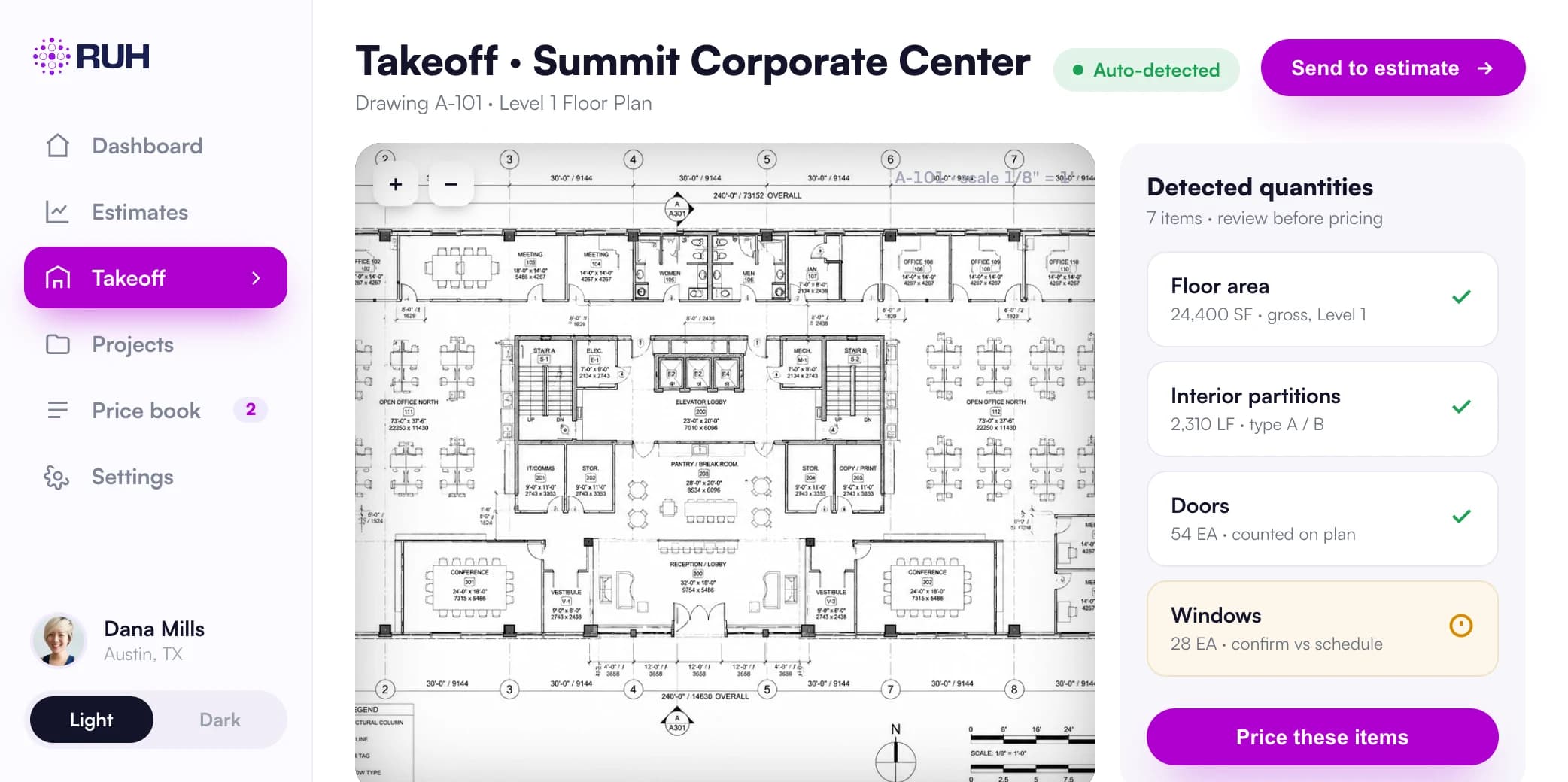
Ruh reads the mechanical plans, measures every line set run including the risers the plan view hides, and prices the copper, insulation, and brazing labor against the contractor's own price book. The estimator reviews the draft, checks the line sizes against the manufacturer's tables, and signs off before the number goes into the bid.
See AI construction takeoff and estimating softwareRefrigerant piping: frequently asked questions
What type of copper is used for refrigerant piping?+
ACR copper, a grade cleaned, dehydrated, and capped at the mill specifically for air conditioning and refrigeration service. It comes as soft annealed coils in smaller diameters and hard drawn straight lengths in larger ones. Joints are brazed with a high temperature alloy rather than soft soldered, and good practice flows dry nitrogen through the pipe during brazing so oxide scale does not form inside and foul the expansion valves.
Does refrigerant piping need to be insulated?+
The suction line always gets closed cell elastomeric insulation; without it the cold line sweats, drips onto ceilings, and loses capacity to heat gain. Cooling-only liquid lines usually run bare, but heat pump and VRF manufacturers often require insulation on both lines because either can run hot or cold depending on mode. Check the manufacturer's installation manual and the project spec, and carry the insulation as its own lf line in the takeoff.
How are refrigerant line sizes selected?+
From the equipment manufacturer's line sizing tables, which key off the unit capacity, the total equivalent length of the run, and the vertical separation between the outdoor and indoor units. Bigger is not safer: an oversized suction line slows the refrigerant velocity that carries compressor oil back to the compressor, which can kill it. Long or tall runs may also require traps and a larger refrigerant charge, both of which belong in the estimate.
Still measuring by hand? Your next takeoff can run while you review this one.
See it on your plansRelated terms
Keep going: read the full guide or explore AI construction takeoff and estimating software.
See Ruh price a bid from your own drawings.
AI takeoff and estimating on your price book, your estimator signs off.
Figures on this page are illustrative. Construction estimates depend on project-specific conditions, source documents, market pricing, and professional judgment. Ruh's AI assists the estimator and does not replace professional review: your team reviews, validates, and approves every estimate, bid, and pricing decision.