Insulation estimating software that prices on your numbers.
Insulation estimating software, the insulation contractor software in front of the bid, measures insulated area by assembly and R-value and prices it, and Ruh does it on your own rates as a trade you set up, since insulation is not one of its 37 built-in trades. Below: the insulation takeoff table, a worked example priced line by line, and the questions insulation estimators ask.
Measuring first? Insulation Takeoff Software
- ✓Batt insulation, measured sf by R-value
- ✓Rigid board insulation, measured sf and board count
- ✓Closed-cell spray foam, measured bf (board feet)
Free walkthrough on your own plans. Your estimator signs off.
The Insulation Estimating Problems This Solves.
SF by R-Value and Assembly Gets Muddled Fast
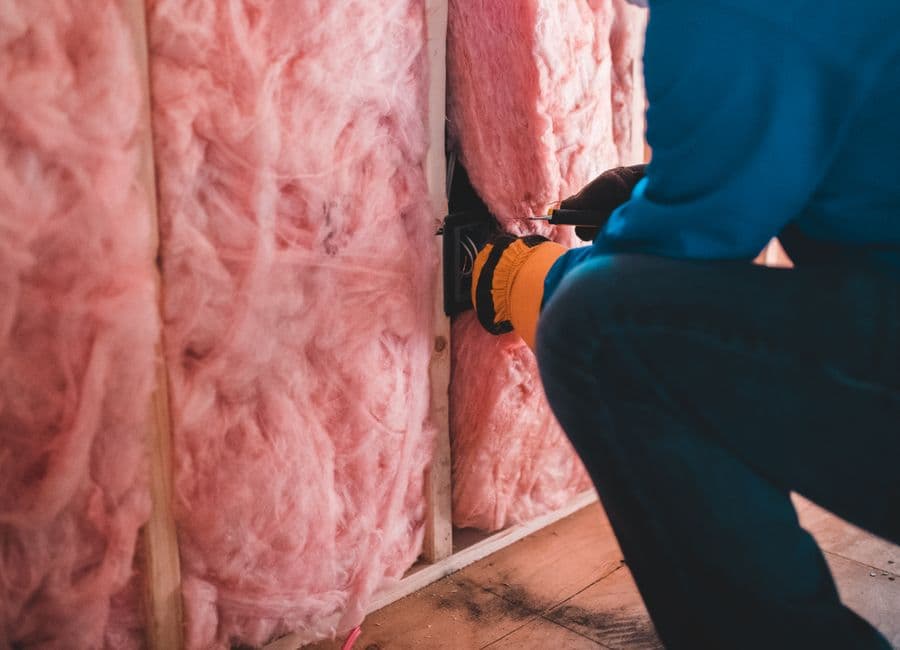
A single floor can carry R-13 batt in metal stud partitions, R-21 in exterior walls, and R-30 in the roof deck, each on a different wall or roof type. Counting it all by hand means re-measuring the same elevations three times and hoping you tagged the right R-value to the right assembly. One mislabeled run and you have priced 4 inch batt where the spec called for 6 inch.
Spray Foam Board-Foot Math Eats Hours
Closed-cell is sold and priced by the board foot, but the drawings give you square footage. Every area has to be converted: sf times thickness in inches equals board feet, and the thickness changes by assembly (2 inches at the rim, 3 inches in cavities, more on the roof deck). Doing that conversion by hand across a building, area by area, is slow and easy to fat-finger.
Pipe and Duct Insulation Hides in the Mechanical Set
Mechanical insulation lives on the plumbing and HVAC drawings, not the architectural set, and it is measured in linear feet by pipe size and insulation thickness. Chasing every chilled water run, every supply duct, and matching the right jacket and thickness to each line size is tedious, and it is the scope most often missed or shorted at bid time.
From Your Insulation Drawings to a Priced Line.
The same pipeline that runs the takeoff runs the pricing, so the number you send out traces back to the sheet it came from.
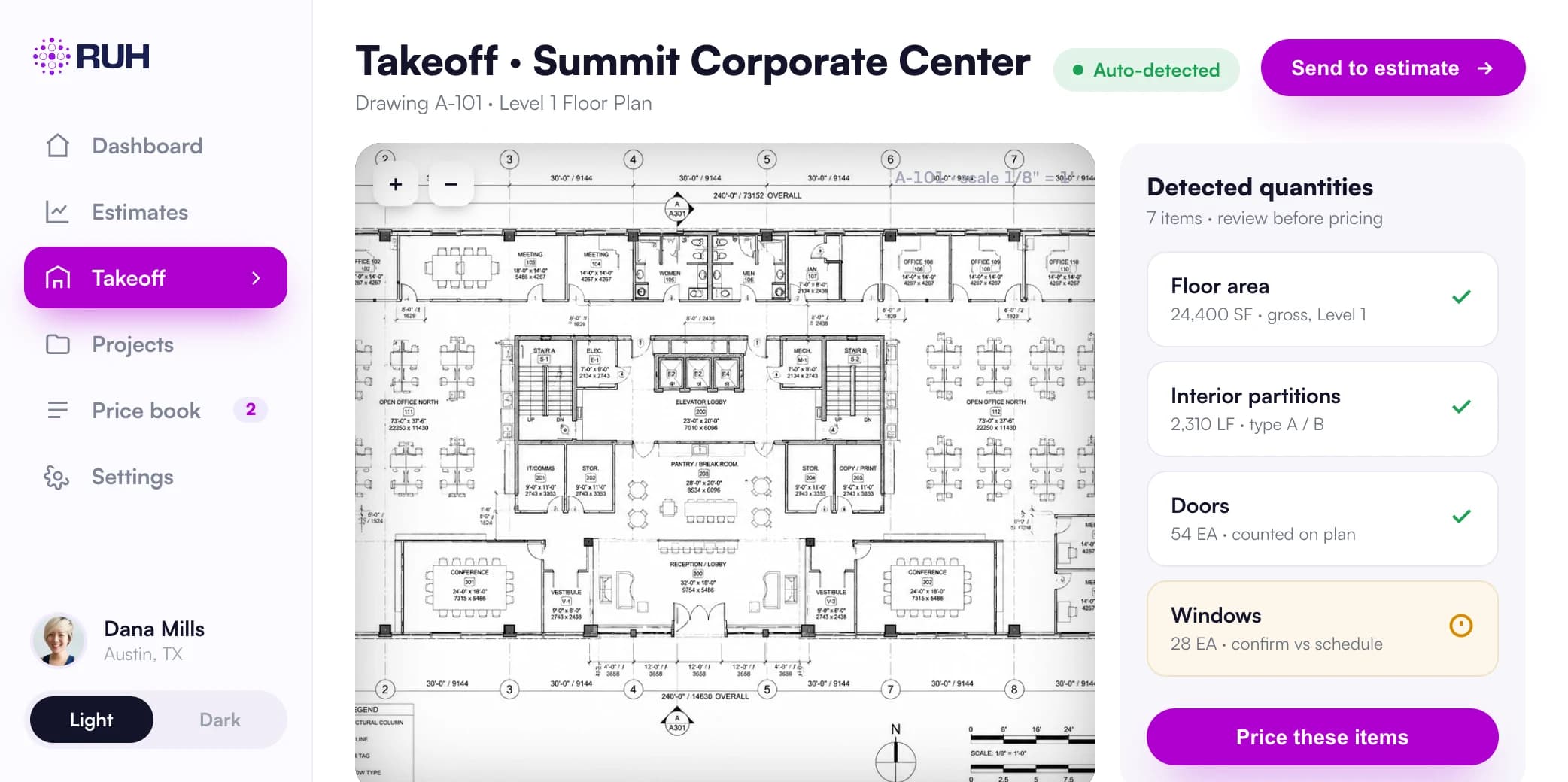
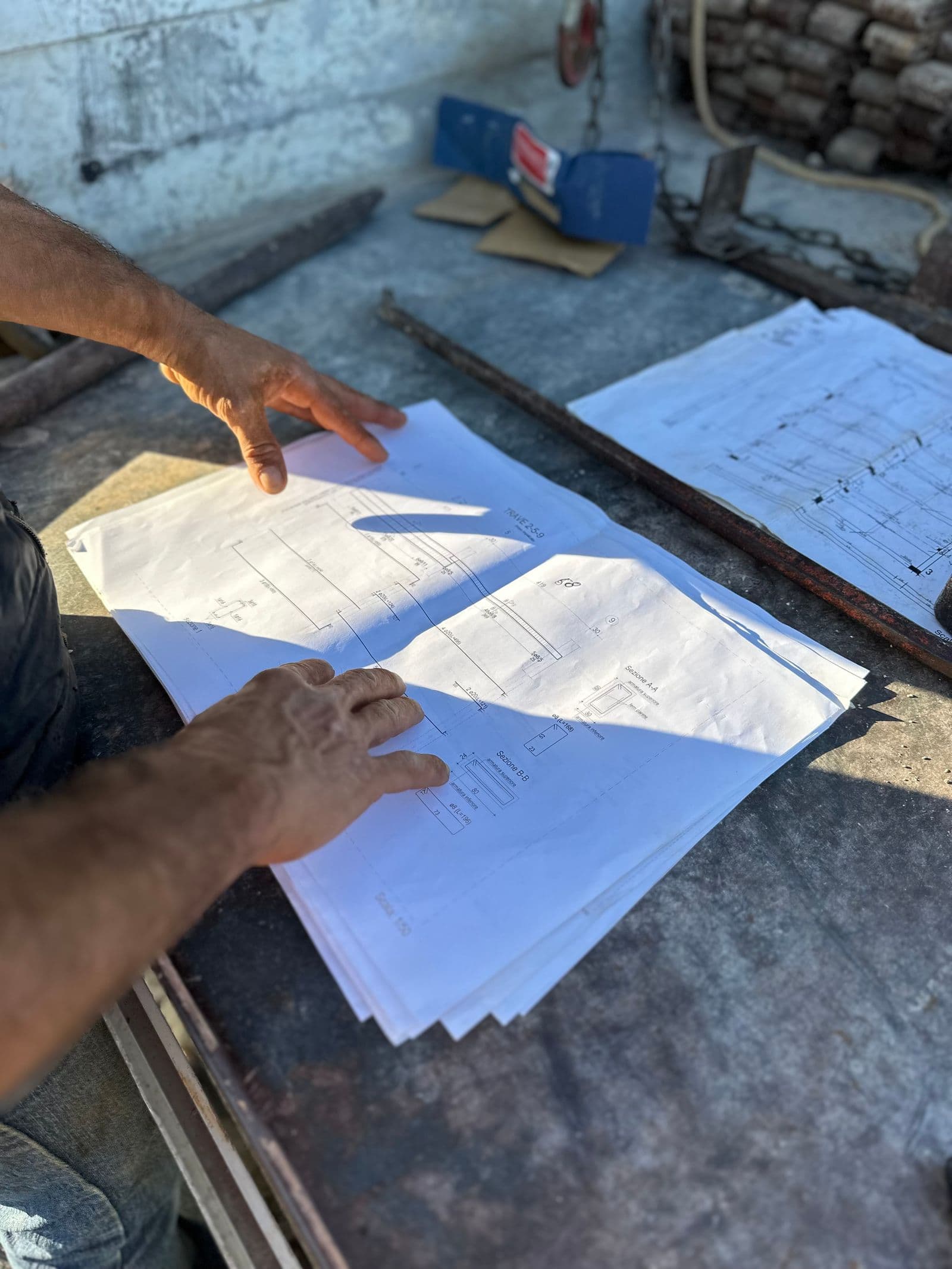
Quantities lifted from the real sheets, each tied to the sheet it came from and checked by a blind second count.
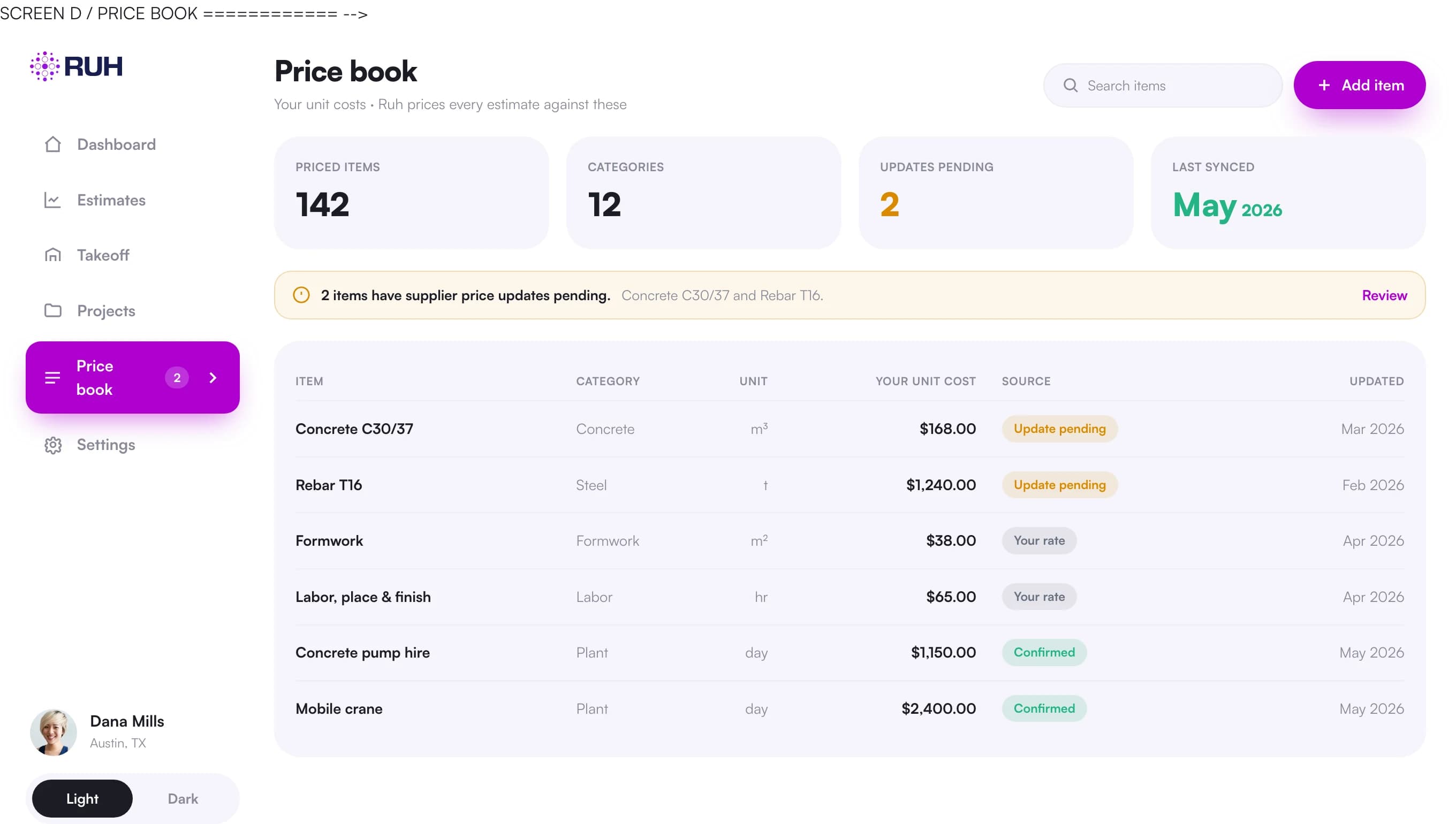
Your own rates and assemblies, not a generic national cost database.
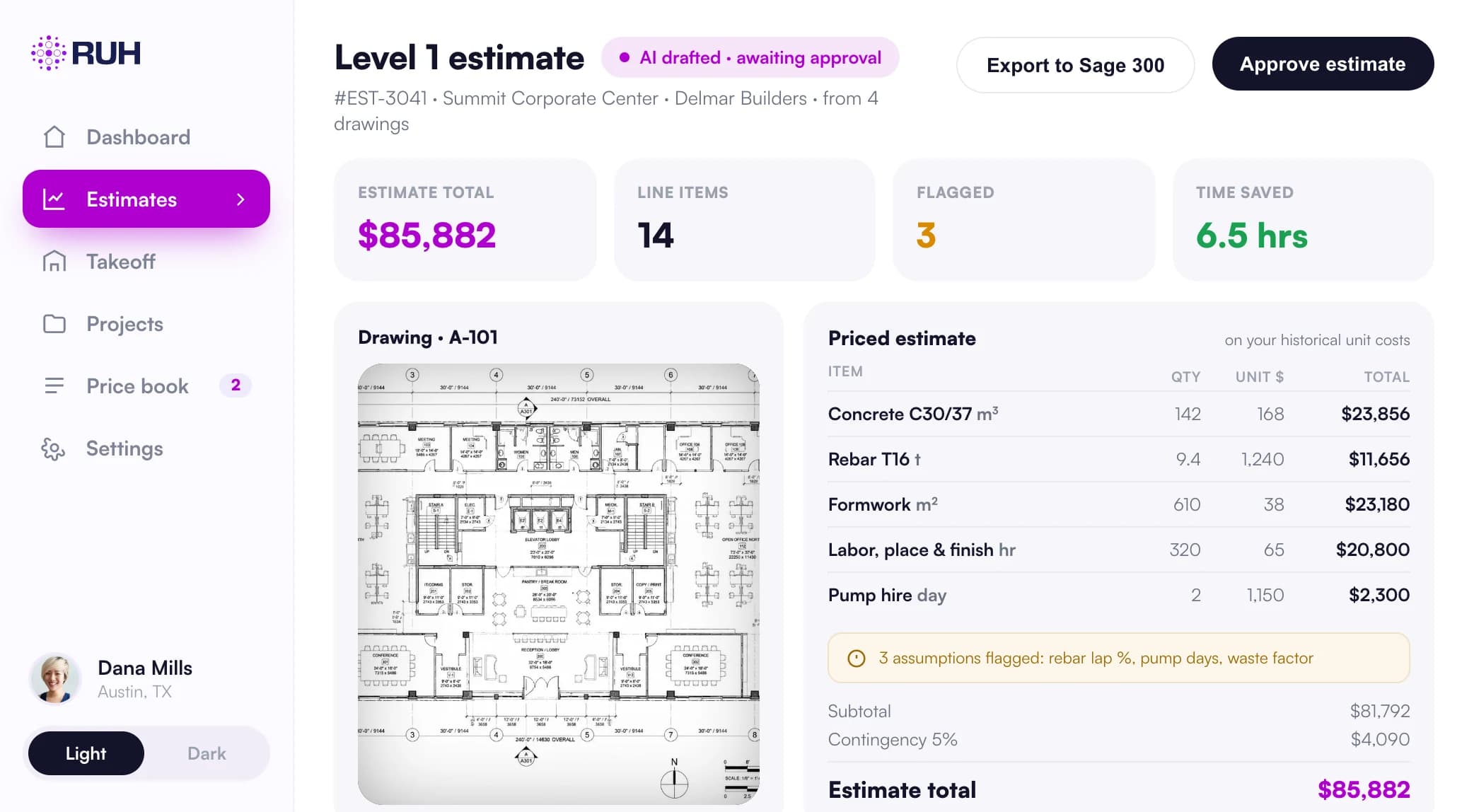
Every line traceable back to the sheet it came from before anything goes out.
What an Insulation Takeoff Counts and Measures.
| Item | Unit | How it is measured and priced |
|---|---|---|
| Batt insulation | sf by R-value | Measured as wall or ceiling area net of openings, tagged to the R-value and stud depth called in the assembly (R-13, R-19, R-21, R-30); priced per sf installed. |
| Rigid board insulation | sf and board count | Continuous insulation on walls or roof; measured by sf, then divided by board size (e.g. 4 ft by 8 ft = 32 sf) to get board count for ordering and fastener takeoff. |
| Closed-cell spray foam | bf (board feet) | Board feet equals sf times thickness in inches. Each area converted at its specified thickness, summed across the assembly; priced per bf. |
| Open-cell spray foam | sf at thickness | Often priced per sf at a stated thickness for cavity fill; thickness drives yield, so the spec thickness is captured per area. |
| Pipe insulation | lf by pipe size | Measured in linear feet per nominal pipe size and insulation thickness off the plumbing and mechanical sets; fittings counted separately as each. |
| Duct insulation / wrap | sf or lf by duct size | Duct wrap measured by exterior sf (perimeter times length); liner measured by interior sf. Round duct often taken by lf at a given diameter. |
| Vapor barrier / retarder | sf | Measured by covered area, usually following the same surface as the batt or board; tape and seam allowance added by lf of seam. |
| Firestopping at penetrations | each | Counted per penetration by assembly type and rating where insulation scope includes firestop; not an area measure. |
| Sound / acoustic batt | sf | Same sf measure as thermal batt but tagged to acoustic assemblies (STC partitions); kept on a separate line so thermal and acoustic scope do not get double-counted. |
A Worked Insulation Example
Small commercial tenant fit-out. Exterior walls: 1,800 sf of R-21 batt at $1.45/sf = $2,610. Interior STC partitions: 2,400 sf of acoustic batt at $1.20/sf = $2,880. Roof deck closed-cell spray foam: 3,000 sf at 3 inches thick. Board feet = 3,000 x 3 = 9,000 bf. At $1.30/bf = $11,700. Mechanical: 220 lf of 2 inch chilled water pipe insulation at $9.50/lf = $2,090. Material and labor subtotal = 2,610 + 2,880 + 11,700 + 2,090 = $19,280. Apply 18% overhead and profit: $19,280 x 0.18 = $3,470.40. Bid total = 19,280 + 3,470.40 = $22,750.40. The spray foam line is where hand estimates slip, because the 3,000 sf has to be carried as 9,000 board feet before pricing. Carry it as sf and you underbid the largest line by roughly two thirds.
Bidding Insulation Work This Month? Book a 30-minute walkthrough of a takeoff on a real plan.
Book a walkthrough
How Ruh Runs Your Insulation Estimates.
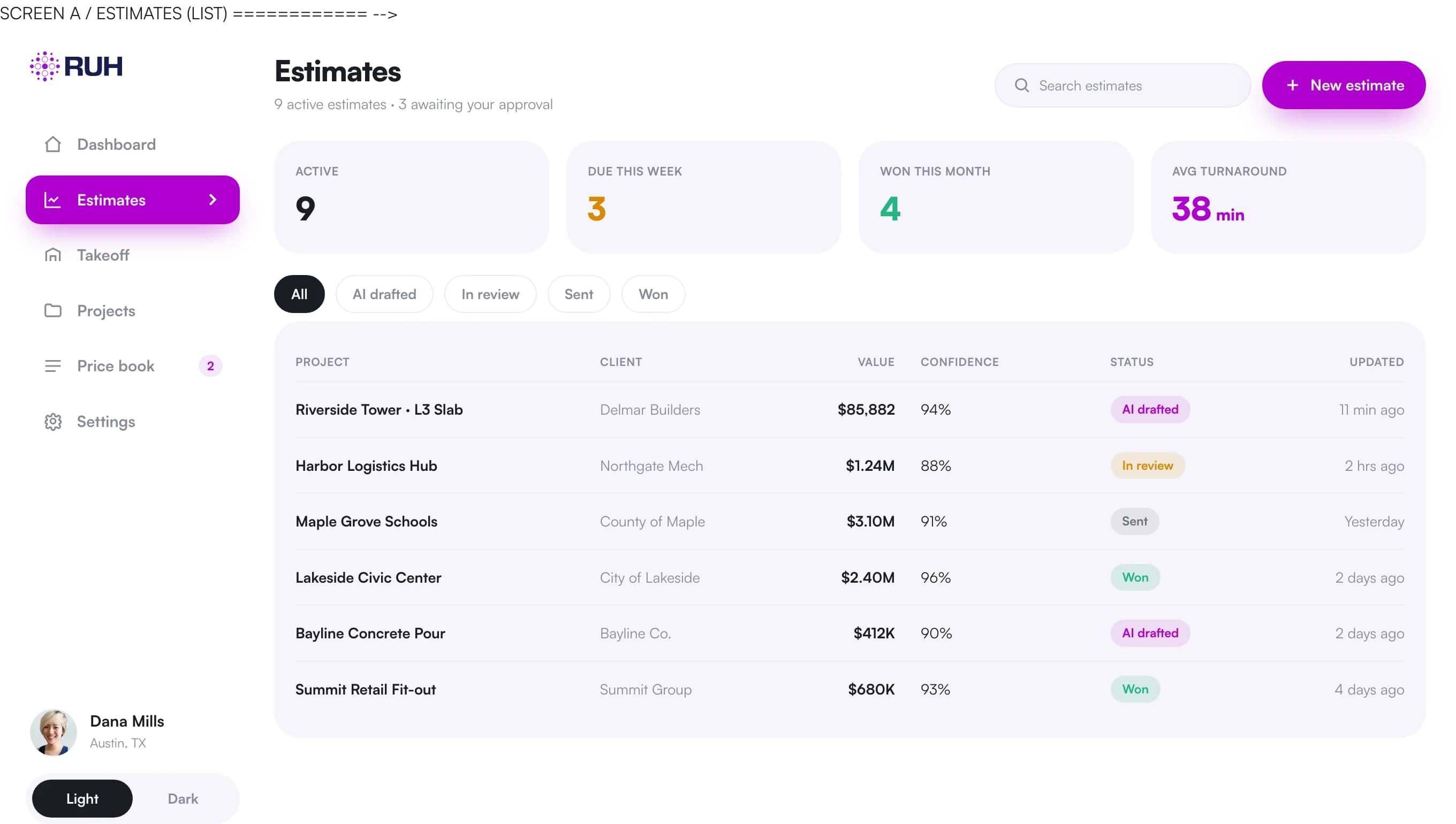
Ruh reads the architectural and mechanical sets together, separates thermal from acoustic scope, and quantifies each assembly in its own unit: batt sf by R-value, rigid board sf and board count, spray foam converted to board feet at the specified thickness, and pipe and duct insulation in linear feet by size. Every line is priced against your own price book and your installed labor rates, with the assembly logic and the sf-to-board-foot conversions shown on each line. The estimator reviews the measured quantities, confirms the R-values and thicknesses match the spec, checks the mechanical takeoff against the drawings, and adjusts any pricing before approving. Nothing goes out the door until you have signed off on the number.
Try Ruh on a real bid. 100% money-back guarantee if you are not satisfied.*
*Scoped delivery, terms apply. Read the guarantee terms
Insulation Estimating Software FAQs
How accurate is the AI takeoff on insulation scope?+
The quantities come straight off the drawings and specs, measured to the assembly, so a 2,400 sf partition reads as 2,400 sf, not a rounded guess. Accuracy depends on drawing quality, which is why every measured line is shown for review. You confirm the R-values, thicknesses, and pipe sizes against the spec before the estimate is final, the same check you would run on a junior estimator's takeoff.
Does it price on my own price book or a generic database?+
Your own price book and your installed labor rates. Ruh prices batt by sf, spray foam by board foot, and pipe and duct insulation by linear foot using the numbers you load, so the bid reflects what your crews and your suppliers actually cost. There is no generic national average buried in the line items unless you choose to use one.
Can it work with the takeoff and estimating tools I already use?+
Yes. Ruh handles the measuring and pricing, then exports the quantities and priced lines in the structure you need, so you can drop them into your existing estimating spreadsheet or bid summary. It is built to feed your current workflow, not to force you onto a new platform you have to relearn.
What stays in the estimator's hands?+
Judgment and sign-off. The AI measures, converts sf to board feet, separates thermal from acoustic, and prices every line, but it does not submit anything. You review the assemblies, catch the scope the drawings left vague, set the markup, and approve the final number. The estimator owns the bid.
Doing the insulation takeoff itself?
The quantities side has its own page: counts, measures, and how the AI takeoff reads your drawings.
Insulation Takeoff SoftwareInsulation Terms in the Glossary.
Figures on this page are illustrative. Construction estimates depend on project-specific conditions, source documents, market pricing, and professional judgment. Ruh's AI assists the estimator and does not replace professional review: your team reviews, validates, and approves every estimate, bid, and pricing decision.
Try Ruh on an insulation bid you are pricing now.
Put us on real work rather than a canned demo. Ruh reads your drawing set, measures the scope, and prices the quantities against your own rates, with every line traceable back to the sheet it came from. If it does not hold up, you are covered by the guarantee below.
- 1Tell us about a bid you are working on and the trade you are pricing
- 2Ruh measures that scope from your drawings and prices it on your own rates, not generic cost data
- 3Every quantity traces back to the sheet it was measured from, so your estimator can check the work
Run Your Next Insulation Bid on Ruh.
Send one insulation set. We run the takeoff and walk you through the quantities, the units, and the pricing on a 30 minute call. If it does not hold up against your estimator, you have lost nothing.