Flooring estimating software that prices on your numbers.
Flooring estimating software, also called flooring estimation software, turns floor plans and the finish schedule into a priced bid for every floor covering, and Ruh does it room by room, with carpet in square yards at 9 SF each, priced through 28 starting resilient flooring and tile recipes you can edit. Below: the flooring takeoff table, a worked example priced line by line, and the questions flooring estimators ask.
Measuring first? Flooring Takeoff Software
- ✓Carpet, measured sy
- ✓VCT / LVT, measured sf
- ✓Tile (porcelain, ceramic, stone), measured sf
Free walkthrough on your own plans. Your estimator signs off.
The Flooring Estimating Problems This Solves.
Carpet sf to sy Conversion Eats Margin When It Slips
Carpet is sold and priced by the square yard, but plans give you square feet. Divide the field area by 9 to get yards, then add waste for seam direction and roll width before you price it. Miss the conversion or forget the roll-width waste on a wide room and you either short the order or pad it blind, and both cost you on a competitive bid.
Waste Factor Changes by Material and by Pattern
A monolithic LVT run is not the same as a patterned tile install or a directional carpet. Sheet goods and patterned tile carry more waste because of repeats and cut loss at the perimeter, while VCT and field tile run leaner. Applying one flat waste percentage across every material is how a takeoff looks clean and still comes up short of material on install day.
Transitions, Base, and Substrate Prep Get Counted Last or Not at All
Floor area is the easy part. Transitions and wall base are linear-foot items measured at thresholds and along every wall, and they are easy to miss room by room. Substrate scope is worse: skim coat, self-leveling underlayment, moisture mitigation, and grinding rarely show on the finish plan, so the prep that drives labor hours never makes it into the number.
From Your Flooring Drawings to a Priced Line.
The same pipeline that runs the takeoff runs the pricing, so the number you send out traces back to the sheet it came from.
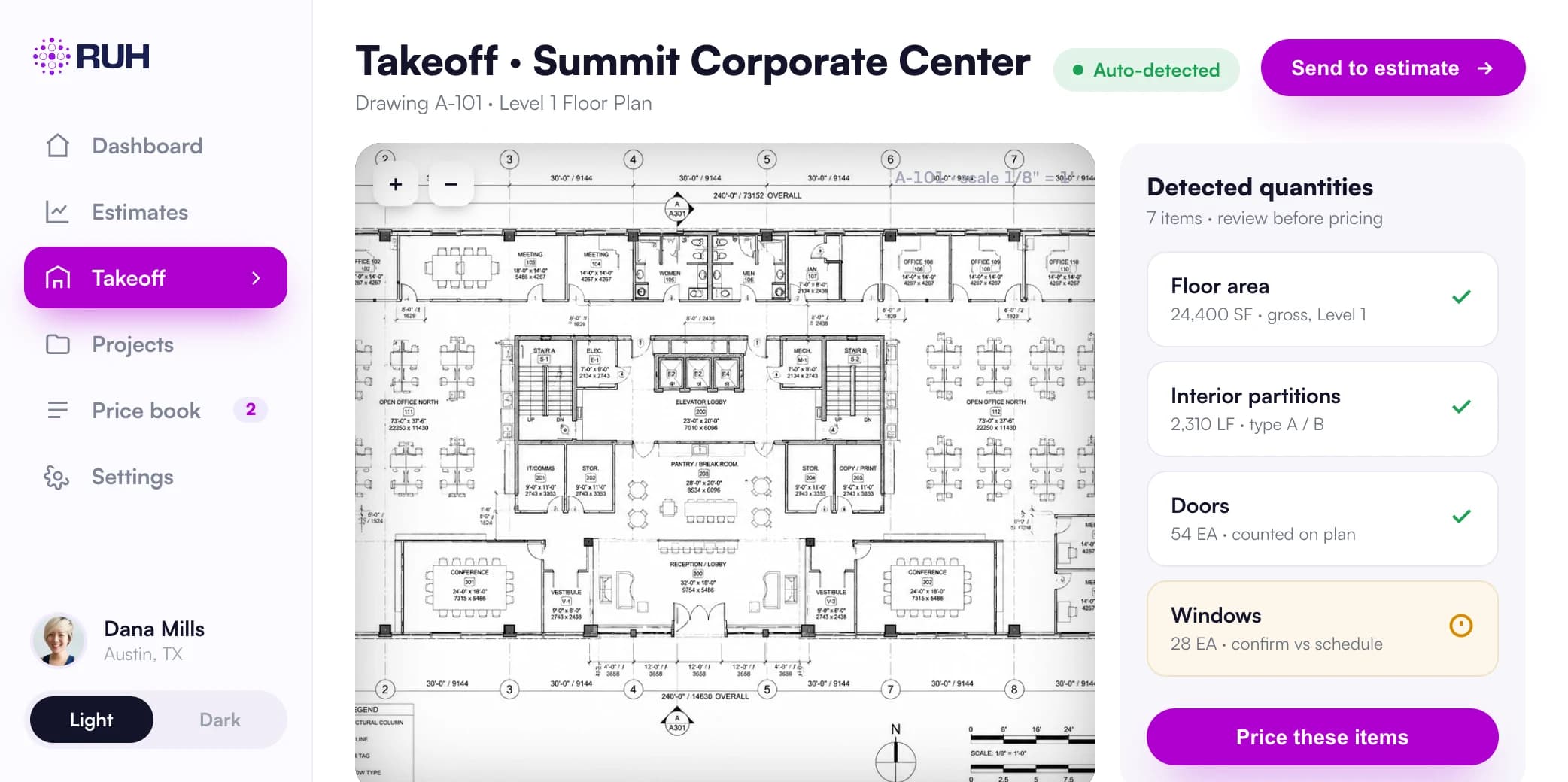
Quantities lifted from the real sheets, each tied to the sheet it came from and checked by a blind second count.
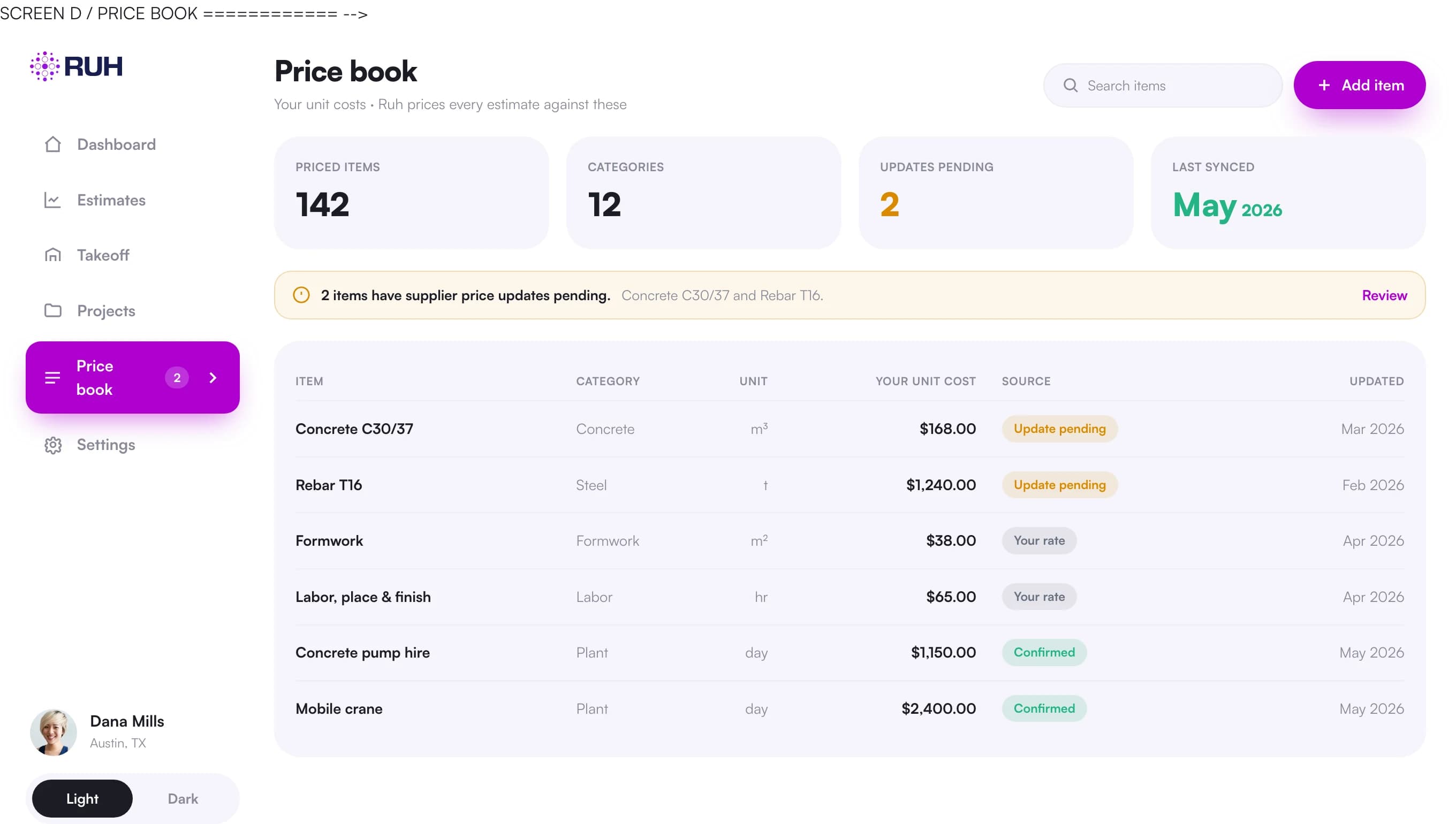
Your own rates and assemblies, not a generic national cost database.
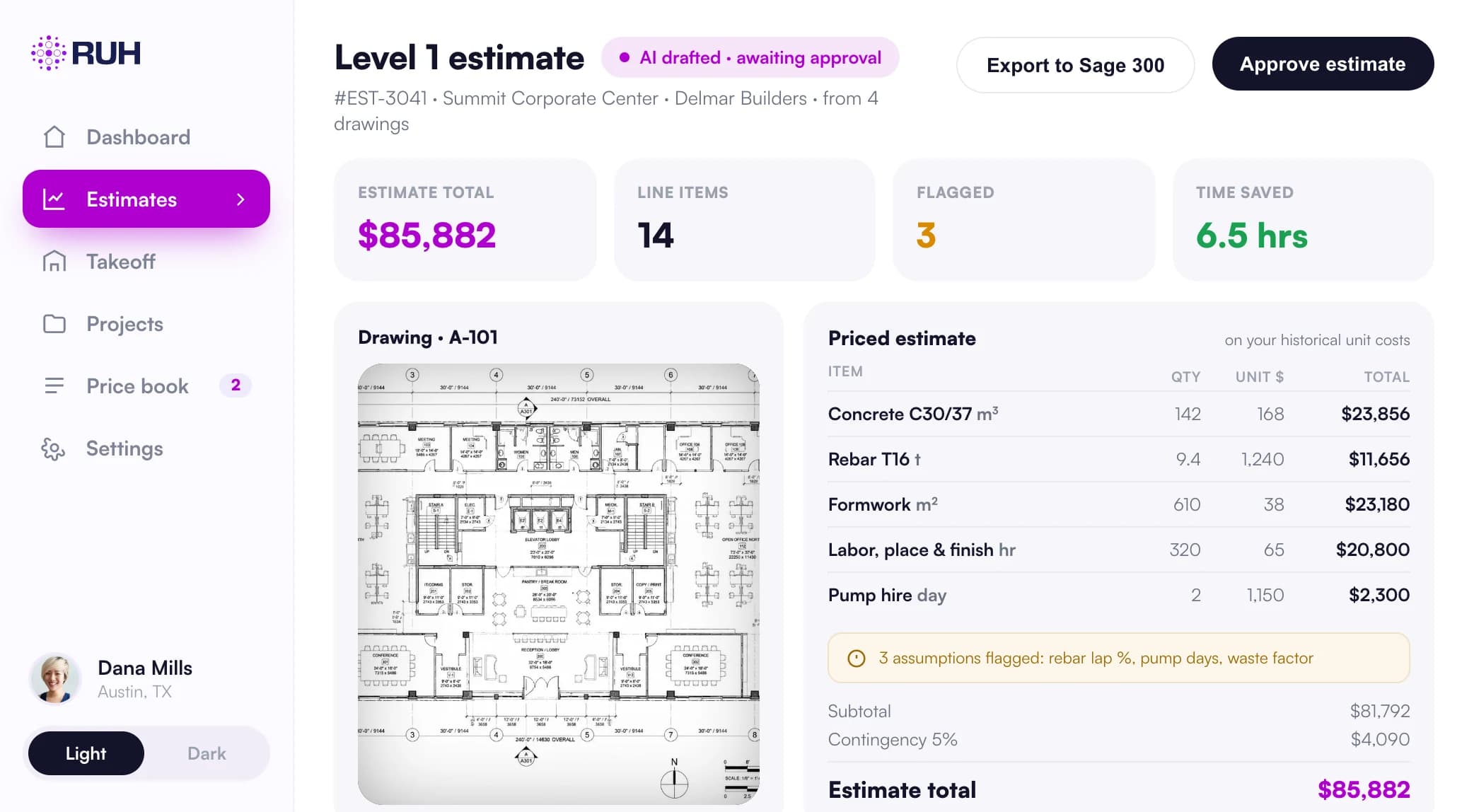
Every line traceable back to the sheet it came from before anything goes out.
What a Flooring Takeoff Counts and Measures.
| Item | Unit | How it is measured and priced |
|---|---|---|
| Carpet | sy | Measure field area in sf, divide by 9 for square yards, add waste for roll width and seam direction, price by the yard |
| VCT / LVT | sf | Net floor area by room, add material-specific waste (lean for VCT, higher for patterned or directional LVT), price per sf installed |
| Tile (porcelain, ceramic, stone) | sf | Field area plus pattern repeat and perimeter cut loss; size waste to tile dimension and layout, price per sf with setting materials |
| Epoxy / resinous flooring | sf | Floor area by system buildout (primer, body coat, topcoat); price per sf by mil thickness and number of coats |
| Transition strips | lf | Measured at every threshold and material change; count by profile (T-mold, reducer, Schluter) and price per linear foot |
| Wall base | lf | Run along wall perimeter room by room, deduct door openings, price per lf by type (rubber, vinyl cove, wood) |
| Underlayment / self-leveler | sf | Area requiring prep; price per sf and convert to bag count by coverage at the specified depth |
| Moisture mitigation | sf | Slab area flagged by RH or calcium chloride results; price per sf for the specified coating system |
| Waste factor | % | Applied per material and pattern on top of net quantities; carried as a visible line so the estimator can adjust it |
| Demo / removal of existing floor | sf | Area of existing finish to remove by type; price per sf and account for disposal and adhesive scraping |
How Does Carpet Estimating Software Convert Square Feet to Square Yards?
Carpet estimating software divides measured square feet by 9 to convert the field area to square yards. In the worked example, 1,800 sf becomes 200 sy, then 8 percent waste for roll width and seams produces 216 sy for pricing. The waste remains visible so the estimator can adjust it before signing off.
Which Floor Coverings Does It Estimate?
Floor covering estimating software handles the materials this entry lists: carpet in square yards, VCT and LVT in square feet, porcelain, ceramic, and stone tile in square feet, and epoxy or resinous flooring in square feet by system buildout. Each material keeps its own waste treatment and installed price, while transitions and wall base remain separate linear-foot lines and substrate preparation remains visible for review.
A Worked Flooring Example
Small office tenant fit-out, one open area plus a corridor. Open area carpet field is 1,800 sf. Convert to yards: 1,800 / 9 = 200 sy. Add 8 percent waste for roll width and seams: 200 x 1.08 = 216 sy. At a price book rate of 38 dollars per sy installed, carpet = 216 x 38 = 8,208 dollars. Corridor LVT field is 540 sf; add 10 percent waste = 594 sf at 6.50 per sf = 3,861 dollars. Wall base runs the full perimeter at 420 lf; at 2.25 per lf = 945 dollars. Transitions at the corridor and door thresholds total 60 lf at 9.00 per lf = 540 dollars. Subtotal: 8,208 + 3,861 + 945 + 540 = 13,554 dollars. Substrate skim coat on the corridor, 540 sf at 1.75 per sf, adds 945 dollars. Material and installed subtotal: 14,499 dollars before markup.
Bidding Flooring Work This Month? Book a 30-minute walkthrough of a takeoff on a real plan.
Book a walkthrough
How Ruh Runs Your Flooring Estimates.
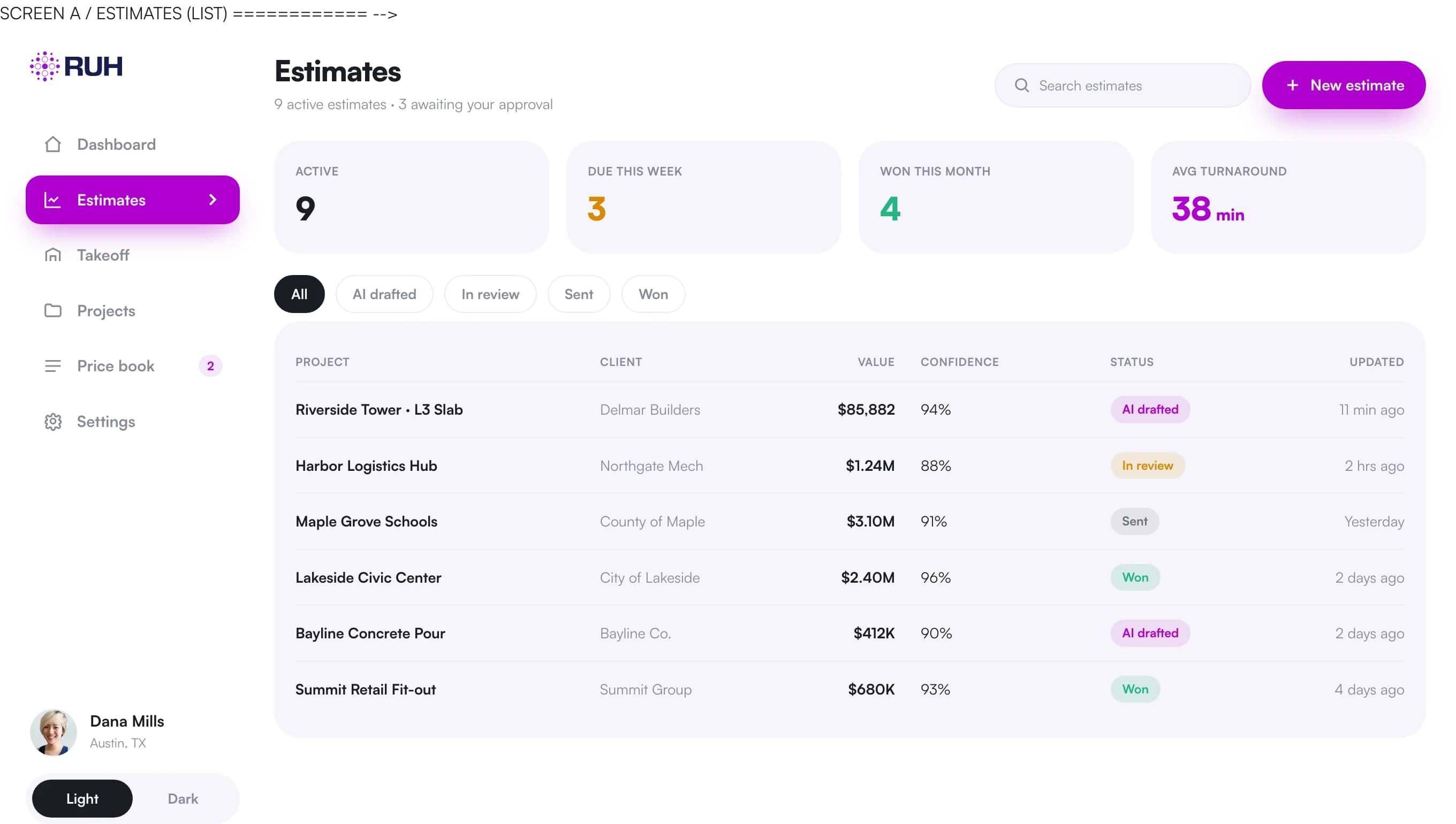
Ruh reads the floor plans and finish schedule, segments the slab by room and material, and produces a takeoff: carpet converted to square yards, VCT, LVT, tile, and epoxy in square feet, transitions and base in linear feet, with a waste factor carried per material and pattern. It prices each quantity against your own price book by material and assembly, then flags any prep scope it inferred and any drawing it could not read cleanly as an issue. Your estimator reviews the quantities, the waste percentages, and the substrate assumptions, adjusts what they know about the site, and signs off. Nothing leaves as a bid until the estimator approves the number, and every dollar traces back to a takeoff line and a price book entry.
Try Ruh on a real bid. 100% money-back guarantee if you are not satisfied.*
*Scoped delivery, terms apply. Read the guarantee terms
Flooring Estimating Software FAQs
How accurate is the takeoff compared to measuring it myself?+
The AI measures floor area, base, and transitions off the drawings and shows its work line by line, with anything ambiguous flagged as an issue. It is built to get the quantities and conversions right, including carpet sf to sy and per-material waste, so your estimator is reviewing and adjusting numbers rather than measuring from scratch. You still verify before the bid goes out.
Does it price against my own costs or some generic database?+
Your price book. Ruh prices every line against your unit costs by material and assembly, including your installed rates for carpet by the yard, sheet and tile goods by the foot, base and transitions by linear foot, and prep. If your rates change, the estimate reflects them. Every dollar traces back to a takeoff line and a price book entry you control.
Can it work with the tools I already use?+
Yes. You can feed it the same PDF drawings and finish schedules you already estimate from, and the line-item output is structured so it exports into the estimating and bid workflow you run today. It is meant to sit in front of your existing process and do the takeoff and pricing, not replace your system of record.
What stays in the estimator's hands?+
Judgment. The AI does the measuring, conversion, and pricing math; your estimator owns the waste percentages, the substrate and prep scope, site conditions the drawings do not show, and the final number. Nothing is submitted as a bid until your estimator reviews the quantities and assumptions and signs off.
What should a flooring estimating tool show before I bid?+
It should show net quantities by material, carpet conversion to square yards, waste by material and pattern, transitions and base in linear feet, and substrate prep as visible lines. Each price should trace to your own price book, with ambiguous areas and assumptions flagged for estimator review and sign-off.
Doing the flooring takeoff itself?
The quantities side has its own page: counts, measures, and how the AI takeoff reads your drawings.
Flooring Takeoff SoftwareFlooring Terms in the Glossary.
Figures on this page are illustrative. Construction estimates depend on project-specific conditions, source documents, market pricing, and professional judgment. Ruh's AI assists the estimator and does not replace professional review: your team reviews, validates, and approves every estimate, bid, and pricing decision.
Try Ruh on a flooring bid you are pricing now.
Put us on real work rather than a canned demo. Ruh reads your drawing set, measures the scope, and prices the quantities against your own rates, with every line traceable back to the sheet it came from. If it does not hold up, you are covered by the guarantee below.
- 1Tell us about a bid you are working on and the trade you are pricing
- 2Ruh measures that scope from your drawings and prices it on your own rates, not generic cost data
- 3Every quantity traces back to the sheet it was measured from, so your estimator can check the work
Run Your Next Flooring Bid on Ruh.
Send one flooring set. We run the takeoff and walk you through the quantities, the units, and the pricing on a 30 minute call. If it does not hold up against your estimator, you have lost nothing.