100% money-backBook a walkthrough

Construction glossary · MEP

What is duct insulation in construction?

Duct insulation is the thermal and acoustic material applied to HVAC ductwork, either as external wrap (foil faced fiberglass blanket installed in the field) or internal liner (fiberglass board installed inside the duct at the fabrication shop). It is taken off in square feet of duct surface, driven by the duct perimeter times the run length plus the wrap's added thickness. The energy code and the mechanical insulation schedule dictate which ducts get covered, at what R-value, and whether wrap or liner is specified.

Updated June 2026 · Reviewed by the Ruh construction team

Reduces heat loss/gainRated in R-valueMeasured in sf of duct surface

Duct wrap insulation layers

FSK vapor jacketFiberglass blanketSheet metal duct

Estimating mep scope this week? Watch Ruh take off a real plan in 30 minutes.

Book a walkthrough
Definition

Duct insulation shows up in two different forms that get priced by two different parties, which is the first thing to sort out on any bid. External wrap (foil faced fiberglass blanket) is installed in the field, usually by a mechanical insulation subcontractor working under the mechanical contractor, and is specified in section 23 07 13 with the duct insulation schedule naming thickness and R-value by duct type and location. Internal liner (fiberglass board with a coated airstream face) is adhered and pinned inside the duct at the sheet metal shop during fabrication, so it travels with the sheet metal price, not the insulation sub's. The energy code decides which ducts need insulation at all; supply ducts in unconditioned spaces almost always do, exhaust duct usually does not. New estimators miss three things: liner makes the sheet metal bigger because plan dimensions are clear inside dimensions, wrap takeoffs based on bare duct perimeter understate the material because insulation wraps the outside, and return air duct in a ceiling plenum often needs liner for acoustics even where the energy code is silent.

How it is measured

Duct insulation is measured in square feet of duct surface. For wrap, the honest stretch-out uses the insulated perimeter: wrapping a rectangular duct with insulation of thickness t adds 2t to each dimension, which adds 8t to the perimeter, then a lap and waste allowance (often around 10 percent) goes on top. For liner, the takeoff is the internal surface of the lined duct, usually generated by the sheet metal shop alongside the metal takeoff. Thickness and R-value from the insulation schedule drive material cost; elevation, duct size, and fitting density drive labor. The schedule lives in the mechanical specs or on the M sheets, and the takeoff has to separate lined runs from wrapped runs because they are different products installed by different people.

Worked example

Worked example

Take 80 lf of 24x12 supply duct in an unconditioned ceiling space, specified for 1.5 in foil faced wrap. Bare perimeter: 2 x (24 + 12) = 72 in, or 6 ft. Wrapped perimeter: each dimension grows by 2 x 1.5 in = 3 in, so 2 x (27 + 15) = 84 in, or 7 ft. Stretch-out: 80 lf x 7 sf per lf = 560 sf. Add 10 percent for laps and waste: 560 x 1.10 = 616 sf, carried as 620 sf. At an illustrative installed rate of $3.25 per sf, 620 x $3.25 = $2,015. A takeoff that used the bare perimeter would carry 80 x 6 = 480 sf, which understates the true 560 sf stretch-out by 80 sf, about 14 percent, on every wrapped run on the job.

100%

Try Ruh on a real bid. 100% money-back guarantee if you are not satisfied.*

*Scoped delivery, terms apply. Read the guarantee terms

Start with a walkthrough
How Ruh handles it

How Ruh handles duct insulation

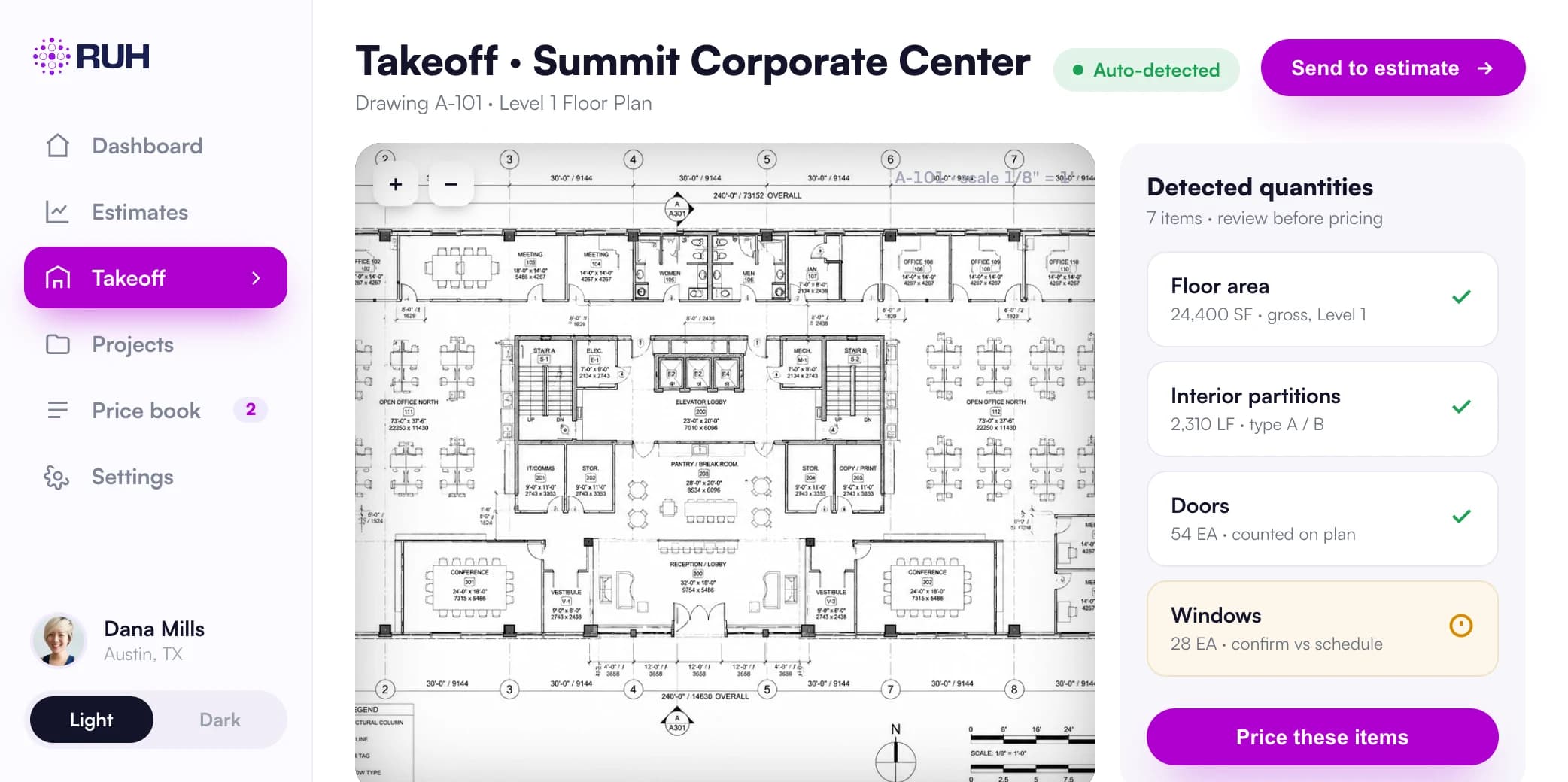
Ruh measures duct surface straight from the drawings, separates lined runs from wrapped runs per the insulation schedule, and extends the square footage with proper stretch-out. Pricing comes from the contractor's own price book, not generic rates, and a human estimator confirms the wrap and waste assumptions before signing off.

See AI construction takeoff and estimating software

Duct insulation: frequently asked questions

What is the difference between duct wrap and duct liner?+

Wrap is a foil faced fiberglass blanket applied to the outside of the duct in the field, primarily for thermal performance and condensation control, usually by a mechanical insulation subcontractor. Liner is fiberglass board glued and pinned to the inside of the duct at the sheet metal shop, valued mostly for sound attenuation, and it ships already installed. They are priced by different parties at different times, so a takeoff has to keep them on separate lines.

Which ducts have to be insulated?+

The energy code and the project's mechanical schedule govern. As a rule, supply and outside air ducts running through unconditioned spaces (attics, plenums above the insulation line, exterior) require insulation at a scheduled R-value, while general exhaust duct typically does not. Return duct varies by jurisdiction and by where it runs. Estimators should take the answer from the duct insulation schedule in the specs rather than assuming by system type.

Why is duct insulation measured on the insulated perimeter instead of the duct size?+

Because the wrap goes around the outside of the duct, the material has to cover a bigger rectangle than the bare sheet metal. Insulation of thickness t adds 2t to each duct dimension, which adds 8t to the perimeter, so 1.5 in wrap adds a full foot of perimeter to every rectangular duct it covers. On big duct the difference is a few percent; on small duct it can exceed 20 percent, so honest stretch-out math matters.

Still measuring by hand? Your next takeoff can run while you review this one.

See it on your plans

Related terms

Keep going: read the full guide or explore AI construction takeoff and estimating software.

The MEP estimating cheat sheet
Every unit, waste factor, and conversion on one page. Free PDF.

See Ruh price a bid from your own drawings.

AI takeoff and estimating on your price book, your estimator signs off.

Figures on this page are illustrative. Construction estimates depend on project-specific conditions, source documents, market pricing, and professional judgment. Ruh's AI assists the estimator and does not replace professional review: your team reviews, validates, and approves every estimate, bid, and pricing decision.