
100% money-backBook a walkthrough

Construction glossary · MEP

What is PEX in construction?

PEX in construction is cross-linked polyethylene tubing, a flexible plastic pipe used for domestic hot and cold water distribution and hydronic heating. It comes in coils and straight lengths, installs with expansion, crimp, or push fittings rather than soldered joints, and is taken off in linear feet by size, just like copper. The choice between PEX and copper is a material decision that changes the price per foot, the fitting system, and the labor hours.

Updated June 2026 · Reviewed by the Ruh construction team

PEX = cross-linked polyethyleneUsed for domestic waterMeasured in LF by diameter

PEX tubing section

PEX wallBorePEX wall1/2 inflexible tubing

Estimating mep scope this week? Watch Ruh take off a real plan in 30 minutes.

Book a walkthrough
Definition

PEX is cross-linked polyethylene tubing, specified for domestic water distribution and hydronic heating in Division 22 and 23 sections and shown on the same plumbing plans as any other water piping. It ships in straight sticks and long coils, which changes how it installs: runs can pull through framing like cable, with far fewer joints than rigid pipe. The three manufacturing types (PEX-A, PEX-B, PEX-C) matter less for performance than the fitting system attached to them: expansion fittings under ASTM F1960 pair with PEX-A, crimp and clamp systems under F1807 are common on PEX-B, and the systems do not mix. Layout matters too: a home-run system feeding fixtures from a central manifold burns much more tubing but fewer fittings than trunk and branch. The mistakes estimators make are pricing PEX footage with copper labor rates, assuming fittings interchange across systems, and missing that insert-style fittings reduce the bore, which sometimes pushes the engineer to upsize a run the copper design served at a smaller size.

How it is measured

PEX is measured in linear feet by size, with 1/2, 3/4, and 1 inch covering most distribution work, and purchased in 20 ft sticks or coils of 100 ft and longer. Fittings are counted each and must be counted by system, since expansion and crimp hardware do not interchange, and manifolds, valves, and slab sleeves are counted each. Supports come closer together than rigid pipe because the tubing is flexible (horizontal hanger spacing commonly lands around 32 inches), so hanger counts run higher per 100 lf than copper. The layout decision drives the quantity: a home-run manifold design can double the tubing footage of a trunk and branch design serving the same fixtures.

Worked example

Worked example

Price the domestic water distribution for a tenant suite two ways using illustrative material costs. The takeoff: 40 lf of 1 inch, 260 lf of 3/4 inch, and 180 lf of 1/2 inch. In PEX: 40 x $1.60 = $64, 260 x $1.10 = $286, and 180 x $0.70 = $126, for $64 + $286 + $126 = $476 of tubing. The same runs in Type L copper at illustrative $7.50, $5.25, and $3.80 per lf: 40 x $7.50 = $300, 260 x $5.25 = $1,365, and 180 x $3.80 = $684, totaling $2,349. The material spread is $2,349 - $476 = $1,873 before labor, where PEX's pulled coil runs and fast fittings cut the joint count further. The catch runs the other way too: PEX insert fittings neck down the bore, so an engineer may upsize a run that copper served at the smaller size, clawing back part of the spread.

100%

Try Ruh on a real bid. 100% money-back guarantee if you are not satisfied.*

*Scoped delivery, terms apply. Read the guarantee terms

Start with a walkthrough
How Ruh handles it

How Ruh handles PEX

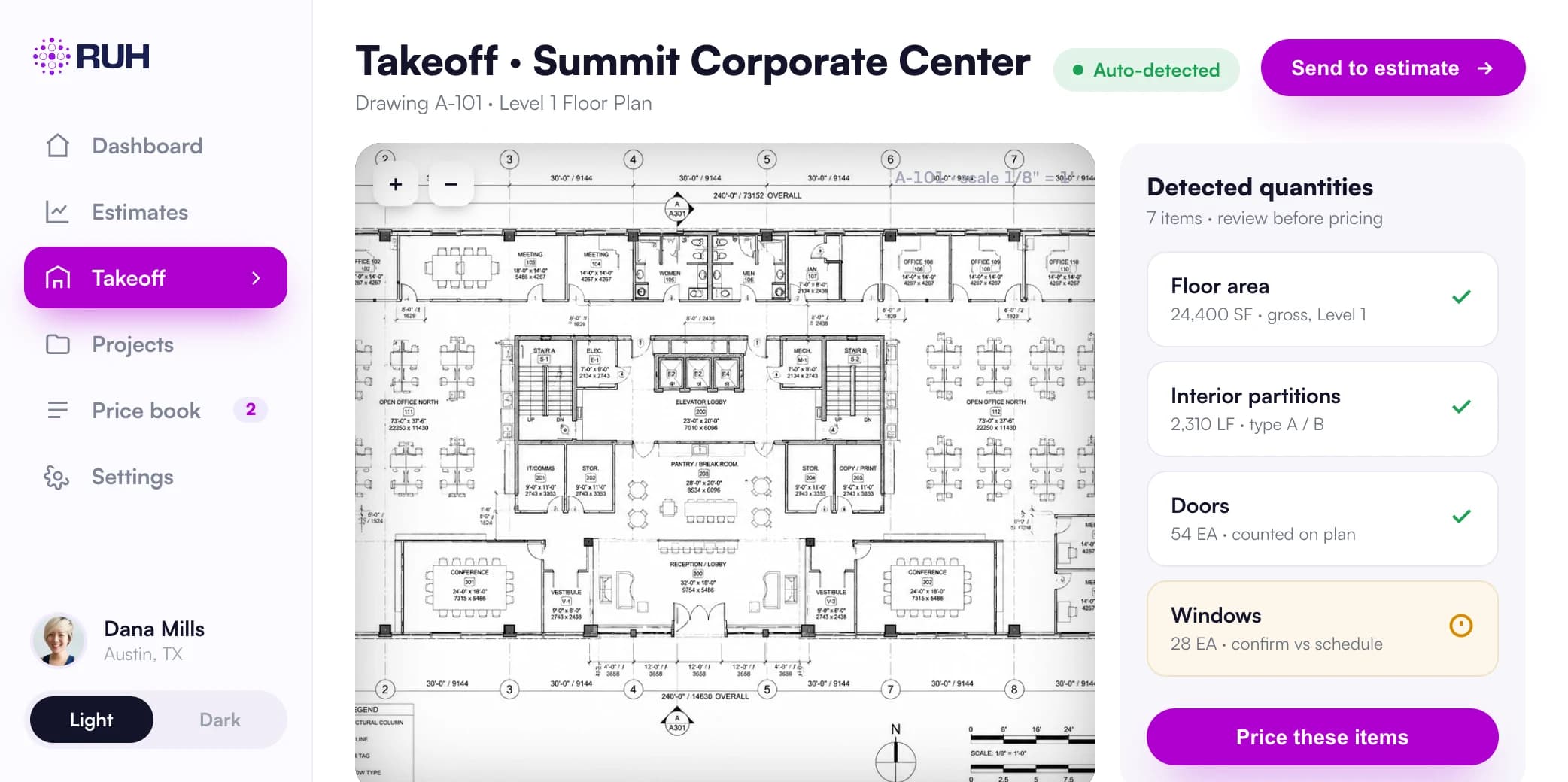
Ruh takes off PEX the way it handles any piping system: it reads the plumbing drawings, measures each run in lf by size, counts fittings by system, and prices the quantities from the contractor's own price book, so the PEX versus copper decision reflects the contractor's real costs. The estimator reviews the draft quantities and rates, then signs off.

See AI construction takeoff and estimating software

PEX: frequently asked questions

Is PEX cheaper than copper?+

On material, almost always, and the gap widens as copper commodity prices rise. On labor, PEX usually wins too: coils pull through framing in long runs with far fewer joints. The full answer depends on the fitting system, the tooling the crew already owns, and what the spec allows; some commercial specs still require copper for domestic water, and a bid that swaps in PEX without an approved substitution is a rejected submittal waiting to happen.

What is the difference between PEX-A, PEX-B, and PEX-C?+

The letters refer to the manufacturing process (peroxide, silane, and electron beam cross-linking), not a quality grade. PEX-A is the most flexible and pairs with ASTM F1960 cold expansion fittings; PEX-B is common with F1807 crimp and clamp systems. Pressure and temperature ratings are broadly similar. For estimating, the practical difference is the fitting system and tool: expansion hardware and crimp hardware do not interchange, so the takeoff must count fittings by system.

Can PEX be used in commercial buildings?+

Yes, and it is increasingly common in hotels, multifamily, and tenant work, subject to the local code and the project spec. Watch the restrictions: PEX cannot be installed exposed to sunlight, listings matter when tubing crosses return air plenums, and manufacturers commonly require a short metal connector section at water heater connections. The spec section for domestic water piping is the controlling document, so confirm acceptance before pricing the swap.

Still measuring by hand? Your next takeoff can run while you review this one.

See it on your plans

Related terms

Keep going: read the full guide or explore AI construction takeoff and estimating software.

The MEP estimating cheat sheet
Every unit, waste factor, and conversion on one page. Free PDF.

See Ruh price a bid from your own drawings.

AI takeoff and estimating on your price book, your estimator signs off.

Figures on this page are illustrative. Construction estimates depend on project-specific conditions, source documents, market pricing, and professional judgment. Ruh's AI assists the estimator and does not replace professional review: your team reviews, validates, and approves every estimate, bid, and pricing decision.