Construction glossary · Envelope and finishes
What is vapor barrier in construction?
A vapor barrier in construction is a low-permeance sheet, most often polyethylene rated under ASTM E1745, installed to stop water vapor from migrating through an assembly, typically under a concrete slab on grade or behind interior gypsum in cold climates. It is measured and bid in square feet of coverage plus the lap and seam tape it takes to keep the run continuous. The estimator scopes it from the slab plan and the wall sections, not from a single dimension.
Updated June 2026 · Reviewed by the Ruh construction team
Vapor barrier in wall section
Estimating envelope and finishes scope this week? Watch Ruh take off a real plan in 30 minutes.
Book a walkthroughA vapor barrier (sometimes called a vapor retarder when the permeance is higher) is the layer that controls diffusion of water vapor into a building assembly. In US commercial work the most common application is the under-slab sheet, usually 10-mil or 15-mil polyethylene meeting ASTM E1745 Class A, lapped, taped, and sealed to footings and penetrations before the pour. The other common use is on the warm-in-winter side of an exterior wall in heating-dominated climates. As an estimator you are scoping the field sheet plus the consumables that make it perform: lap tape at seams, sealant or boot kits at pipe and conduit penetrations, and termination detail at slab edges. You price it off the slab area or wall area shown on the drawings, add a coverage allowance for laps, and carry the seam tape as a separate line in linear feet. Permeance class and thickness drive both the material unit cost and whether the spec will accept a substitution.
Measured in square feet of plan or wall area, with seam and lap tape carried separately in linear feet. For under-slab, take the slab area off the foundation or slab plan in the structural set (the same outline you use for slab concrete) and apply a coverage factor, commonly 10 to 15 percent, for laps and turn-ups at the slab edge. Count penetrations from the plumbing and electrical underslab plans for boots and sealant. For wall use, take the area off the partition or exterior wall elevations and sections. Note the specified permeance class and mil thickness from the spec division 07 vapor retarder section, since that sets the unit price.
Worked example
Take a 9,600 sf slab on grade. With laps and slab-edge turn-ups you cannot install exactly 9,600 sf of sheet, so apply a 12 percent coverage factor: 9,600 sf x 1.12 = 10,752 sf of poly to buy. A common 15-mil roll covers about 20 sf per linear foot at width, so 10,752 sf divided by an 1,800 sf roll = 5.97, round to 6 rolls. Seams: figure 5 sheet seams running the long dimension at 80 ft each = 5 x 80 ft = 400 lf of lap tape. Price it illustratively, US market: material at 0.22 per sf gives 10,752 x 0.22 = 2,365.44, and seam tape at 0.35 per lf gives 400 x 0.35 = 140.00. Combined material is roughly 2,505 before labor and penetration boots. The estimator confirms thickness and permeance class against the spec before locking the unit price.
Try Ruh on a real bid. 100% money-back guarantee if you are not satisfied.*
*Scoped delivery, terms apply. Read the guarantee terms
How Ruh handles vapor barrier
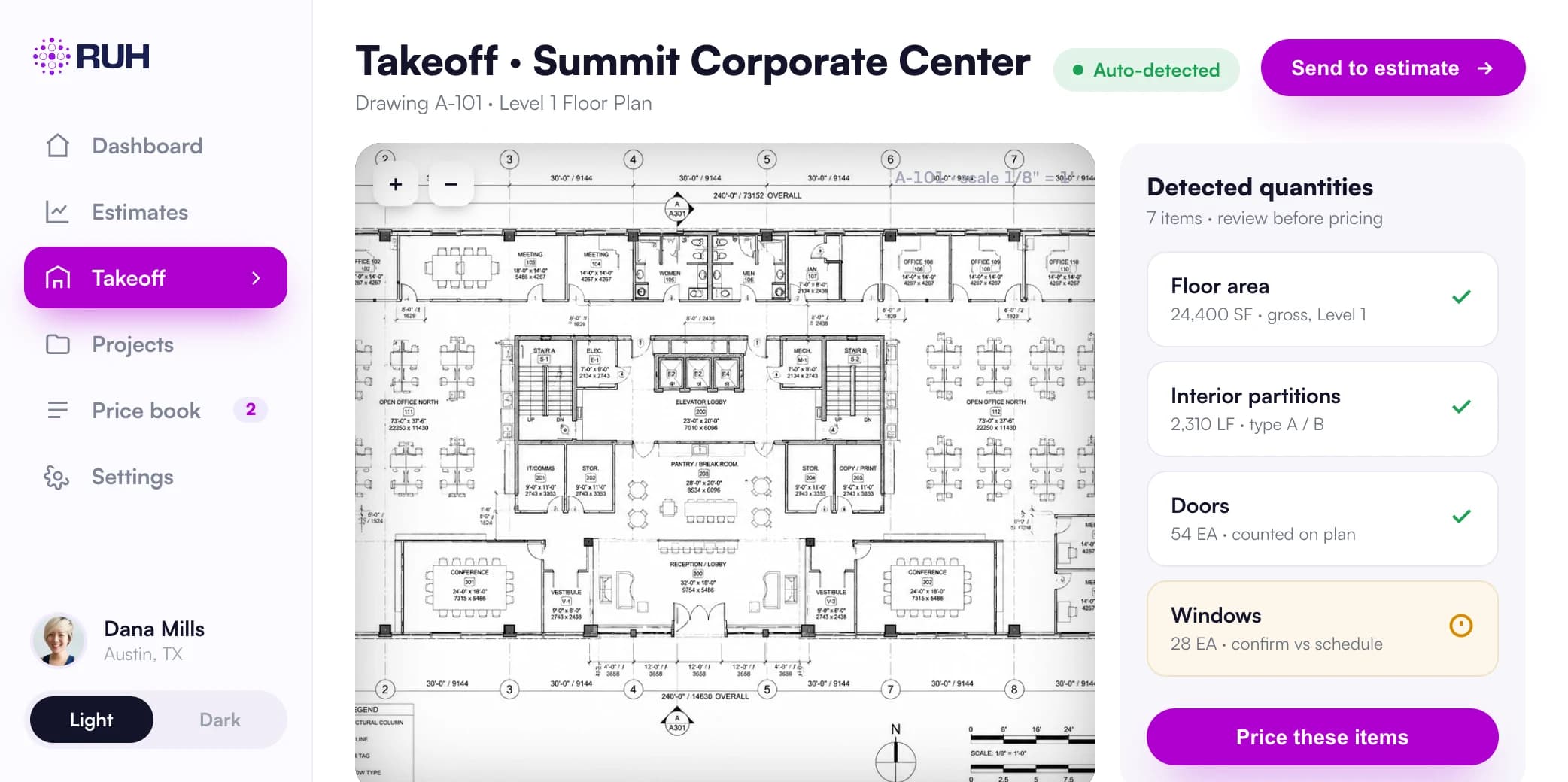
Ruh reads the structural slab plan and the division 07 vapor retarder spec, pulls the slab outline as square feet, and applies the lap coverage factor to produce the sheet quantity, then counts underslab penetrations from the plumbing and electrical sheets for boots and sealant. It carries the seam tape as linear feet and prices the whole line on your own price book for the specified mil and permeance class. The estimator reviews the takeoff, the coverage factor, and the substitution call, then signs off.
See construction estimating softwareVapor barrier: frequently asked questions
What is the difference between a vapor barrier and a vapor retarder?+
It is permeance. A true vapor barrier is very low perm, while a vapor retarder allows some controlled diffusion. The spec calls out the ASTM E1745 class and a perm rating, and that number decides which product you can carry and at what unit cost.
Why add a coverage factor instead of just bidding the slab square footage?+
Because the sheet has to lap at every seam and turn up at the slab edge, so you never install exactly the slab area. A 10 to 15 percent allowance covers laps and turn-ups. Skipping it leaves you short on material and short on the seam tape line.
Is seam tape really a separate line item?+
Yes. The poly is square feet and the tape is linear feet, and they price differently. Lumping them hides the seam labor and the tape cost, which on a large slab with many sheet joints is not trivial. Keep them split so the bid is clean.
Still measuring by hand? Your next takeoff can run while you review this one.
See it on your plansRelated terms
Keep going: read the full guide or explore construction estimating software.
See Ruh price a bid from your own drawings.
AI takeoff and estimating on your price book, your estimator signs off.
Figures on this page are illustrative. Construction estimates depend on project-specific conditions, source documents, market pricing, and professional judgment. Ruh's AI assists the estimator and does not replace professional review: your team reviews, validates, and approves every estimate, bid, and pricing decision.