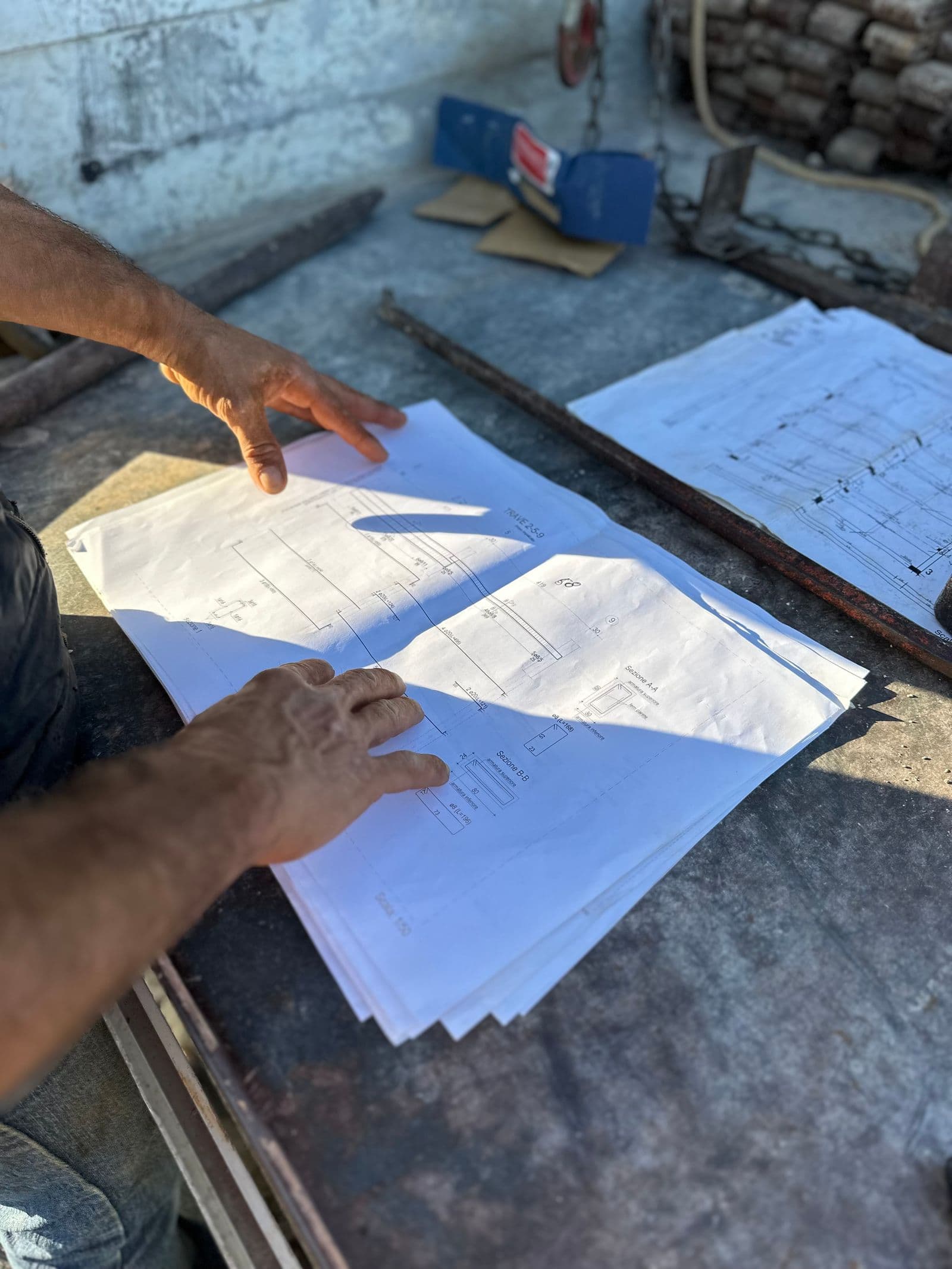
Landscape estimating software that prices on your numbers.
Landscape estimating software turns site and planting drawings into a priced bid, and Ruh does it by counting plants by species and container size against the plant schedule and measuring softscape and hardscape, with topsoil at 81 SF per cubic yard at 4 in, priced through 9 starting landscaping recipes you can edit. Below: the landscape takeoff table, a worked example priced line by line, and the questions landscape estimators ask.
Measuring first? Landscaping Takeoff Software
- ✓Planting beds, measured sf
- ✓Sod / turf, measured sf
- ✓Shrubs and groundcover plants, measured ea by container size
Free walkthrough on your own plans. Your estimator signs off.

The Landscape Estimating Problems This Solves.
Plant Counts by Size and Species off the Schedule
The planting plan calls out dozens of species at mixed container sizes, and pricing swings hard between a 3-gallon shrub and a 36-inch box tree. Hand-counting symbols across a 6-sheet planting set is slow and easy to undercount, and one missed cluster of trees can wipe a thin margin. You need an accurate count per species per size that ties back to the plant schedule, not a guess.
Mulch and Soil Volumes That Have to Convert to Cubic Yards
Bed areas come off the plan in square feet, but you buy mulch, topsoil, and amended planting soil by the cubic yard at a spec depth. Converting bed sf to cy at 3 inch mulch or 6 inch amended soil, then rounding to truckloads, is where takeoffs leak money. Get the depth or the area wrong and you either eat the overage or short the site.
Irrigation Head and Zone Counts Buried in the Irrigation Plan
Irrigation pricing is driven by head count, zone count, valve count, and mainline plus lateral linear feet, all spread across a dense plan with overlapping symbols. Miss a zone or undercount rotors versus spray heads and the controller, valves, and labor are all off. This is detailed counting work that gets rushed at bid time and shows up as a change order later.
From Your Landscape Drawings to a Priced Line.
The same pipeline that runs the takeoff runs the pricing, so the number you send out traces back to the sheet it came from.
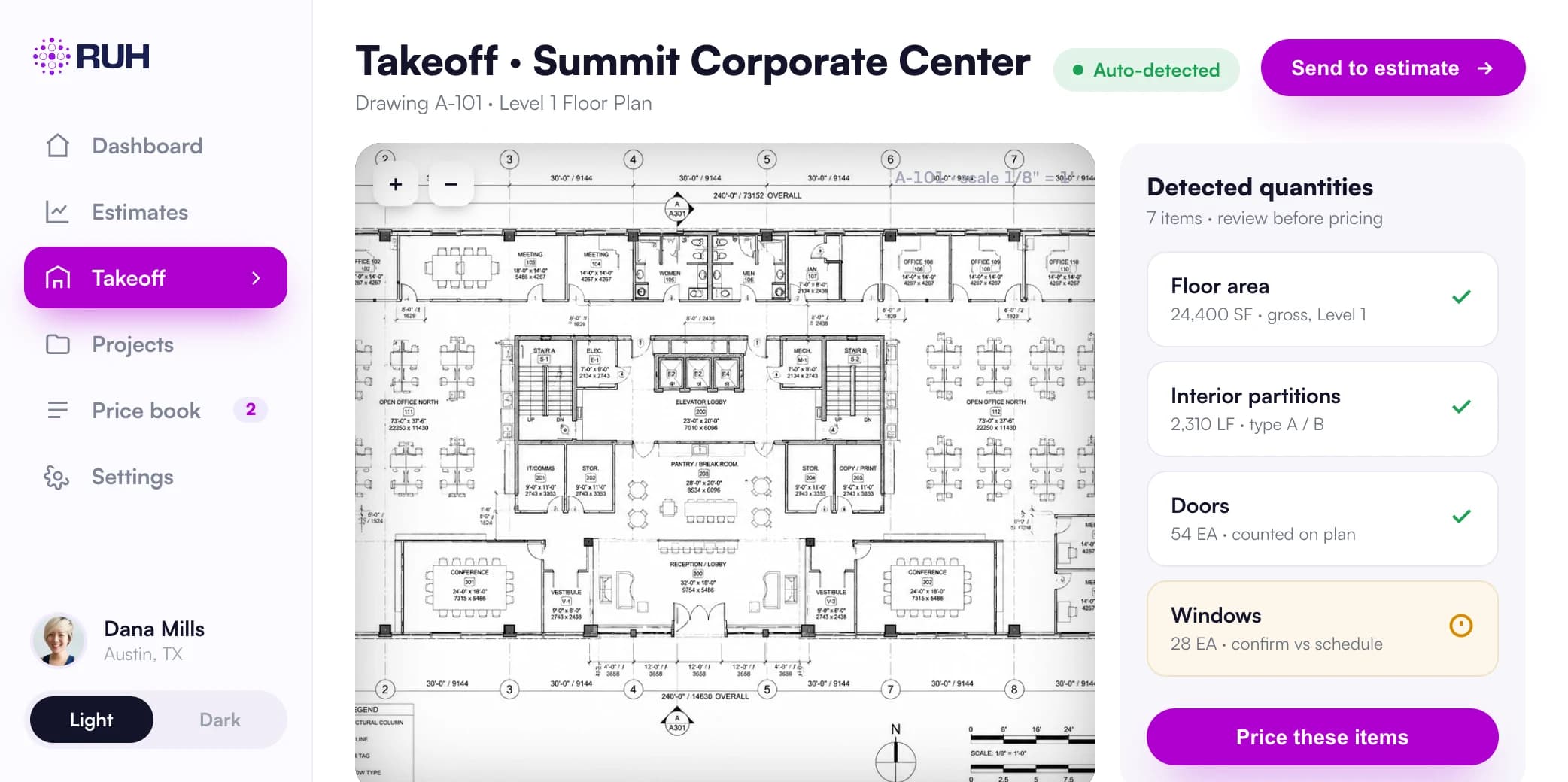
Quantities lifted from the real sheets, each tied to the sheet it came from and checked by a blind second count.
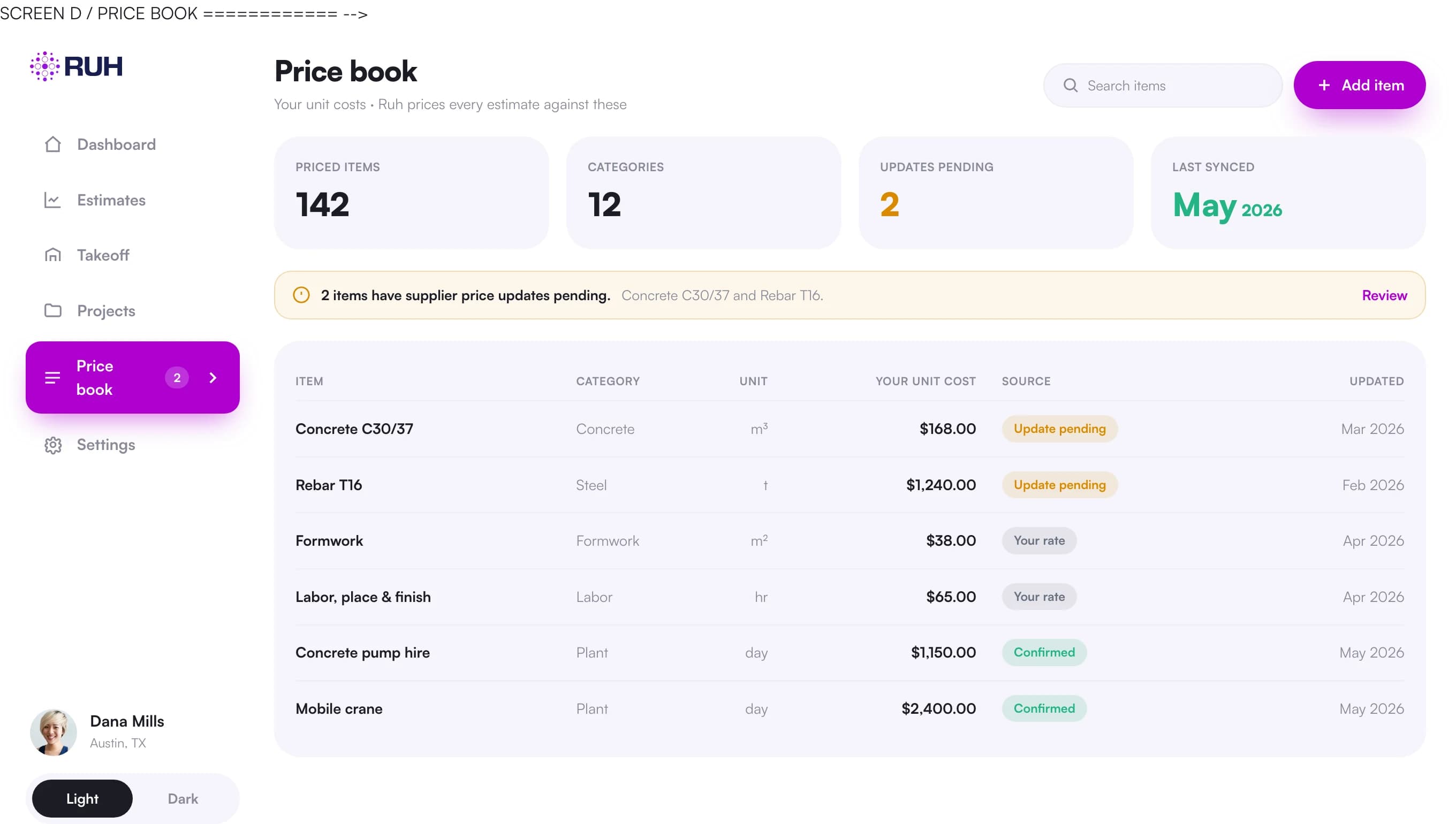
Your own rates and assemblies, not a generic national cost database.
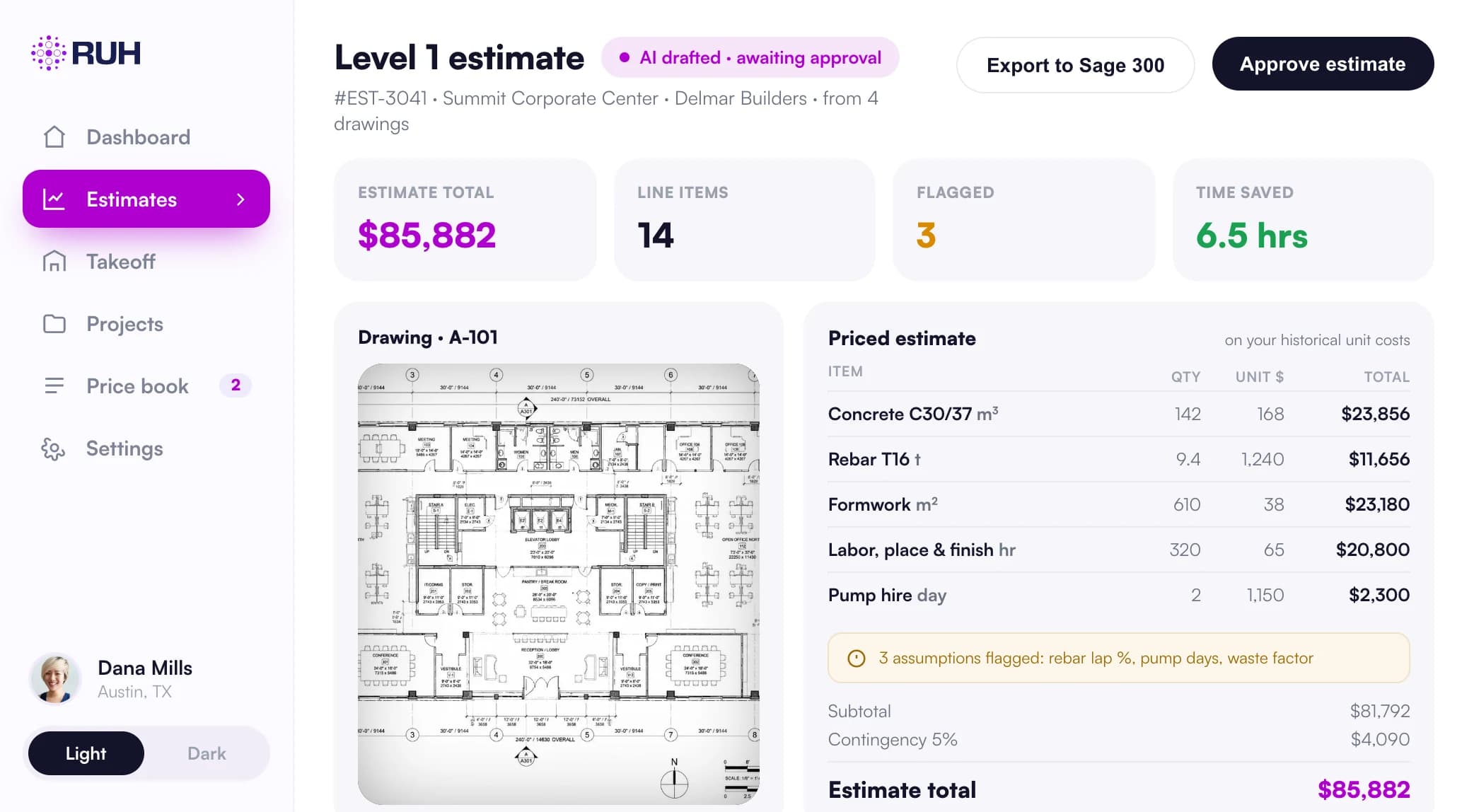
Every line traceable back to the sheet it came from before anything goes out.
What a Landscape Takeoff Counts and Measures.
| Item | Unit | How it is measured and priced |
|---|---|---|
| Planting beds | sf | Bed outlines measured as area in square feet, then carried as a planting bed assembly (soil prep, amendment, edging, mulch) priced per sf or broken to components. |
| Sod / turf | sf | Measured as area in square feet; priced per sf installed including fine grading, then converted to rolls or pallets for ordering. |
| Shrubs and groundcover plants | ea by container size | Counted per species at each container size (1 gal, 3 gal, 5 gal); priced per each by size off the plant schedule, labor scaled to size. |
| Trees | ea by caliper / box size | Counted per species by caliper or box size (2 inch cal, 24 inch box, 36 inch box); priced per each, with larger sizes carrying crane or equipment labor. |
| Mulch | cy | Bed sf times spec depth (for example 3 inch = 0.25 ft) divided by 27 to get cubic yards, then rounded up to delivered truckloads. |
| Topsoil / amended planting soil | cy | Bed or backfill area times depth, converted sf to cy at 27 cf per cy; priced per cy delivered plus placement labor. |
| Irrigation heads | ea | Counted by type (spray, rotor, drip emitter) off the irrigation plan; priced per head installed including swing joint and fitting allowance. |
| Irrigation zones / valves | ea | Zone and control valve count from the plan; priced per valve assembly, drives controller station count and wire. |
| Irrigation mainline and lateral | lf | Pipe runs measured in linear feet by size; priced per lf including trenching, fittings, and backfill. |
| Hardscape paving | sf | Pavers, concrete, or stone measured as area in square feet, tracked separately from softscape sf; priced per sf by material and base section. |
Landscaping Bidding Software: From Counted Plants to a Signed Number
Landscaping bidding software earns its keep between the takeoff and the proposal, where re-keyed plant counts and a mulch depth that changed on the plan quietly break a bid. Because Ruh prices the measured takeoff directly, the bid is the priced takeoff itself: plants by species and container size, irrigation by zone, hardscape by area, each extended on your own crew rates and exported into your proposal format. Overhead, profit, and the final number stay with your estimator.
A Worked Landscape Example
Small commercial frontage. Planting beds measure 4,000 sf. Mulch at 3 inch depth: 4,000 sf x 0.25 ft = 1,000 cf, divided by 27 = 37.0 cy, round to 38 cy at $45/cy delivered and placed = $1,710. Amended planting soil at 6 inch: 4,000 sf x 0.5 ft = 2,000 cf / 27 = 74.1 cy, round to 75 cy at $52/cy = $3,900. Plants: 120 shrubs at 5 gal x $38 ea = $4,560; 12 trees at 24 inch box x $385 ea = $4,620. Sod: 6,000 sf at $0.95/sf = $5,700. Subtotal materials and install = $1,710 + $3,900 + $4,560 + $4,620 + $5,700 = $20,490. Apply 18% overhead and profit: $20,490 x 1.18 = $24,178. The bed sf, plant counts, and per-each prices are all visible, so any reviewer can trace the $24,178 back to a measured quantity and a unit cost. Figures are illustrative.
Bidding Landscape Work This Month? Book a 30-minute walkthrough of a takeoff on a real plan.
Book a walkthrough
How Ruh Runs Your Landscape Estimates.
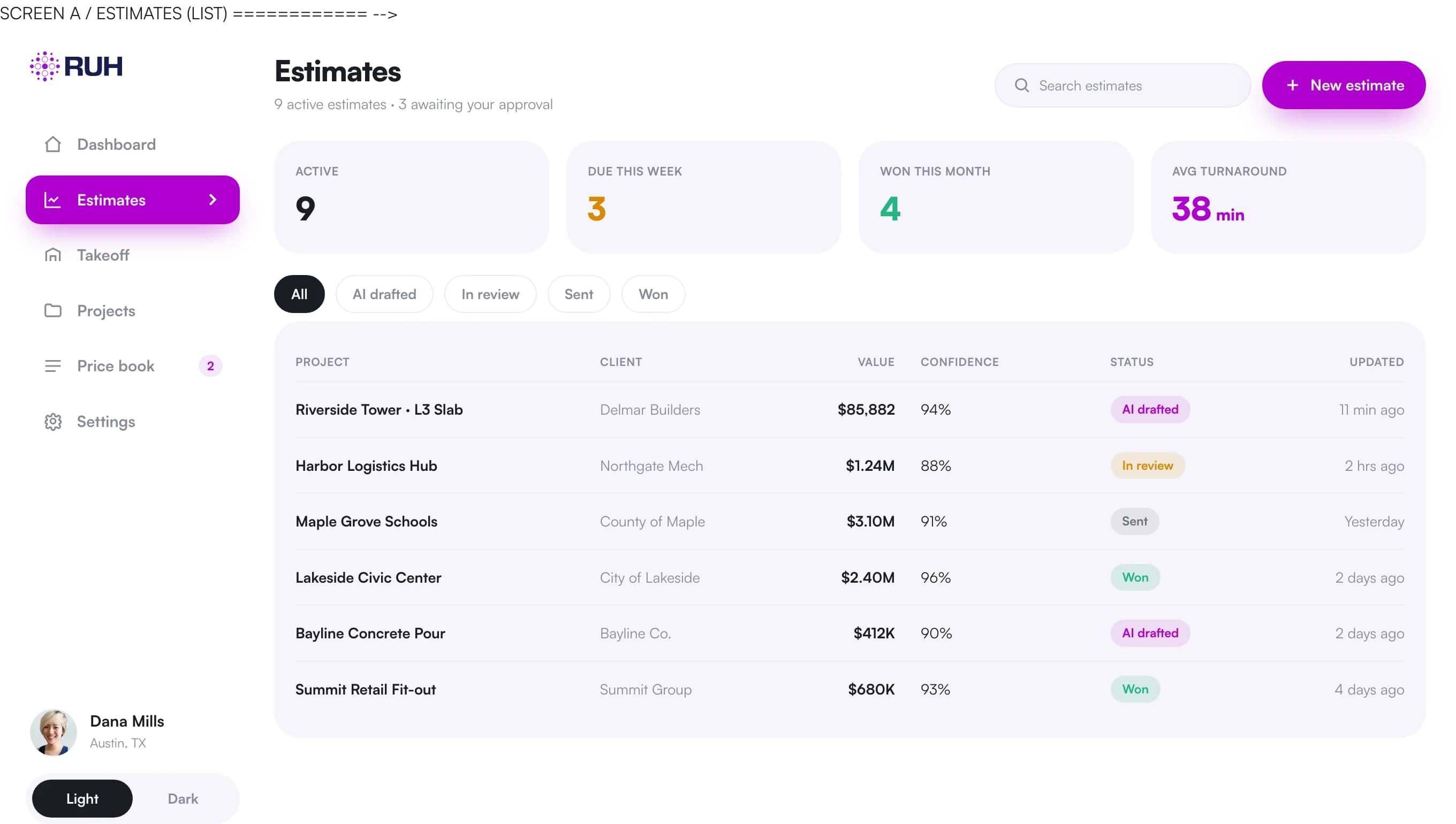
Ruh runs the landscape scope end to end inside your tenant: one sub-agent reads the planting plan and counts every plant by species and container size against the plant schedule, another measures bed sf, sod sf, and hardscape sf and converts mulch and soil to cubic yards at spec depth, and a third counts irrigation heads, zones, valves, and pipe lf off the irrigation plan. Each quantity is priced against your own price book by region, plant size, and crew rate, with an issue logged for anything ambiguous instead of a silent guess. Your estimator reviews the takeoff line by line, adjusts counts, depths, and unit costs, resolves the flagged items, and signs off. Nothing goes out as a bid until a human has owned the number.
Try Ruh on a real bid. 100% money-back guarantee if you are not satisfied.*
*Scoped delivery, terms apply. Read the guarantee terms
Landscape Estimating Software FAQs
How accurate is the AI takeoff on a dense planting plan?+
The agent counts plants by species and container size directly off the plan and reconciles them against the plant schedule, returning a count per line tied to its sheet. Anything it cannot read cleanly, like an overlapping tree cluster or a smudged symbol, is flagged for review rather than guessed. Your estimator confirms or corrects each count before it prices, so the final number reflects a human-verified takeoff, not a raw machine output.
Does it price against my own price book and crew rates?+
Yes. Pricing runs against your price book, your vendor sheets, and your labor and crew rates, broken out by region, plant size, and assembly. A 36 inch box tree, 3 inch mulch, and a rotor head each pull your numbers, not a generic regional average. If your prices change, you update the price book and the estimate reprices.
Can it work with the tools we already use?+
It runs against the files and systems you already have: PDF planting, irrigation, and site plans, your spreadsheet estimate templates, and your existing price sheets. Output exports to your bid format so you are not rekeying quantities. The goal is to drop into your current workflow, not replace it.
What stays the estimator's job?+
Judgment stays human. The estimator reviews every takeoff line, sets and adjusts depths, container sizes, and unit costs, resolves the flagged questions, applies overhead and profit, and decides the final bid. The software does the counting, measuring, and unit-cost math; the estimator owns the number and signs off before it goes out.
Is this landscaping estimating software for commercial work, or residential too?+
The pipeline is the same landscaping estimating software either way: planting plans, irrigation, and hardscape measured off the drawings and priced on your book. Commercial landscape construction estimating software has to carry the extra scopes those sets bring (erosion control, site furnishings, establishment periods), and those price as their own lines on your rates, the same as every other quantity.
Doing the landscape takeoff itself?
The quantities side has its own page: counts, measures, and how the AI takeoff reads your drawings.
Landscaping Takeoff SoftwareLandscape Terms in the Glossary.
Figures on this page are illustrative. Construction estimates depend on project-specific conditions, source documents, market pricing, and professional judgment. Ruh's AI assists the estimator and does not replace professional review: your team reviews, validates, and approves every estimate, bid, and pricing decision.
Try Ruh on a landscape bid you are pricing now.
Put us on real work rather than a canned demo. Ruh reads your drawing set, measures the scope, and prices the quantities against your own rates, with every line traceable back to the sheet it came from. If it does not hold up, you are covered by the guarantee below.
- 1Tell us about a bid you are working on and the trade you are pricing
- 2Ruh measures that scope from your drawings and prices it on your own rates, not generic cost data
- 3Every quantity traces back to the sheet it was measured from, so your estimator can check the work
Run Your Next Landscape Bid on Ruh.
Send one landscape set. We run the takeoff and walk you through the quantities, the units, and the pricing on a 30 minute call. If it does not hold up against your estimator, you have lost nothing.