
100% money-backBook a walkthrough

Construction glossary · MEP

What is copper pipe types in construction?

Copper pipe types in construction are the wall thickness grades of copper tube: Type K (thickest wall), Type L (medium), and Type M (thinnest), all sharing the same outside diameter for a given nominal size. Type L is the workhorse for domestic water piping in US commercial buildings, Type K serves underground water service, and Type M is limited to lighter duty work where the local code allows it. The type changes the price per foot and the spec compliance, not the fittings.

Updated June 2026 · Reviewed by the Ruh construction team

K / L / M thick to thin wallType L common domestic waterMeasured in LF by diameter

Copper pipe types by wall thickness

Type M (thin)Type L (medium)Type K (thick)DWV (drainage)Type L, common for water lines

Estimating mep scope this week? Watch Ruh take off a real plan in 30 minutes.

Book a walkthrough
Definition

Copper tube for building water systems comes in three wall thickness grades under ASTM B88: Type K (thickest), Type L, and Type M (thinnest), identified by green, blue, and red printing respectively. All three share the same outside diameter at a given nominal size, so fittings interchange; what changes is the wall, the weight of metal, and the price per foot. In US commercial work, Type L hard drawn tube is the default for domestic water above grade, Type K soft coils handle underground water service where many jurisdictions want a continuous run with no buried joints, and Type M appears where the code and spec allow lighter duty. The spec section for domestic water piping makes the call, and the submittal locks it. New estimators get burned two ways: carrying Type M pricing against a Type L spec, a swing that compounds across thousands of feet, and treating ACR and DWV copper as the same product family when they are separate tubes with their own sizing conventions.

How it is measured

Copper is taken off in linear feet by size and by type, never as one blended copper number, because the spec assigns types by service and the price per foot follows the wall thickness. Fittings are counted each, and the joint count drives labor: a soldered system and a press-fit system carry the same footage but very different hours, and press often wins inside occupied buildings where hot work permits slow everything down. Risers come off the riser diagram, mains and branches off the floor plans, and insulation is a separate line in lf. Copper is a traded commodity, so price book entries need a quote date attached.

Worked example

Worked example

Take off the domestic water riser and branch mains for a three-story office in Type L hard copper, with illustrative material pricing. Riser: 3 floors x 12 ft floor-to-floor = 36 lf of 2 inch. Branch mains: 135 lf of 3/4 inch across the floors. Material at $21.00 per lf for 2 inch Type L: 36 x $21.00 = $756. At $5.40 per lf for 3/4 inch Type L: 135 x $5.40 = $729. Tubing material totals $756 + $729 = $1,485 before fittings, hangers, insulation, and labor. Now the spec trap: bidding the 3/4 inch runs as Type M at an illustrative $4.30 per lf saves 135 x ($5.40 - $4.30) = $148.50 on this small takeoff, but if the spec calls for Type L the submittal gets rejected and the swap comes out of the contractor's pocket at install time, when the price is no longer a desk decision.

100%

Try Ruh on a real bid. 100% money-back guarantee if you are not satisfied.*

*Scoped delivery, terms apply. Read the guarantee terms

Start with a walkthrough
How Ruh handles it

How Ruh handles copper pipe types

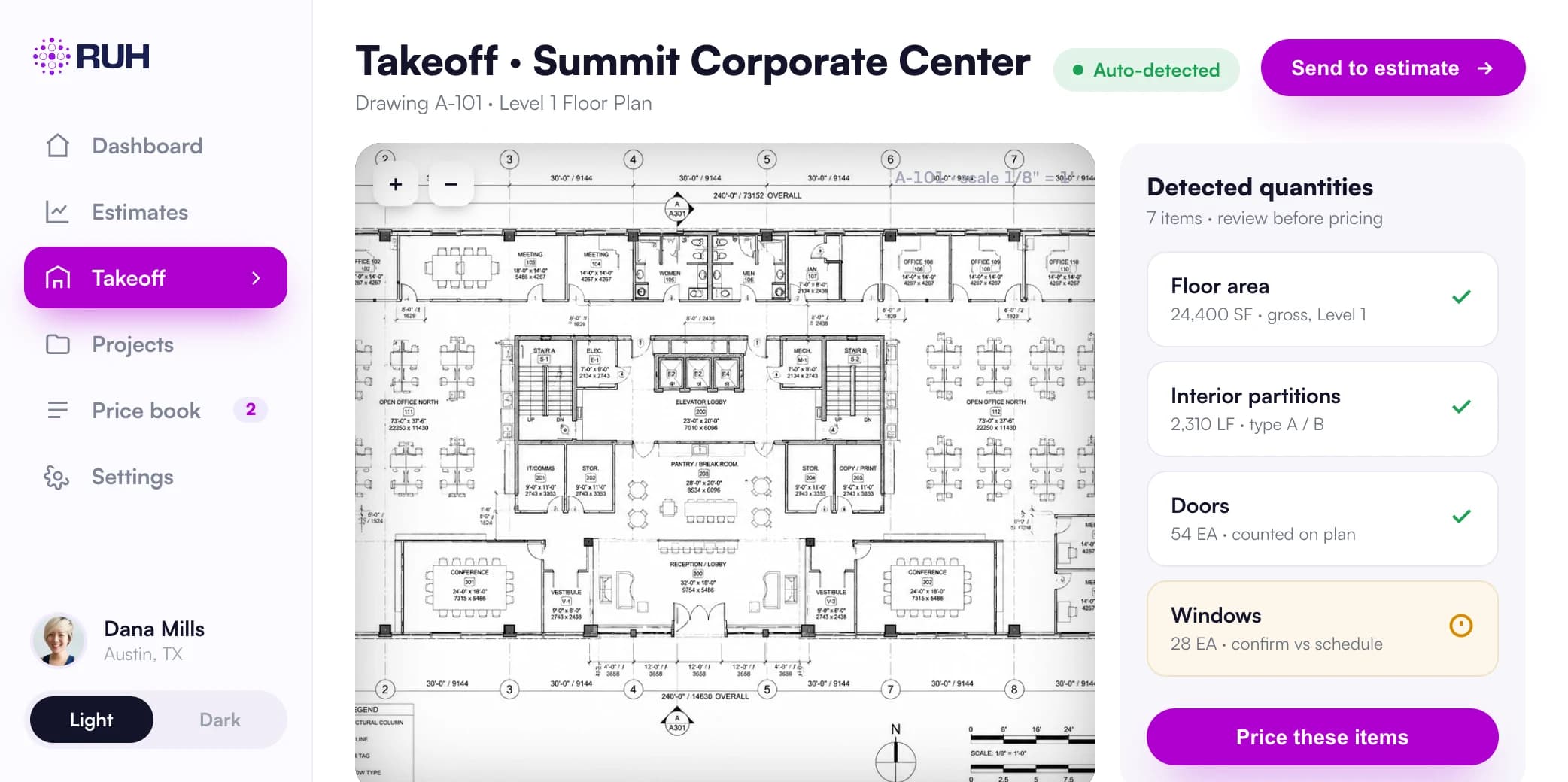
When Ruh runs the takeoff it reads the spec section and the plumbing sheets together, so copper quantities land in lf by both size and type rather than a single blended copper line, and pricing comes from the contractor's own price book entries for K, L, or M. The estimator reviews the type assignments against the submittals, adjusts where needed, and signs off.

See AI construction takeoff and estimating software

Copper pipe types: frequently asked questions

What is the difference between Type K, L, and M copper pipe?+

Wall thickness. Type K is the thickest, Type L is the middle grade, and Type M is the thinnest, all under ASTM B88 and all sharing the same outside diameter for a given nominal size, so they accept the same fittings. The printed color identifies them: green for K, blue for L, red for M. A thicker wall means more copper, higher pressure capacity in the smaller sizes, and a higher price per foot.

Which copper type is used for domestic water in commercial buildings?+

Type L hard drawn tube is the standard call for domestic water distribution above grade in US commercial specs. Type K, often in soft annealed coils, handles underground water service, where many jurisdictions also want a continuous run with no buried joints. Type M shows up where the code and the spec allow lighter duty work. Always read the actual spec section; assuming L everywhere or M anywhere is how bids drift.

Are copper pipe types interchangeable on a takeoff?+

Physically, the fittings interchange because all three types share the same outside diameter. Contractually, no: the spec assigns a type to each service, and substituting a thinner wall than specified means a rejected submittal or a tear-out. For the estimator, this means copper lines must carry both size and type in the takeoff, with separate price book entries, because 3/4 inch Type L and 3/4 inch Type M are different materials at different costs.

Still measuring by hand? Your next takeoff can run while you review this one.

See it on your plans

Related terms

Keep going: read the full guide or explore AI construction takeoff and estimating software.

The MEP estimating cheat sheet
Every unit, waste factor, and conversion on one page. Free PDF.

See Ruh price a bid from your own drawings.

AI takeoff and estimating on your price book, your estimator signs off.

Figures on this page are illustrative. Construction estimates depend on project-specific conditions, source documents, market pricing, and professional judgment. Ruh's AI assists the estimator and does not replace professional review: your team reviews, validates, and approves every estimate, bid, and pricing decision.