Earthwork estimating software that prices on your numbers.
Earthwork estimating software turns site and grading drawings into a priced bid, and Ruh does it with cut and fill taken only from documented surfaces, at 27 cubic feet to the yard, and trench runs and utilities measured, priced through 48 starting recipes across 5 site trades you can edit. Below: the sitework takeoff table, a worked example priced line by line, and the questions sitework estimators ask.
Measuring first? Excavation Takeoff Software
- ✓Cut and fill, measured cy
- ✓Mass excavation, measured cy
- ✓Trench excavation, measured cy (from lf x section)
Free walkthrough on your own plans. Your estimator signs off.
The Earthwork Estimating Problems This Solves.
Cut/Fill Balance and Swell/Shrink Factors Are Easy to Get Wrong
Raw plan volumes are bank cubic yards, but trucks haul loose yards and compacted fill measures yet differently. Miss the swell factor on export or the shrink (compaction) factor on import and a balanced site looks like surplus, or a surplus site looks balanced. A 10 to 15 percent error on factors can flip a job from net export to net import and swing the haul line by tens of thousands of dollars.
Trench Volumes Come From Length Times Section, and the Section Keeps Changing
Utility and footing trenches are priced as cy, but you take them off as lf and convert by trench width, depth, and side slope. Depth follows invert elevations that step down across the run, and bedding and backfill have separate sections. Doing this by hand per segment is slow and error prone, and one wrong average depth quietly inflates or shorts the excavation, bedding, and spoil all at once.
Import/Export Haul Cost and Base Course Unit Conversion Get Fumbled Under Deadline
Net import or export drives a haul line that is often the biggest single number on the bid, and it depends on round trip cycle time, truck size, and the swell on the loose material. Separately, aggregate base is shown as a compacted cy on the plan but bought and billed by the ton, so the cy to tons conversion rides on the compacted density of that specific material. Get either wrong and margin disappears before you mobilize.
From Your Earthwork Drawings to a Priced Line.
The same pipeline that runs the takeoff runs the pricing, so the number you send out traces back to the sheet it came from.
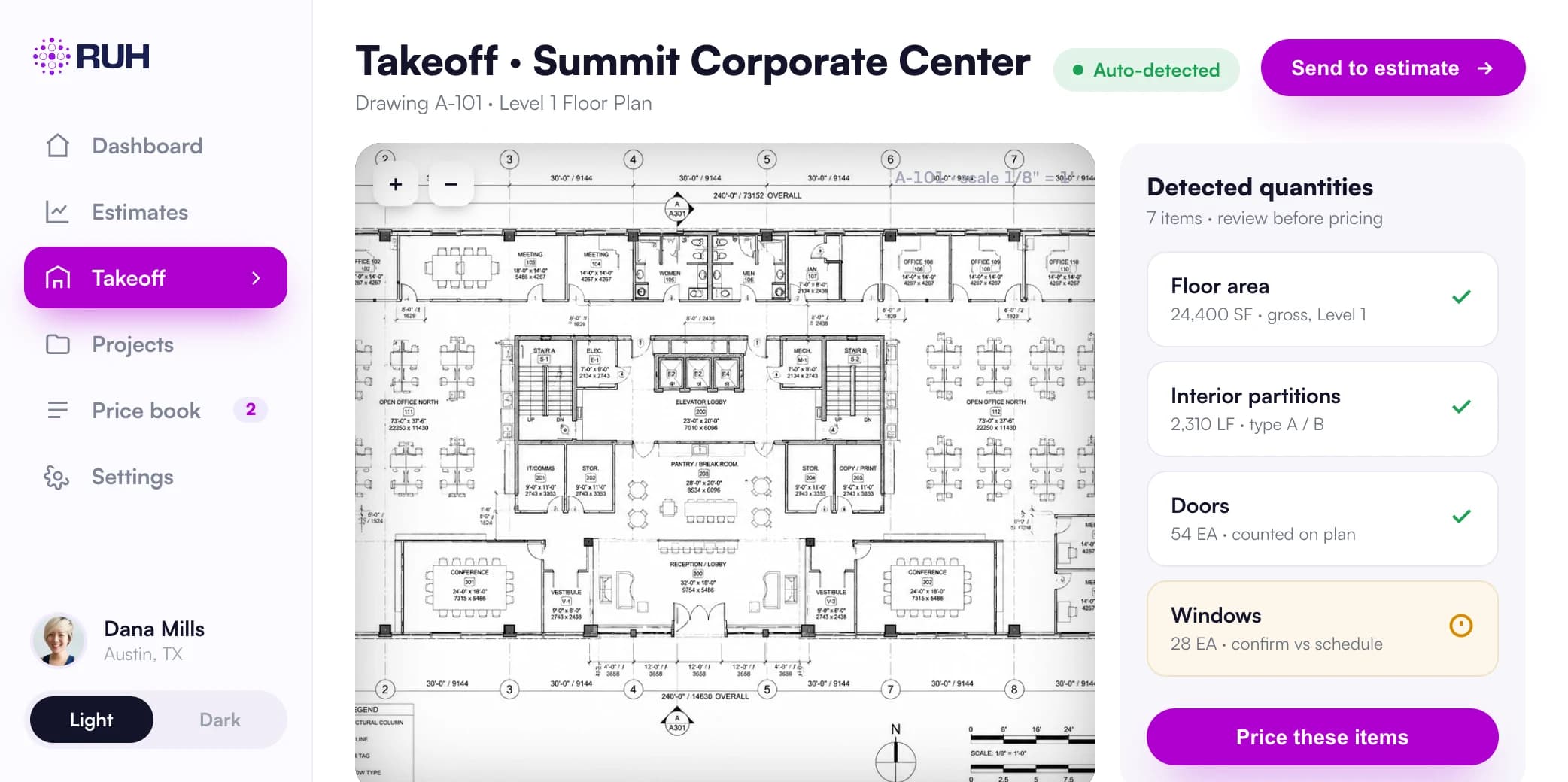
Quantities lifted from the real sheets, each tied to the sheet it came from and checked by a blind second count.
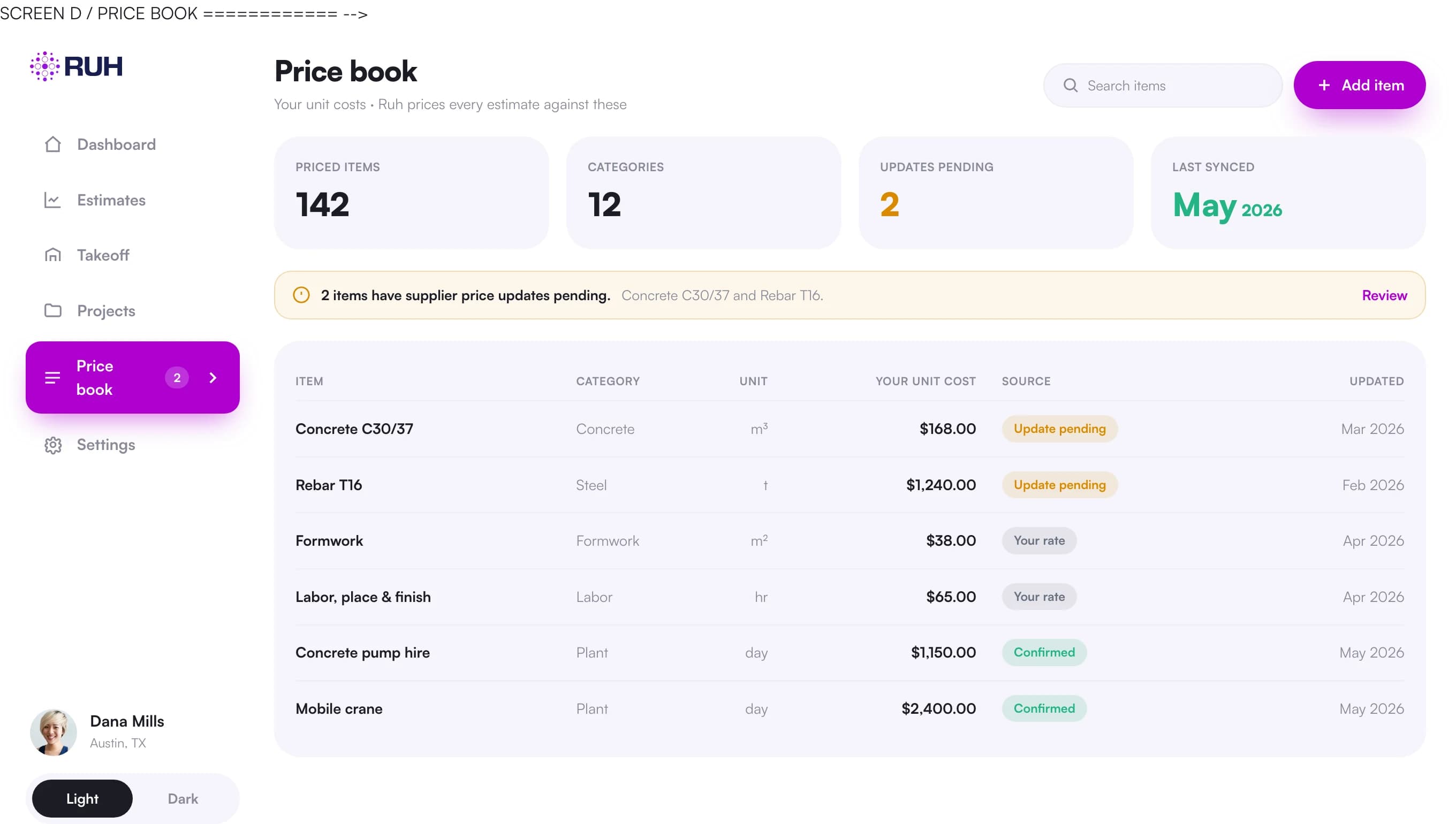
Your own rates and assemblies, not a generic national cost database.
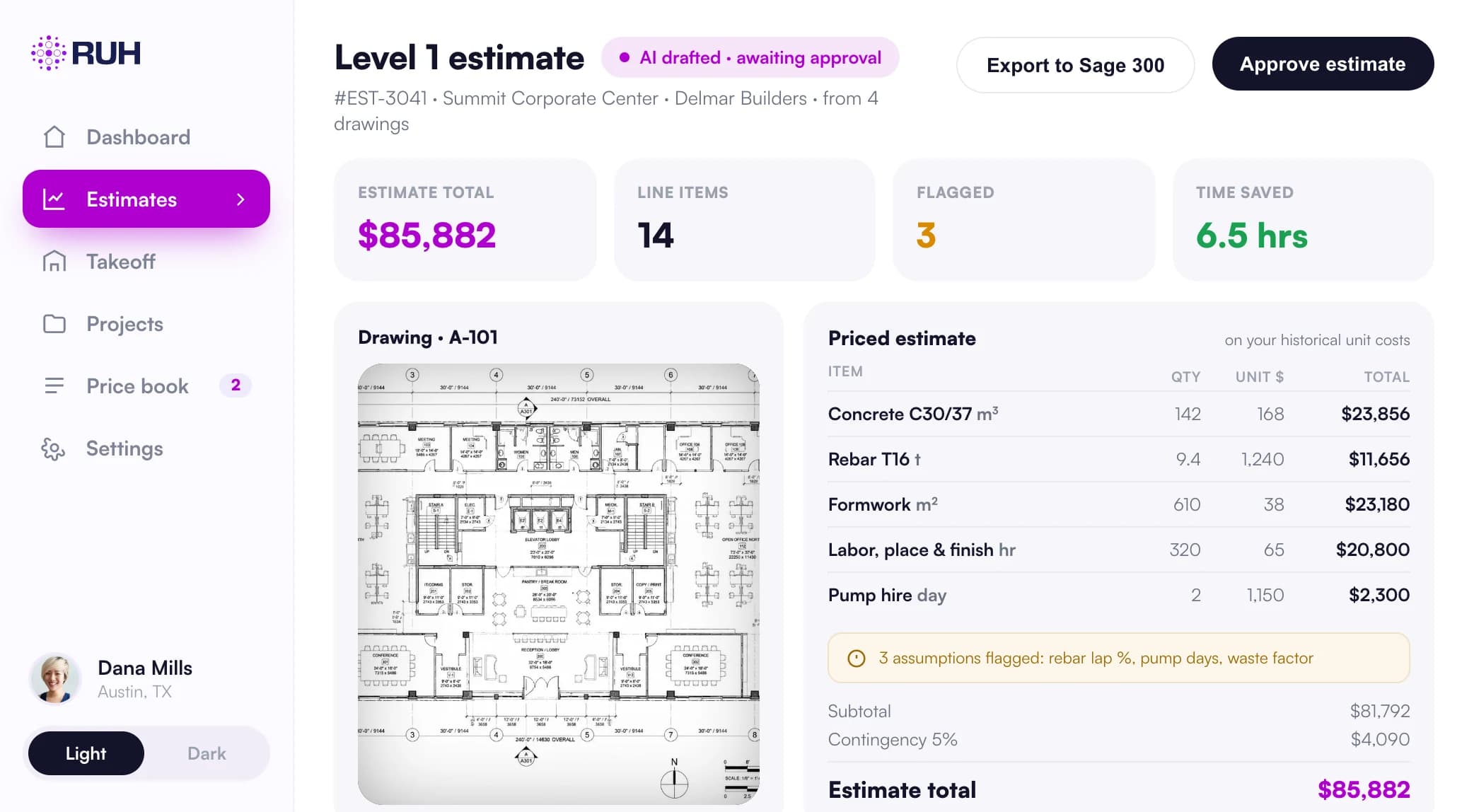
Every line traceable back to the sheet it came from before anything goes out.
What an Earthwork Takeoff Counts and Measures.
| Item | Unit | How it is measured and priced |
|---|---|---|
| Cut and fill | cy | Volume between existing and proposed grade surfaces; reported as bank cy then adjusted by swell for export and shrink for compacted fill |
| Mass excavation | cy | Bulk dig for building pads, basements, and ponds; priced per cy at a production rate, separate from structural or trench excavation |
| Trench excavation | cy (from lf x section) | Length by trench width, average depth, and side slope; depth driven by invert elevations, split into bedding, pipe zone, and backfill |
| Aggregate base course | cy or tons | Plan compacted cy converted to tons by material density; priced per ton delivered plus place and compact |
| Compaction / fine grading | sf | Subgrade prep and proof roll measured by area; priced per sf or per square, separate from the fill volume itself |
| Haul-off (export) / import | cy | Net of cut minus fill after swell and shrink; priced per loose cy by truck cycle, or per load, plus tipping or borrow fees |
| Grading / earthwork by area | sf or acre | Rough and finish grade as an assembly per area when cut/fill is near balance; rolls strip, grade, and compact into one rate |
| Topsoil strip and respread | cy or sf | Strip depth times area for stockpile cy; respread priced separately by area and target depth |
| Erosion control / SWPPP items | lf or ea | Silt fence and inlet protection by lf or each; quantified off the erosion plan, not the grading surface |
| Dewatering / over-excavation | cy or ls | Unsuitable soil removal by cy and replacement with select fill; pumping often a lump sum allowance flagged for estimator review |
A Worked Earthwork Example
Small commercial pad. Surfaces compute 1,800 bank cy of cut and 1,200 cy of required compacted fill. Reuse the cut as fill on site. Apply a shrink factor of 1.20, so 1,200 compacted cy needs 1,200 x 1.20 = 1,440 bank cy of fill material. Cut is 1,800 bank cy, so 1,800 - 1,440 = 360 bank cy is surplus to export. Apply a swell factor of 1.25 for loose haul: 360 x 1.25 = 450 loose cy. At a haul-off rate of $14 per loose cy, export = 450 x $14 = $6,300. Move the 1,440 cy of on-site fill at $5 per bank cy = $7,200. Now the base course: 320 compacted cy of aggregate base at a density of 1.5 tons per cy = 480 tons; at $26 per ton delivered and placed = $12,480. Earthwork subtotal: $6,300 + $7,200 + $12,480 = $25,980, before grading, compaction testing, and markup.
Bidding Earthwork Work This Month? Book a 30-minute walkthrough of a takeoff on a real plan.
Book a walkthrough
How Ruh Runs Your Earthwork Estimates.
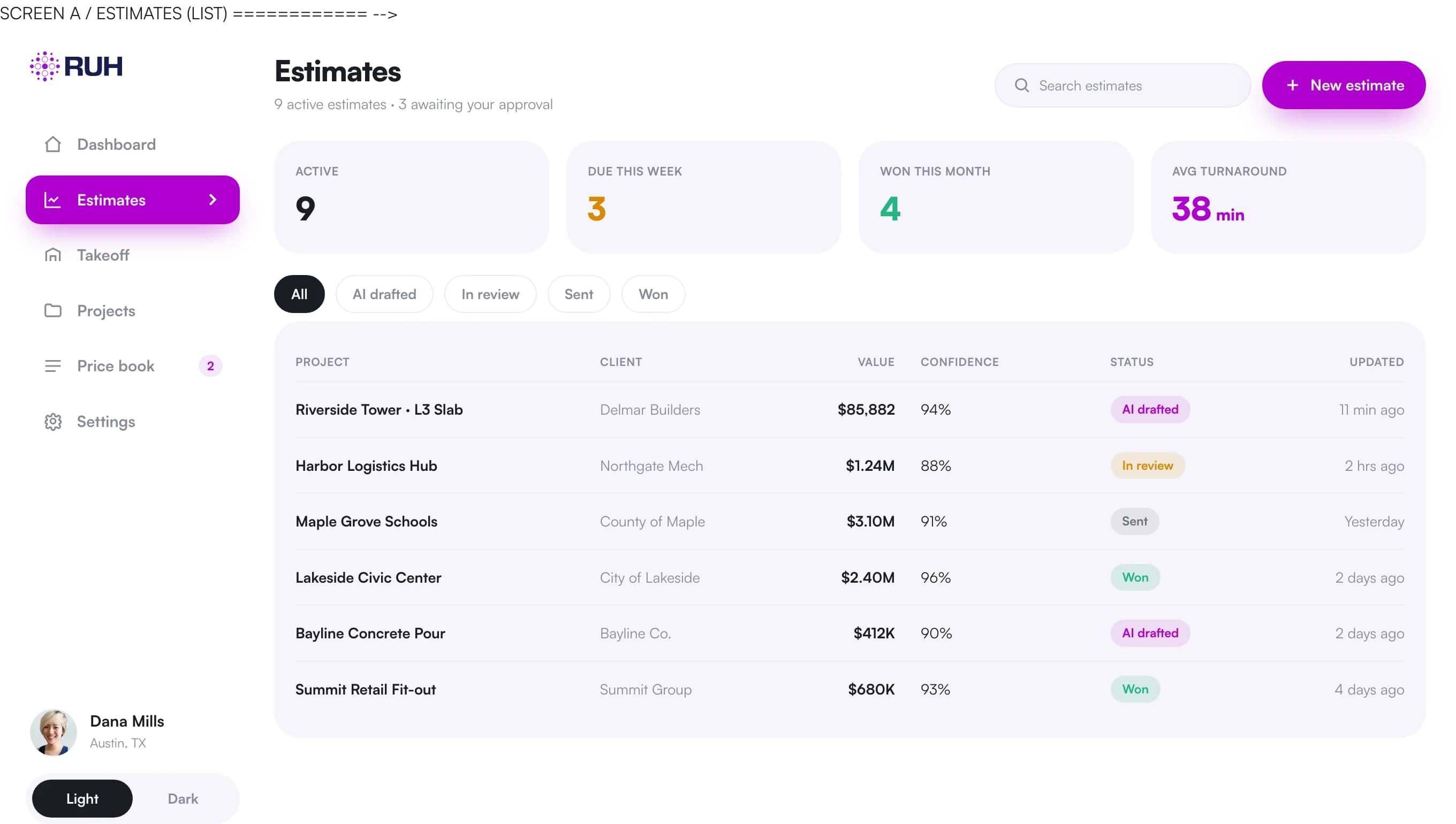
Ruh ingests the civil set (existing and proposed grading, utility plans, geotech notes), builds the cut/fill model and trench runs, and quantifies mass excavation, aggregate base, compaction areas, and topsoil, then prices every line against your price book including your swell and shrink factors and haul rates. It computes the net import/export and the cy to tons conversions for you, and flags assumptions it had to make (average trench depth, unsuitable-soil allowances, borrow source). Your estimator reviews the cut/fill balance, confirms the factors and haul logic against the geotech and site conditions, adjusts production rates, and signs off. The AI does the measuring and the math; the number that leaves the office is the estimator's.
Try Ruh on a real bid. 100% money-back guarantee if you are not satisfied.*
*Scoped delivery, terms apply. Read the guarantee terms
Earthwork Estimating Software FAQs
How accurate is the takeoff on cut and fill?+
The AI builds the cut/fill surface from your existing and proposed grading sheets and reports bank cy, then applies the swell and shrink factors you set. Accuracy depends on plan quality and the factors, which is why every balance, factor, and haul figure is shown for your estimator to check against the geotech before sign-off. It is a fast, auditable first pass, not a black box.
Does it use my own unit prices and factors?+
Yes. Ruh prices against your price book, your rates per cy, ton, lf, and sf, your swell and shrink factors, your haul and borrow rates, and your production assumptions. There is no generic cost database deciding your bid. If you maintain different factors by soil type, those carry through.
Can it work with my current takeoff and estimating tools?+
Ruh produces a quantified, priced scope you can export to your spreadsheet or estimating system, and it reads standard PDF and civil drawing sets. It is meant to replace the hours of manual measuring and conversion, not force you off the tools your team already bids in.
What stays the estimator's job?+
Judgment. The estimator owns the cut/fill balance call, the swell and shrink factors, haul cycle assumptions, unsuitable-soil and dewatering allowances, production rates, and final markup. Ruh measures and prices; the estimator reviews, adjusts, and signs. Nothing goes out unreviewed.
Doing the earthwork takeoff itself?
The quantities side has its own page: counts, measures, and how the AI takeoff reads your drawings.
Excavation Takeoff SoftwareEarthwork Terms in the Glossary.
Figures on this page are illustrative. Construction estimates depend on project-specific conditions, source documents, market pricing, and professional judgment. Ruh's AI assists the estimator and does not replace professional review: your team reviews, validates, and approves every estimate, bid, and pricing decision.
Try Ruh on an earthwork bid you are pricing now.
Put us on real work rather than a canned demo. Ruh reads your drawing set, measures the scope, and prices the quantities against your own rates, with every line traceable back to the sheet it came from. If it does not hold up, you are covered by the guarantee below.
- 1Tell us about a bid you are working on and the trade you are pricing
- 2Ruh measures that scope from your drawings and prices it on your own rates, not generic cost data
- 3Every quantity traces back to the sheet it was measured from, so your estimator can check the work
Run Your Next Earthwork Bid on Ruh.
Send one earthwork set. We run the takeoff and walk you through the quantities, the units, and the pricing on a 30 minute call. If it does not hold up against your estimator, you have lost nothing.