
Construction glossary · MEP
What is chiller in construction?
A chiller in construction is a piece of central plant equipment that produces chilled water for a building's air conditioning system, sized in tons of refrigeration, where one ton equals 12,000 Btu per hour of cooling. Air-cooled chillers reject heat through onboard condenser fans and typically sit on the roof or a pad outside, while water-cooled chillers live in a mechanical room and reject heat through a cooling tower. On the estimate, chillers are counted each (ea) off the mechanical equipment schedule, with capacity in tons driving the price.
Updated June 2026 · Reviewed by the Ruh construction team
How chillers are counted
Estimating mep scope this week? Watch Ruh take off a real plan in 30 minutes.
Book a walkthroughOn a commercial project the chiller is usually the single most expensive piece of HVAC equipment in the mechanical contract, so it gets its own line on the equipment schedule (tagged CH-1, CH-2) with tonnage, voltage, efficiency, and refrigerant listed. The scope lives on the mechanical sheets and in Division 23 of the specifications, and the mechanical contractor owns it, though the crane and rigging to set a machine that can weigh 20,000 lbs is often a priced line of its own. Air-cooled machines are packaged and simpler to estimate; water-cooled machines drag a cooling tower, condenser water pumps, and a second piping loop into the plant scope. New estimators get burned in predictable spots: pricing the chiller bare and missing rigging, the concrete housekeeping pad, vibration isolation, flow switches, and factory startup; missing refrigerant monitoring and ventilation requirements in the machinery room; and not catching that on some projects the owner purchases the chiller directly and the contractor only installs it. Read the schedule notes and the spec section before carrying a number.
Chillers are a count, taken each (ea) from the mechanical equipment schedule, never measured in linear or square feet. Capacity in tons is the primary cost driver, followed by type (air-cooled versus water-cooled), voltage, efficiency rating, sound packages, and refrigerant. The schedule lives on the M-series sheets, with the physical location on the mechanical plans and the piping connections on the plant flow diagram. Each unit drags a tail of follow-on quantities the estimator takes off separately: a concrete housekeeping pad, vibration isolation, chilled water and condenser water connections in lf, valves and specialties at each connection, an electrical feed carried by Division 26, and a startup and commissioning allowance. Rigging is its own line, priced by unit weight and how far the crane has to reach.
Worked example
The equipment schedule on a mid-rise office shows two air-cooled chillers, CH-1 and CH-2, at 150 tons each, for 300 tons of plant capacity. Furnish cost at an illustrative $900 per ton: 150 tons x $900 = $135,000 per unit, and 2 x $135,000 = $270,000. Rigging and setting at an illustrative $8,000 per unit adds 2 x $8,000 = $16,000. Each housekeeping pad is 24 ft x 8 ft x 6 in thick: 192 sf x 0.5 ft = 96 cf, and 96 / 27 is about 3.6 cy per pad, so two pads are roughly 7.1 cy, carried as 8 cy at an illustrative $450 per cy in place = $3,600. The chiller package totals $270,000 + $16,000 + $3,600 = $289,600 before piping, electrical, controls, or startup. Sanity check: $289,600 / 300 tons is about $965 per ton, a number you can compare against your last plant job.
Try Ruh on a real bid. 100% money-back guarantee if you are not satisfied.*
*Scoped delivery, terms apply. Read the guarantee terms
How Ruh handles chiller
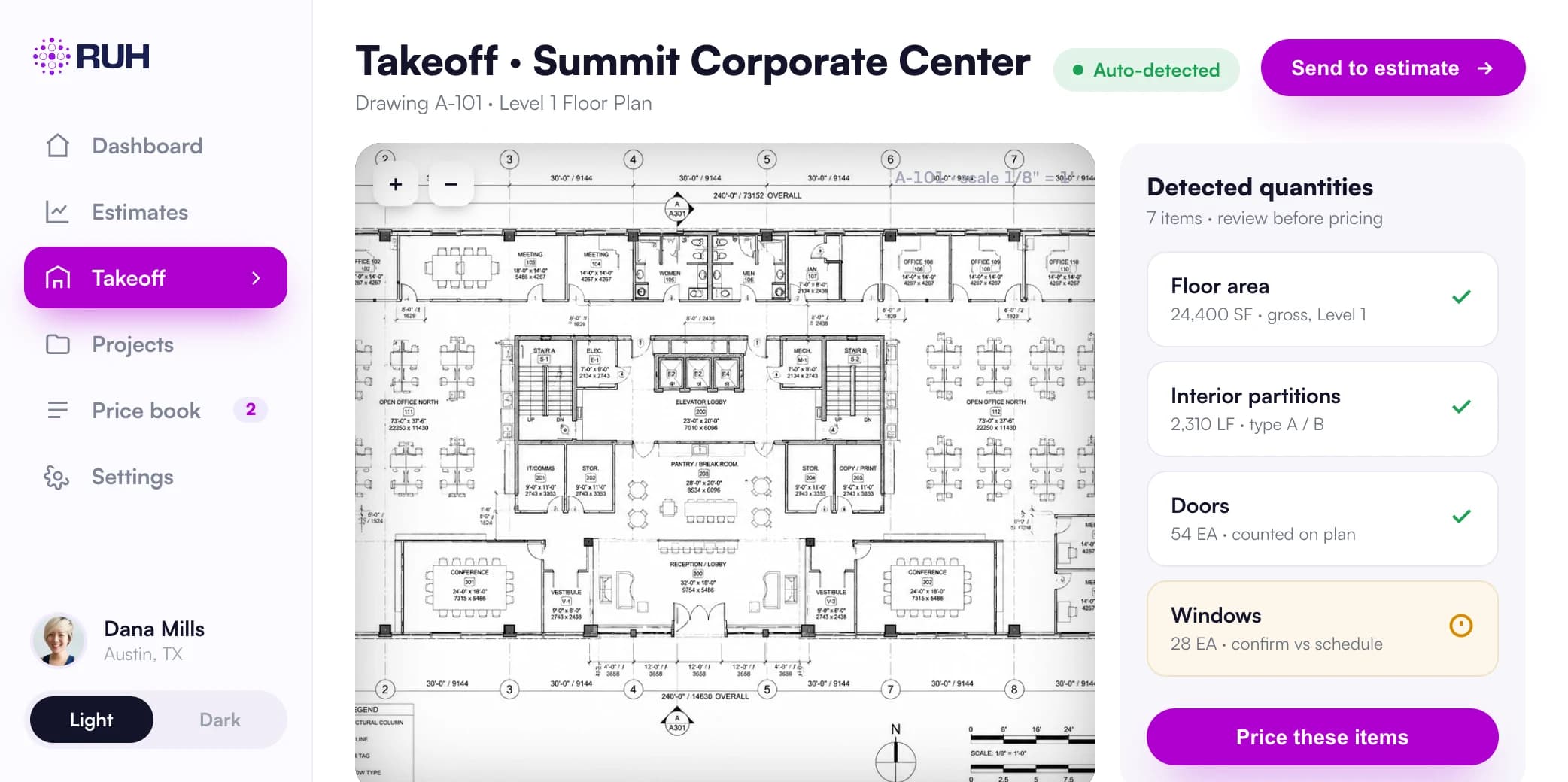
Ruh reads the mechanical schedules and plans, picks up each chiller as a counted unit with its tonnage and follow-on items, and prices the package against the contractor's own price book rather than generic equipment data. The estimator gets a line-item draft, checks the scope splits (rigging, pad, startup, owner-furnished equipment), and signs off before the number goes anywhere.
See AI construction takeoff and estimating softwareChiller: frequently asked questions
What is the difference between an air-cooled and a water-cooled chiller?+
An air-cooled chiller rejects heat directly to outdoor air through onboard condenser fans, so it is a packaged unit that sits outside on a pad or roof. A water-cooled chiller rejects heat to a condenser water loop, which means the estimate also has to carry a cooling tower, condenser water pumps, and a second piping system. Water-cooled plants are typically more efficient at larger tonnages, but the installed scope is substantially bigger than the chiller line alone.
What does a ton mean on a chiller schedule?+
One ton of refrigeration equals 12,000 Btu per hour of cooling, a unit left over from the days when cooling was delivered by melting ice (one ton of ice melting over 24 hours absorbs heat at roughly that rate). A 300 ton chiller can remove 3,600,000 Btu of heat per hour. Estimators use tons both to read the schedule and to benchmark installed cost per ton against past plant jobs.
What gets missed when estimating a chiller installation?+
The bare equipment price is the easy part. The misses are usually rigging and crane time, the concrete housekeeping pad, vibration isolation, flow switches and safeties, refrigerant monitoring in the machinery room, the chemical treatment tie-in, factory startup, and the scope boundary with the electrical contractor on the power feed. On some projects the owner buys the chiller directly, so confirm whether you are furnishing and installing or installing only.
Still measuring by hand? Your next takeoff can run while you review this one.
See it on your plansRelated terms
Keep going: read the full guide or explore AI construction takeoff and estimating software.
See Ruh price a bid from your own drawings.
AI takeoff and estimating on your price book, your estimator signs off.
Figures on this page are illustrative. Construction estimates depend on project-specific conditions, source documents, market pricing, and professional judgment. Ruh's AI assists the estimator and does not replace professional review: your team reviews, validates, and approves every estimate, bid, and pricing decision.