Construction glossary · MEP
What is boiler in construction?
A boiler in construction is central plant equipment that burns fuel (usually natural gas) or uses electricity to produce hot water or steam for building heating, with capacity listed in MBH (thousands of Btu per hour) or boiler horsepower (BHP). The mechanical equipment schedule lists both input and output ratings, and the ratio between them is the boiler's efficiency. Estimators count boilers each (ea), then pick up the venting, gas piping, pumps, and trim that come with them.
Updated June 2026 · Reviewed by the Ruh construction team
How boilers are counted
Estimating mep scope this week? Watch Ruh take off a real plan in 30 minutes.
Book a walkthroughBoilers live on the mechanical equipment schedule (tagged B-1, B-2) and in Division 23 of the specifications, with hot water boilers far more common than steam in modern US commercial work. The mechanical contractor owns the scope, but the boiler drags in work that crosses trade lines: gas piping (sometimes the plumber's), flue venting, combustion air, condensate handling, and the electrical feed. The first thing a new estimator gets wrong is input versus output: a 2,000 MBH input boiler at 95 percent efficiency only delivers 1,900 MBH to the building, and heating plants are sized on output. The second is venting: a condensing boiler runs flue gases cool enough to condense, which means corrosion-resistant venting (stainless steel or polypropylene, per the manufacturer's listing) and a condensate neutralization kit before the drain, neither of which is in the bare equipment price. Older non-condensing boilers vent hotter and need different materials and clearances. Read the schedule, the flue detail, and the spec before carrying a number, because two boilers with the same MBH rating can carry very different installation costs.
Boilers are counted each (ea) from the mechanical equipment schedule, with capacity in MBH (1 MBH equals 1,000 Btu per hour) or boiler horsepower, where 1 BHP equals 33,475 Btu per hour. Cost drivers are output capacity, condensing versus non-condensing, fuel type, venting material and length, and turndown requirements. The schedule lists input MBH, output MBH, and efficiency; the piping connections show up on the plant flow diagram and the flue routing on sections. Follow-on takeoff items include the housekeeping pad, flue vent in lf by diameter and material, gas piping in lf, boiler pumps, relief valve piping, condensate neutralization, and factory startup. Hydronic specialties such as the air separator and expansion tank are plant-level counts shared with the rest of the heating loop.
Worked example
The schedule shows two condensing boilers, B-1 and B-2, each rated 2,000 MBH input at 95 percent efficiency. Output check: 2,000 x 0.95 = 1,900 MBH each, so the plant delivers 3,800 MBH. Boilers at an illustrative $55,000 each furnished: 2 x $55,000 = $110,000. Rigging and setting at an illustrative $3,500 per unit: 2 x $3,500 = $7,000. Polypropylene flue venting, 40 lf per boiler at an illustrative $90 per lf installed: 80 lf x $90 = $7,200. Condensate neutralization kits at an illustrative $1,200 each: 2 x $1,200 = $2,400. The boiler package totals $110,000 + $7,000 + $7,200 + $2,400 = $126,600 before gas piping, pumps, hydronic specialties, or controls. As a benchmark, $126,600 / 3,800 MBH of output is about $33 per MBH, a number worth logging for the next plant comparison.
Try Ruh on a real bid. 100% money-back guarantee if you are not satisfied.*
*Scoped delivery, terms apply. Read the guarantee terms
How Ruh handles boiler
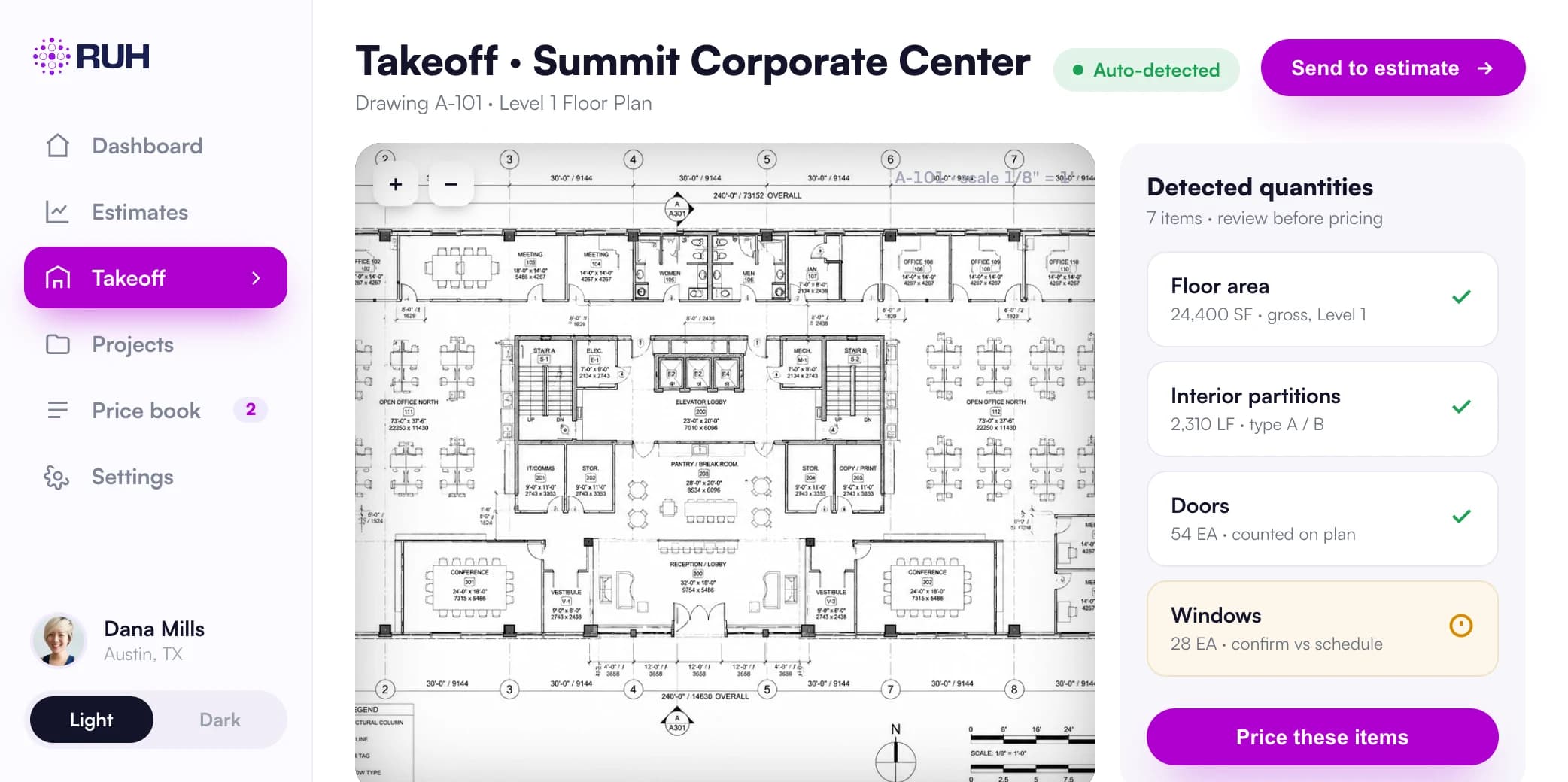
Ruh takes the boiler scope straight off the contractor's drawings: it reads the equipment schedule, counts the units with their ratings, picks up the venting and connection quantities, and prices everything on the contractor's own price book. The estimator reviews the draft, confirms the condensing vent material and the trade boundary on gas piping, and signs off.
See AI construction takeoff and estimating softwareBoiler: frequently asked questions
What does MBH mean on a boiler schedule?+
MBH stands for thousands of Btu per hour (the M is the Roman numeral for one thousand), so a 2,000 MBH boiler handles 2,000,000 Btu per hour. Schedules list both input MBH (fuel burned) and output MBH (heat delivered to the water), and the ratio between them is the boiler's efficiency. Always confirm which rating a capacity note refers to, because sizing or benchmarking on the wrong one skews the whole plant.
What is boiler horsepower (BHP)?+
Boiler horsepower is an older capacity unit still common on steam boilers and industrial work: 1 BHP equals 33,475 Btu per hour, the heat needed to evaporate 34.5 pounds of water per hour at 212 degrees F. A boiler delivering 1,900 MBH of output is about 57 BHP (1,900,000 / 33,475). Commercial hot water boiler schedules usually stick with MBH, but estimators still see BHP on plant retrofit and industrial bids.
Why do condensing boilers cost more to install than the equipment price suggests?+
Condensing boilers extract extra heat by cooling flue gases until water vapor condenses, and that condensate is acidic. The installation needs corrosion-resistant venting in stainless steel or polypropylene per the manufacturer's listing, a condensate neutralization kit ahead of the floor drain, and piping designed for low return water temperatures so the boiler actually condenses. Estimators who price the unit plus a length of standard flue miss those lines.
Still measuring by hand? Your next takeoff can run while you review this one.
See it on your plansRelated terms
Keep going: read the full guide or explore AI construction takeoff and estimating software.
See Ruh price a bid from your own drawings.
AI takeoff and estimating on your price book, your estimator signs off.
Figures on this page are illustrative. Construction estimates depend on project-specific conditions, source documents, market pricing, and professional judgment. Ruh's AI assists the estimator and does not replace professional review: your team reviews, validates, and approves every estimate, bid, and pricing decision.