100% money-backBook a walkthrough
Construction glossary · Sitework

What is final gradingin construction?

Final grading in construction, also called finish grading or fine grading, is the last earthwork pass that brings a surface to the exact design elevations and tolerances required just before paving, concrete flatwork, or landscaping. Where rough grading leaves the site within roughly a tenth of a foot of subgrade, final grading trims to the tighter tolerance the spec sets for each surface, often expressed in hundredths of a foot under pavement. It is a precision operation priced by area, usually square yards.

Free 30-minute walkthrough on your own drawings. No card.

Updated August 2026 · Reviewed by the Ruh construction team

Measured in square yardsTolerance hundredths of a footLives on civil grading planCost driver tolerance and mobilizations

How final grading area is measured

square feetdivide by 9square yards60,000 sf = 6,667 sy
The definition

Final grading, explained.

Final grading lives on the civil grading plan and the paving and flatwork details, with landscape grading carried on the landscape sheets, and the tolerance for each surface buried in the earthwork and paving spec sections. Scope ownership is where new estimators get burned: the sitework contractor typically final grades earth subgrade, but fine grading the aggregate base under asphalt or concrete is often claimed by, or left to, the paving contractor, and planting areas may belong to landscape. If two bids each assume the other trade has it, the fine grade gets bought twice or not at all, and scope letters at buyout exist to catch exactly this. The second miss is treating final grading as a rounding error. The step from a tenth to a few hundredths is the expensive part: it means a motor grader or trimmer with GPS or string line, a grade checker, and rehandling trimmed material, often across multiple mobilizations as the job phases. Price it as its own line, by surface type.

How it is measured

Final grading is measured by area in square yards or square feet, broken out by surface: subgrade under asphalt, under concrete flatwork, building pad, and landscape areas, because tolerance and production differ for each. Cost drivers are the specified tolerance, equipment (motor grader, trimmer, or skid steer with a grading attachment), the number of separate mobilizations as phases open up, and what happens to the trimmings. Quantities come off the civil grading plan and the paving limits; the tolerance language comes from the earthwork and base course spec sections. Many estimators carry final grading inside a paving or flatwork assembly, which is fine as long as someone confirms it is in there exactly once.

Worked example

A worked final grading example.

Worked example

Area60,000 / 9 = about 6,667 sy
Grader hours6,667 / 900 = roughly 7.4 hours, carried as 8 hours
Grader cost (illustrative)8 x $245 = $1,960; $1,960 / 6,667 = $0.294 per sy
Trimmings volume60,000 sf x 0.05 ft = 3,000 cf; 3,000 / 27 = about 111 cy
Trim cost (illustrative)8 x $245 = $1,960, about $0.29 per sy
How Ruh handles it

How Ruh handles final grading.

100%

Try Ruh on a real bid. 100% money-back guarantee if you are not satisfied.*

*Scoped delivery, terms apply. Read the guarantee terms

Start with a walkthrough

Final grading: frequently asked questions

Who is responsible for final grading on a commercial project?+

It splits by surface, which is why it gets missed. The sitework contractor usually final grades earth subgrade, the paving contractor often fine grades the aggregate base immediately ahead of asphalt or concrete, and the landscape contractor finish grades planting areas to receive topsoil. None of that is universal, so the scope letters and bid clarifications need to say explicitly who fine grades what, or the GC ends up paying for it twice.

How flat does final grading have to be?+

The spec section for each surface sets it, and it varies by use. Subgrade and base under paving are commonly held to tolerances expressed in hundredths of a foot, often described in the field as a half inch or better, while landscape areas might be acceptable at a tenth. Tighter tolerance means slower production and better equipment, so read the actual spec language before pricing rather than assuming one number sitewide.

Why is final grading priced separately from rough grading?+

Because the cost structure is different. Rough grading is a volume operation priced around moving dirt; final grading is a precision operation where the volume is tiny but the production rate is governed by tolerance, equipment, and grade checking. Final grading also tends to happen in multiple visits as phases become ready, and each remobilization costs money that a single blended grading rate will hide.

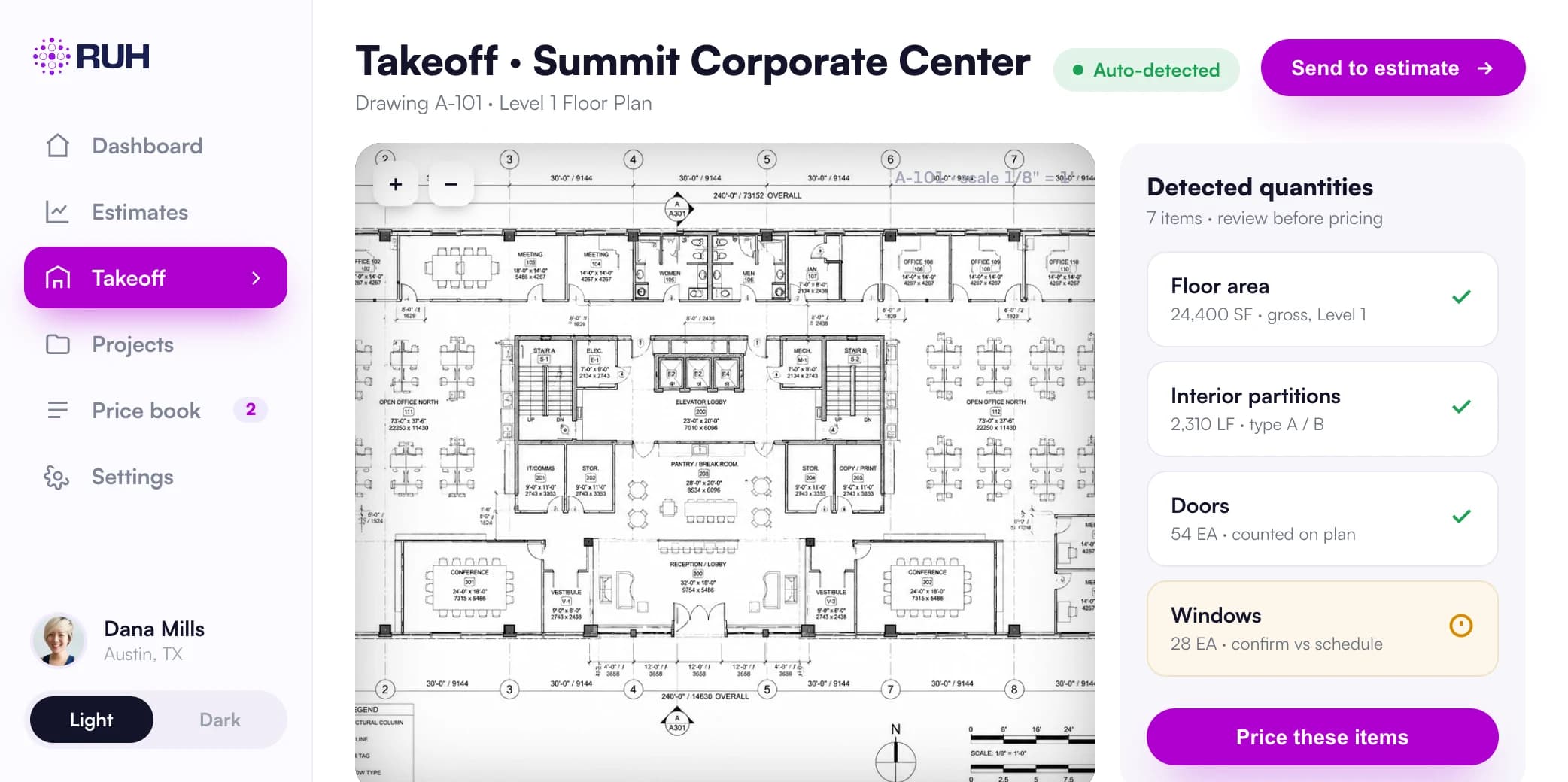
Still measuring by hand? Your next takeoff can run while you review this one.

See it on your plans

Related terms

Keep going: read the full guide or explore AI construction takeoff and estimating software.

The Sitework estimating cheat sheet
Every unit, waste factor, and conversion on one page. Free PDF.

Figures on this page are illustrative. Construction estimates depend on project-specific conditions, source documents, market pricing, and professional judgment. Ruh's AI assists the estimator and does not replace professional review: your team reviews, validates, and approves every estimate, bid, and pricing decision.
100% money-back guarantee

Try Ruh on a bid you are pricing now.

Put your next takeoff on Ruh.