Construction glossary · Sitework
What is aggregate base in construction?
Aggregate base in construction is a compacted layer of crushed stone placed under asphalt, concrete pavement, curbs, and sidewalks to spread wheel loads into the subgrade and provide a stable, drainable platform for paving. Estimators take it off as area times depth, carrying square yards (sy) for placement and cubic yards (cy) or tons for material. The pavement section detail calls out the stone class and a compaction requirement, commonly 95 percent of maximum density.
Updated June 2026 · Reviewed by the Ruh construction team
How aggregate base is measured in a pavement section
Estimating sitework scope this week? Watch Ruh take off a real plan in 30 minutes.
Book a walkthroughAggregate base is the structural stone layer of a paving assembly, sitting between the compacted subgrade and the asphalt or concrete surface. It lives on the civil C-sheets: the paving plan shows the limits of each pavement type, and the pavement section details show base depth for each section, with the geotech report recommending the thicknesses. The material is a dense-graded crushed stone whose name changes by state DOT (Class 2 in California, CA-6 in Illinois, ABC in the Carolinas), so estimators price what the local quarry actually sells. The sitework or grading contractor typically owns the scope, sometimes the paving sub. New estimators get three things wrong: they take off only the asphalt footprint and miss base under curb, sidewalk, and dumpster pads; they overlook the detail note extending base beyond the edge of pavement, often 12 inches; and they forget the difference between compacted volume in place and loose volume delivered, which can run 20 to 25 percent.
Aggregate base is measured as area times depth. Pull the area of each pavement section from the paving plan in sf, convert to sy (divide by 9) for the placement and fine grading lines, and compute cy (area times depth in ft, divided by 27) or tons for the material line. Standard duty and heavy duty sections carry different depths, so they are taken off separately. Cost drivers are depth, the specified stone class, haul distance from the quarry, and compaction effort, with proof rolling and density testing sometimes carried as their own lines. Watch the section detail for base extending past the pavement edge and for a geotextile separation layer beneath it.
Worked example
Try Ruh on a real bid. 100% money-back guarantee if you are not satisfied.*
*Scoped delivery, terms apply. Read the guarantee terms
How Ruh handles aggregate base
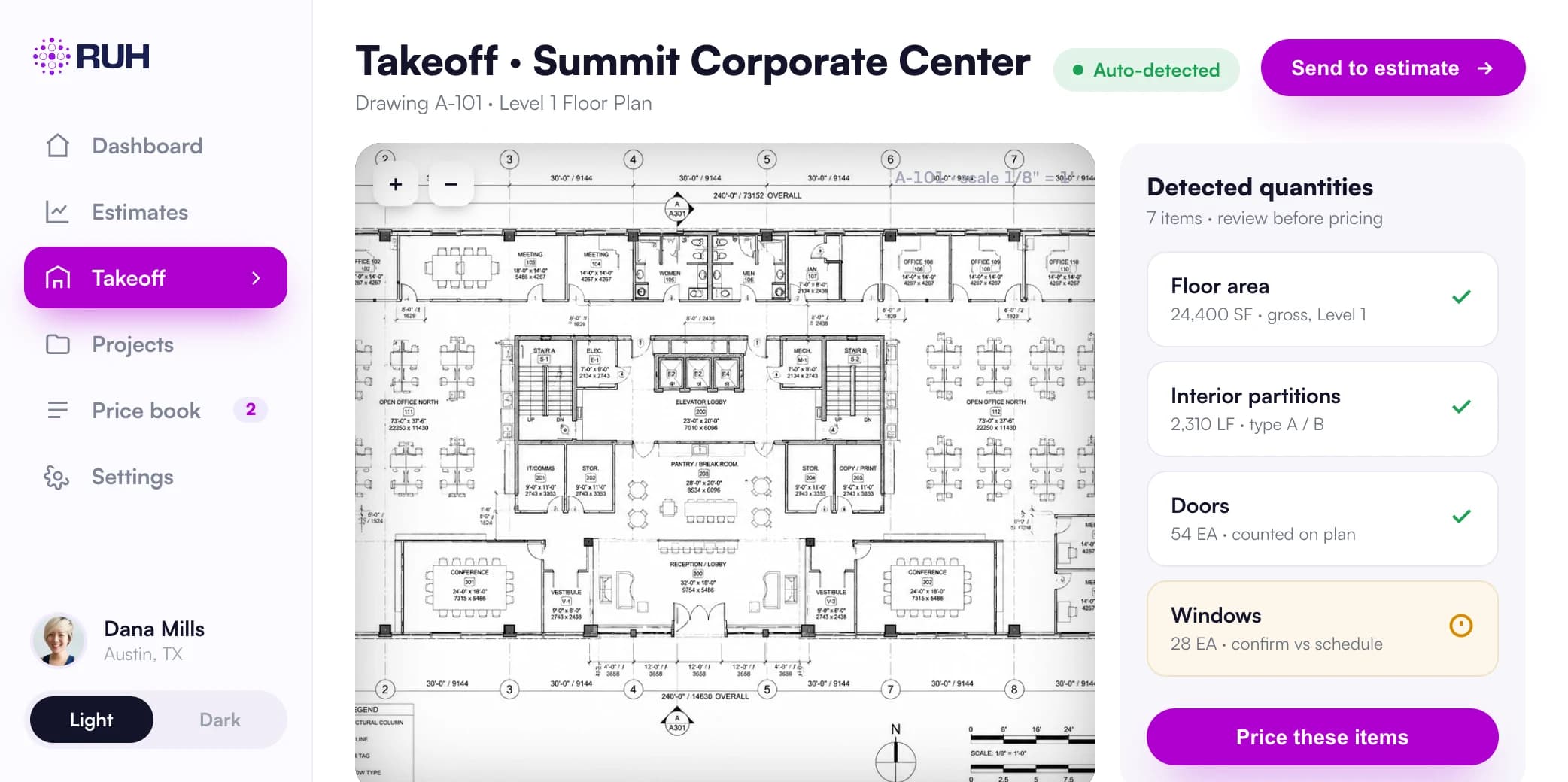
Ruh reads the civil sheets, separates each pavement section, and runs the base takeoff as area times depth in sy, cy, and tons, then prices the quantities against the contractor's own price book. The estimator reviews the section splits, the compaction factor, and the edge conditions, then signs off before the numbers reach the bid.
See AI construction takeoff and estimating softwareAggregate base: frequently asked questions
What is the difference between aggregate base and subbase?+
Base is the layer directly under the pavement surface and uses a tighter, higher quality crushed stone gradation. Subbase, when the section includes one, sits between the subgrade and the base and uses a cheaper, coarser material, since its job is bulk support and drainage rather than direct load transfer. Thicker roadway and heavy duty sections often carry both layers; light duty parking sections usually carry base only.
How many tons of aggregate base are in a cubic yard?+
Compacted dense-graded crushed stone is commonly estimated at roughly 1.9 to 2.0 tons per compacted cubic yard, but the real conversion depends on gradation, the rock source, and moisture content. Quarries quote their own conversion factor, so estimators who buy by the ton should use the supplier's number instead of a generic one. A few percent of slip on a thousand-ton order is real money.
Why is the delivered quantity higher than the takeoff volume?+
Three reasons. Loose stone compacts, so filling 741 cy of in-place volume takes more than 741 cy of delivered material, often 20 to 25 percent more. The section detail usually extends the base beyond the pavement edge, adding area the asphalt footprint does not show. And soft subgrade discovered during proof rolling gets undercut and replaced with extra stone, which is why many estimators carry an undercut allowance.
Still measuring by hand? Your next takeoff can run while you review this one.
See it on your plansSee Ruh price a bid from your own drawings.
AI takeoff and estimating on your price book, your estimator signs off.
Figures on this page are illustrative. Construction estimates depend on project-specific conditions, source documents, market pricing, and professional judgment. Ruh's AI assists the estimator and does not replace professional review: your team reviews, validates, and approves every estimate, bid, and pricing decision.