100% money-backBook a walkthrough
Construction glossary · Sitework

What is hydroseedingin construction?

Hydroseeding in construction is a planting method that sprays a slurry of seed, fertilizer, fiber mulch, water, and usually a tackifier onto prepared soil through a hose or tower-mounted cannon. It is used both to establish permanent turf and as temporary stabilization on disturbed areas for erosion control compliance. Estimators measure it in square feet or acres, and it is the low-cost alternative to sod, trading instant cover for a several-week establishment period.

Free 30-minute walkthrough on your own drawings. No card.

Updated June 2026 · Reviewed by the Ruh construction team

Measured in sf and acresAcre conversion 43,560 sfSlope rule 3:1 needs blanketsCost driver mix and mulch rate

How hydroseed cost splits against sod

Hydroseed $8,160Sod $64,600
The definition

Hydroseeding, explained.

Hydroseeding appears in two places in a commercial drawing set: the landscape sheets (L-series) for permanent turf and the civil erosion and sediment control plans for temporary stabilization, and the two scopes can overlap on the same dirt. A landscape or erosion control subcontractor performs the work, often the same outfit maintaining the SWPPP measures. The estimate lives or dies on the area takeoff and the mix spec: seed blend, fertilizer, and the mulch application rate (commonly specified in pounds per acre) move the per-acre material cost materially. New estimators trip in predictable ways. They take plan area on steep slopes when the sprayed surface area is larger than the plan footprint, they double count areas the landscape plan assigns to sod or planting beds, and they ignore the watering and establishment period that the spec keeps on the contractor until coverage is accepted. Temporary hydroseed that gets disturbed by a later phase and resprayed is a real cost; phasing matters, and a respray allowance is often the honest carry.

How it is measured

Hydroseeding is measured in square feet for small or scattered areas and acres for large ones, with 43,560 sf per acre. The quantity is the disturbed area to be stabilized minus building, pavement, sod, and planting bed footprints, which is why estimators often derive it by subtracting hardscape from the limits of disturbance. On slopes steeper than about 3:1, true surface area exceeds plan area, and the spec may call for a heavier mulch rate or swap in erosion control blankets instead. Cost drivers: mix design and mulch rate, water source on remote sites, access (hose work is slower than spraying from the truck), and whether the spec requires a second application or a guarantee of established coverage.

Worked example

A worked hydroseeding example.

Worked example

Area to acres68,000 / 43,560 is about 1.56 acres
Hydroseed (illustrative)68,000 sf x $0.12 = $8,160
Sod comparison (illustrative)68,000 sf x $0.95 = $64,600
First-cost difference$64,600 - $8,160 = $56,440
How Ruh handles it

How Ruh handles hydroseeding.

100%

Try Ruh on a real bid. 100% money-back guarantee if you are not satisfied.*

*Scoped delivery, terms apply. Read the guarantee terms

Start with a walkthrough

Hydroseeding: frequently asked questions

Is hydroseeding cheaper than sod?+

On first cost, substantially: hydroseed typically prices at cents per square foot while installed sod runs many times that. The tradeoff is time and risk. Sod is finished grass the day it is laid; hydroseed needs watering and several weeks of growth, and a hard rain before establishment can wash seed and mulch into the silt fence. Specs often dictate which areas get which treatment, so check the landscape plan before assuming the cheaper line.

How is hydroseeding measured for a takeoff?+

By area: square feet on smaller scopes, acres on large ones, at 43,560 sf per acre. The cleanest method is to start with the disturbed area or limits of disturbance and subtract buildings, pavement, sod, and planting beds. On slopes steeper than roughly 3:1, account for true surface area exceeding plan area, and check whether the erosion control plan swaps hydroseed for blankets or heavier mulch rates on those faces.

Does hydroseeding satisfy SWPPP stabilization requirements?+

It is one of the standard temporary and permanent stabilization methods on erosion control plans, and inspectors generally accept it once uniform coverage establishes. Construction general permits typically require stabilization to begin within a set number of days after grading stops in an area, so phasing drives when and how often you spray. Areas regraded later must be stabilized again, which is why experienced estimators carry a respray allowance.

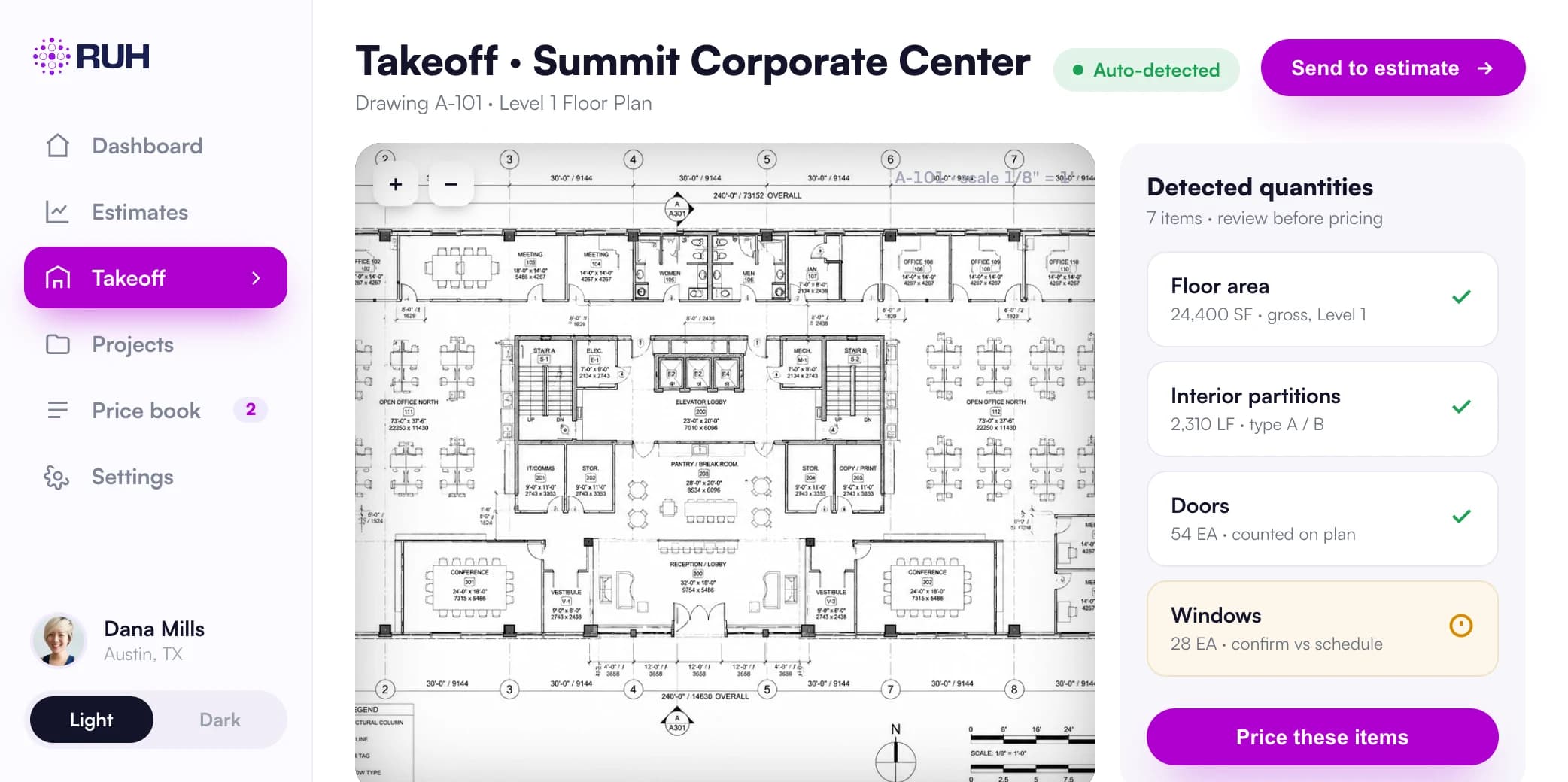
Still measuring by hand? Your next takeoff can run while you review this one.

See it on your plans

Related terms

Keep going: read the full guide or explore AI construction takeoff and estimating software.

The Sitework estimating cheat sheet
Every unit, waste factor, and conversion on one page. Free PDF.

Figures on this page are illustrative. Construction estimates depend on project-specific conditions, source documents, market pricing, and professional judgment. Ruh's AI assists the estimator and does not replace professional review: your team reviews, validates, and approves every estimate, bid, and pricing decision.
100% money-back guarantee

Try Ruh on a bid you are pricing now.

Put your next takeoff on Ruh.