
Construction glossary · MEP
What is MC cable in construction?
MC cable (metal clad cable) is a factory assembled wiring product with insulated conductors and a grounding conductor inside a flexible interlocking metal armor, used to wire branch circuits without installing conduit and pulling wire separately. Estimators measure it in linear feet (lf) by conductor configuration, such as 12/2 or 12/3. Choosing MC over conduit and wire is a means and methods decision that can swing branch wiring labor significantly, so estimators often price both where the spec allows a choice.
Updated June 2026 · Reviewed by the Ruh construction team
MC cable section
Estimating mep scope this week? Watch Ruh take off a real plan in 30 minutes.
Book a walkthroughMC cable is the electrical contractor's main labor saving alternative to pipe and wire for branch circuits. On the drawings it barely appears: power plans show devices and circuiting, and the Division 26 specification says where MC is permitted, commonly concealed dry locations and fixture whips, and where it is not, often homeruns, exposed work, or exterior runs. The electrical subcontractor owns the choice wherever the spec leaves it open, which makes MC versus EMT with wire a classic means and methods cost decision rather than a drawing question. New estimators get three things wrong. They assume MC everywhere and get busted when the spec restricts it. They scale circuit lengths point to point on the plan and forget that cable routes up walls, across structure, and down to devices, so real footage runs well past plan footage. And they forget the hardware that rides along: an MC connector at every box entry, supports at the intervals NEC Article 330 requires, and anti short bushings at terminations. A clean MC takeoff lists lf by configuration plus connectors as ea, with the spec language noted next to the quantity.
MC cable is measured in linear feet (lf), broken out by conductor count and size: 12/2 and 12/3 for most 20 A branch circuits, 10/2 and 10/3 for larger loads, with copper content driving material price. Lengths come from the power plan circuiting, measured device to device and back to the panel, then grossed up for vertical drops, routing around structure, and slack at terminations, commonly 10 to 15 percent. Connectors are counted each, two per box-to-box segment in effect, and supports ride in the labor unit. Plenum and health care variants, such as hospital grade MC with redundant grounding, carry their own line items. The comparison that matters is installed cost per lf against conduit and wire for the same circuit.
Worked example
The power plans show 1,800 lf of 20 A receptacle branch circuits. Add 10 percent for drops down walls and slack at boxes: 1,800 x 1.10 = 1,980 lf. Option A, 12/2 MC at an illustrative installed cost of $4.20 per lf (cable, connectors, supports, and labor): 1,980 x $4.20 = $8,316. Option B, 1/2 in EMT with three 12 AWG THHN conductors at an illustrative installed $7.10 per lf: 1,980 x $7.10 = $14,058. MC saves $14,058 - $8,316 = $5,742, about 41 percent, and nearly all of it is labor, because bending and strapping pipe and then pulling wire takes a crew far longer than routing cable through the same space. Before carrying the lower number, the estimator confirms the spec permits MC for concealed branch work and prices the homeruns, which are often required to be in conduit, as a separate line.
Try Ruh on a real bid. 100% money-back guarantee if you are not satisfied.*
*Scoped delivery, terms apply. Read the guarantee terms
How Ruh handles MC cable
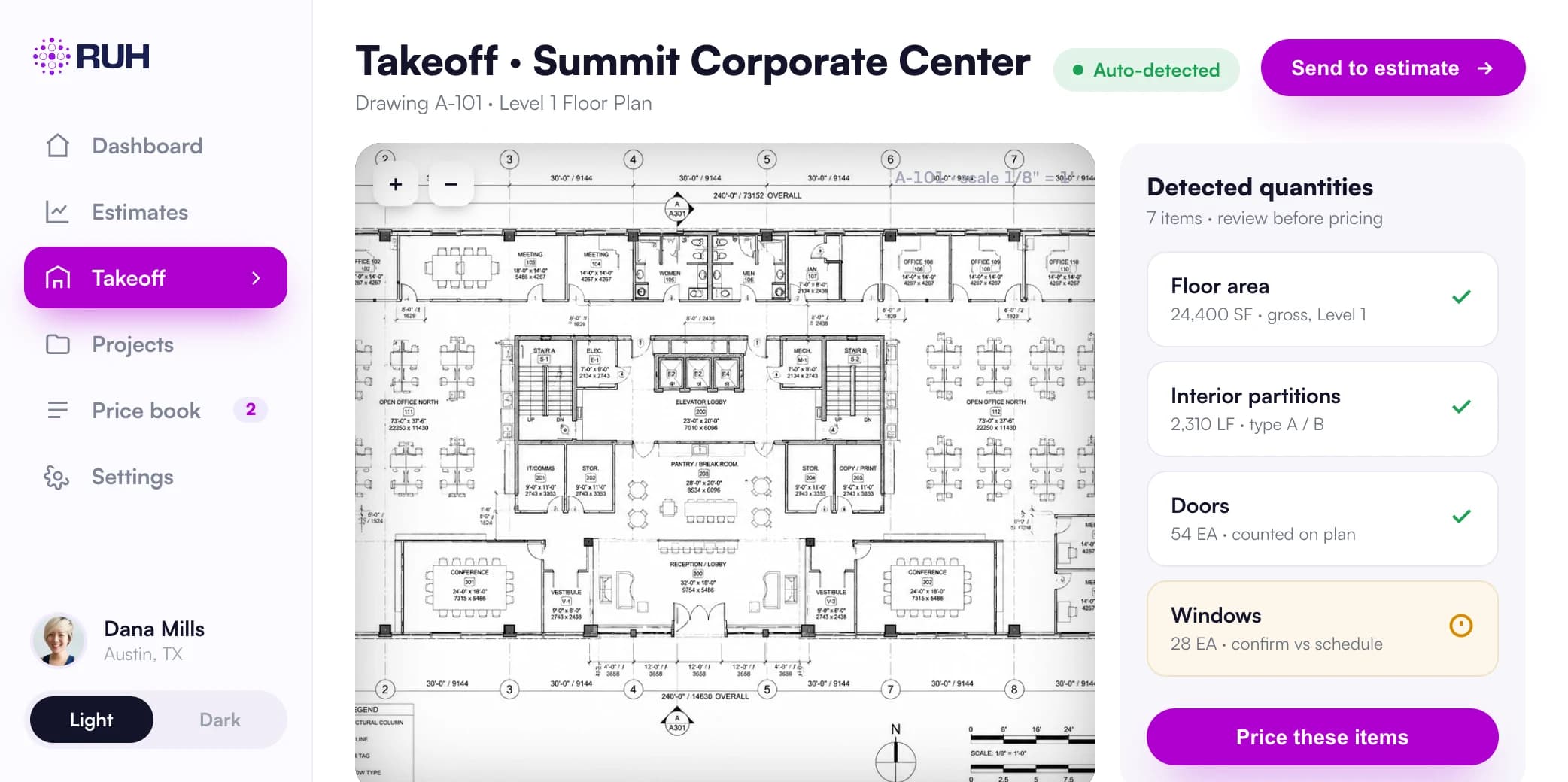
Ruh takes off the branch circuiting from the contractor's power plans, measures the lf by cable configuration, and extends it against the contractor's own price book, so the MC versus conduit comparison reflects their real labor units instead of database averages. The estimator reviews the routing and spec assumptions, makes the means and methods call, and signs off on the final quantities.
See AI construction takeoff and estimating softwareMC cable: frequently asked questions
Is MC cable cheaper than conduit and wire?+
Usually yes on installed cost for branch circuits, because the labor to route and support cable is much lower than bending conduit and pulling conductors, even though MC material can cost more per foot than EMT plus wire. The advantage shrinks on short runs with few bends and disappears where the spec requires conduit anyway. Price both options on long repetitive branch work; the spread is often the difference between winning and losing the electrical bid.
What is the difference between MC cable and BX (AC cable)?+
Both are armored cables, but standard MC cable carries a full size insulated equipment grounding conductor inside the armor, while AC cable (often called BX) uses its armor with an internal bonding strip as the grounding path. The NEC covers them under separate articles (330 for MC, 320 for AC) with different permitted uses. Commercial specs commonly accept MC and reject AC, so read the spec before treating them as interchangeable.
Where is MC cable not allowed?+
The NEC permits MC in most locations, but project specifications routinely restrict it further: many commercial specs limit MC to concealed branch circuits in dry locations and require conduit for homeruns, exposed work, exterior or wet locations, and anywhere subject to physical damage. Standard MC is also not rated for wet locations or direct burial unless specifically listed for it. The spec section, not just the code, decides what you can carry in the bid.
Still measuring by hand? Your next takeoff can run while you review this one.
See it on your plansRelated terms
Keep going: read the full guide or explore AI construction takeoff and estimating software.
See Ruh price a bid from your own drawings.
AI takeoff and estimating on your price book, your estimator signs off.
Figures on this page are illustrative. Construction estimates depend on project-specific conditions, source documents, market pricing, and professional judgment. Ruh's AI assists the estimator and does not replace professional review: your team reviews, validates, and approves every estimate, bid, and pricing decision.