
100% money-backBook a walkthrough

Construction glossary · MEP

What is EMT conduit in construction?

EMT conduit (electrical metallic tubing) is thin wall steel tubing used to route and protect wiring in interior commercial construction, joined with set screw or compression fittings instead of threads. It is the workhorse raceway of US commercial interiors because it is light, fast to bend, and far cheaper to install than rigid conduit. Estimators measure EMT in linear feet by trade size, with the size driven by how many conductors the run must carry.

Updated June 2026 · Reviewed by the Ruh construction team

EMT = electrical metallic tubingThin-wall no threadsMeasured in LF by trade size

How EMT conduit is supported

10 ft max o.c.conduit runcompression/set-screw fittings

Estimating mep scope this week? Watch Ruh take off a real plan in 30 minutes.

Book a walkthrough
Definition

EMT (electrical metallic tubing) is the thin wall member of the conduit family and the default raceway for interior commercial work in the US. Where rigid metal conduit is heavy schedule pipe with threaded joints, EMT is light galvanized steel tubing joined with set screw or compression fittings, so an electrician bends it with a hand bender in the smaller trade sizes and installs far more feet per day. The drawings rarely label it run by run; instead a general note or the Division 26 raceway spec says branch wiring shall be in EMT unless noted otherwise, and the takeoff follows that note. The electrical subcontractor owns the scope. New estimators get burned two ways: pricing EMT labor where the spec actually demands rigid or IMC (exposed mechanical areas, exterior runs, locations subject to damage), and ignoring the fitting spec, because the compression fittings required in damp locations cost noticeably more than set screw fittings, and the count runs one coupling per 10 ft stick plus two connectors per terminated run.

How it is measured

EMT is measured in linear feet (lf) by trade size, 1/2 in through 4 in, sold in 10 ft sticks. The lf drives everything else: couplings at one per stick, connectors at two per terminated run, straps and hangers at the code support spacing. Conductor fill drives the size, so the estimator needs the circuit consolidation logic before the size mix is real. Labor per lf climbs with trade size, installation height, and congestion above ceilings, and it jumps where the fitting spec changes from set screw to compression. Branch footage comes off the power and lighting plans as inferred routes; anything explicitly sized lives in the feeder schedule and one-line diagram.

Worked example

Worked example

A consolidated homerun carries 11 #12 THHN conductors back to the panel in one raceway. Per the NEC Chapter 9 tables, #12 THHN has a cross section of 0.0133 sq in, so the bundle needs 11 x 0.0133 = 0.1463 sq in of fill. The 40 percent fill limit for 1/2 in EMT is about 0.122 sq in, so 1/2 in fails (0.1463 is greater than 0.122). The limit for 3/4 in EMT is about 0.213 sq in, so 3/4 in passes, which matches the published wire fill tables (9 #12 THHN maximum in 1/2 in, 16 in 3/4 in). On a 120 lf run, the upsize is cheap insurance: at illustrative material prices of $0.95 per lf for 1/2 in and $1.45 per lf for 3/4 in, the delta is 120 x $0.50 = $60. Estimators who default every run to 1/2 in get caught here twice, on material and on the change order.

100%

Try Ruh on a real bid. 100% money-back guarantee if you are not satisfied.*

*Scoped delivery, terms apply. Read the guarantee terms

Start with a walkthrough
How Ruh handles it

How Ruh handles EMT conduit

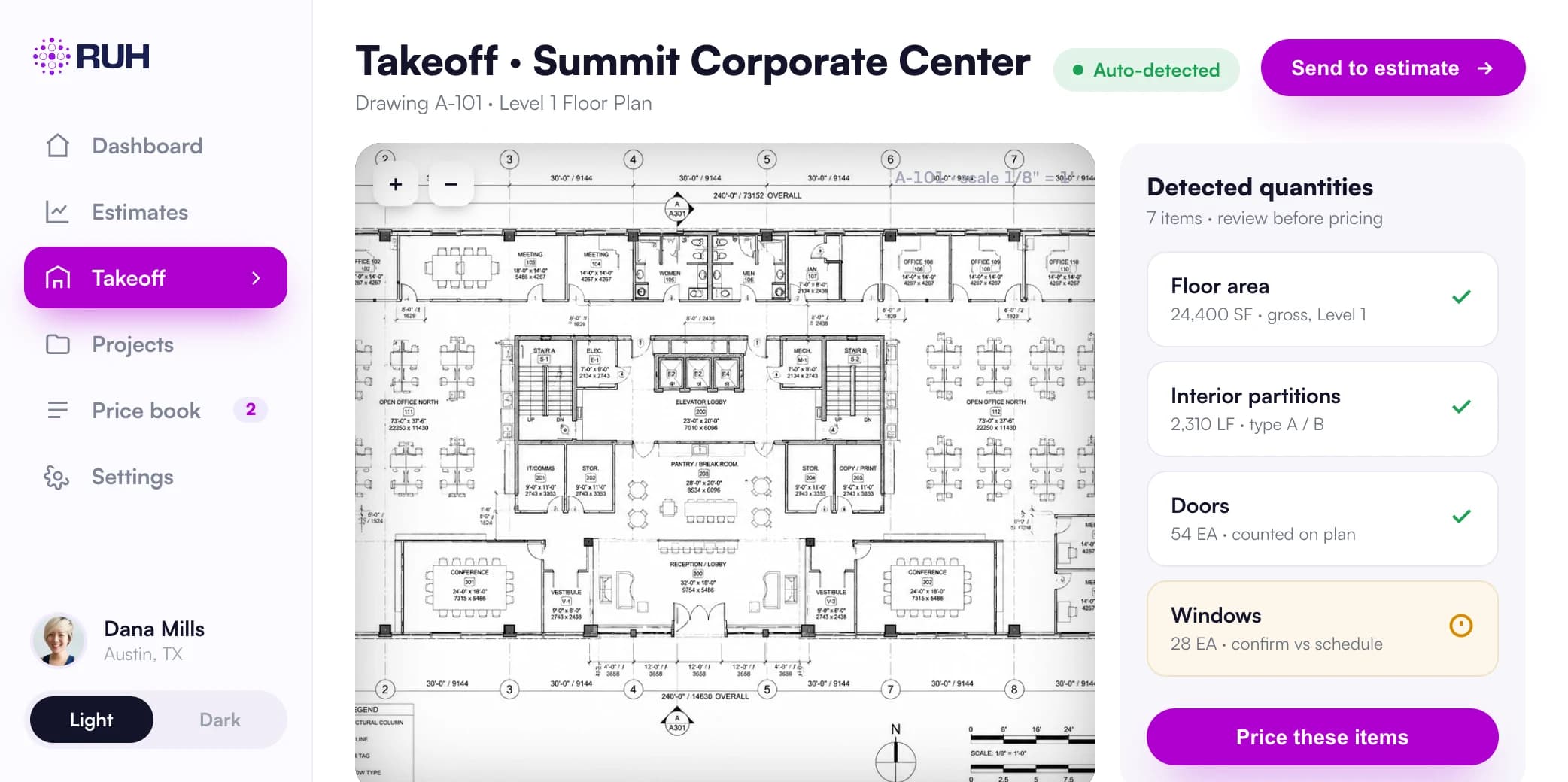
When the drawings call for EMT, Ruh performs the takeoff straight from the plan set, returning lf by trade size with connectors and supports counted off the footage. Pricing runs against the contractor's own price book rather than a generic database, and the estimator reviews the size calls and signs off on the final quantities.

See AI construction takeoff and estimating software

EMT conduit: frequently asked questions

What does EMT stand for in electrical work?+

EMT stands for electrical metallic tubing, a thin wall galvanized steel raceway joined with set screw or compression fittings rather than threads. It is the most common conduit type in US commercial interiors because it is light, bends with a hand bender in the smaller trade sizes, and installs much faster than rigid metal conduit. Trade sizes run from 1/2 in up to 4 in, sold in 10 ft lengths.

Where can EMT conduit not be used?+

EMT is not permitted where it would be subject to severe physical damage, and project specs commonly restrict it further, calling for rigid metal conduit on exposed runs in mechanical areas or below a stated height, and PVC or rigid for underground work. Damp and wet locations change the fitting requirement to compression or raintight types. Always read the Division 26 raceway spec before assigning every foot to EMT pricing.

What is the difference between EMT and rigid conduit?+

Wall thickness, joining method, and labor. Rigid metal conduit (RMC) is heavy wall pipe with threaded couplings that protects conductors in the harshest locations, while EMT is thin wall tubing with set screw or compression fittings. EMT costs less per foot in both material and labor, which is why estimators must catch every spec location where the heavier product is required; pricing RMC footage at EMT rates is a classic bust.

Still measuring by hand? Your next takeoff can run while you review this one.

See it on your plans

Related terms

Keep going: read the full guide or explore AI construction takeoff and estimating software.

The MEP estimating cheat sheet
Every unit, waste factor, and conversion on one page. Free PDF.

See Ruh price a bid from your own drawings.

AI takeoff and estimating on your price book, your estimator signs off.

Figures on this page are illustrative. Construction estimates depend on project-specific conditions, source documents, market pricing, and professional judgment. Ruh's AI assists the estimator and does not replace professional review: your team reviews, validates, and approves every estimate, bid, and pricing decision.