100% money-backBook a walkthrough

Construction glossary · MEP

What is lighting fixture in construction?

A lighting fixture in construction is a complete lighting unit, the housing, LED array or lamp, driver, and lens, installed and counted as one item. The formal term on specifications and schedules is luminaire, but field and estimating usage says fixture. Fixtures are counted each by type tag (Type A, Type B, and so on) from the fixture schedule and the lighting plans, and each type carries its own unit cost.

Updated June 2026 · Reviewed by the Ruh construction team

Counted by fixture type tagSource lighting plan / RCPPriced $/EA installed

How lighting fixtures are counted

+ 48 more60 EALight fixture (type A)lighting plan / RCP

Estimating mep scope this week? Watch Ruh take off a real plan in 30 minutes.

Book a walkthrough
Definition

Lighting fixtures live in two places in a commercial set: the fixture schedule (often titled luminaire schedule) on the electrical sheets, which defines each type tag with its basis-of-design manufacturer, catalog number, source, voltage, mounting, and finish, and the lighting plans and RCP, which show where every fixture goes. The electrical subcontractor owns furnishing and installing them, though on many jobs the fixtures are bought as a package through a lighting rep, and on tenant work some are owner furnished. The type tag is the unit of pricing. A Type A lay-in troffer and a Type F decorative pendant can differ in cost by a factor of twenty, which is why blended per-fixture pricing is the classic new estimator mistake. The other traps: missing the emergency variants (a Type A-EM with a battery driver costs more than a base Type A and is easy to lump in with it), missing the controls scope (sensors, dimming drivers) that travels with the fixture package, and trusting a quantity column printed on the schedule instead of counting the plans.

How it is measured

Fixtures are counted each (ea) by type tag, one line per type, taken off the lighting plans or RCP and reconciled against the fixture schedule. Unit cost has two halves. Material is driven by the catalog number on the schedule: source and lumen package, driver type (0-10V dimming costs more than switched), emergency battery options, and finish. Labor is driven by mounting and access: a troffer laid into an accessible grid hangs fast, a recessed downlight in a hard lid is slower, and a pendant at 18 ft over a lobby floor needs a lift and two electricians. Fixture whips, occupancy sensors, and wall controls are usually carried as their own count lines next to the fixtures rather than buried in the fixture unit cost.

Worked example

Worked example

A small office build-out has three fixture types on the schedule. Type A, 2x4 LED troffer in lay-in grid: 120 ea. Type B, 6 in recessed LED downlight in hard lid: 36 ea. Type C, 4 ft suspended linear: 22 ea. Illustrative material costs: $95, $80, and $260. Illustrative labor at a $78 per hour loaded rate: 0.75 hr, 1.0 hr, and 1.5 hr each. Type A: 120 x ($95 + 0.75 x $78) = 120 x $153.50 = $18,420. Type B: 36 x ($80 + $78) = 36 x $158 = $5,688. Type C: 22 x ($260 + $117) = 22 x $377 = $8,294. Subtotal: $32,402. The schedule also flags 8 of the Type A as A-EM with battery drivers at an illustrative $90 material adder: 8 x $90 = $720, for $33,122 total. Notice the EM line: it hides inside a type you already counted, and forgetting it costs real money.

100%

Try Ruh on a real bid. 100% money-back guarantee if you are not satisfied.*

*Scoped delivery, terms apply. Read the guarantee terms

Start with a walkthrough
How Ruh handles it

How Ruh handles lighting fixture

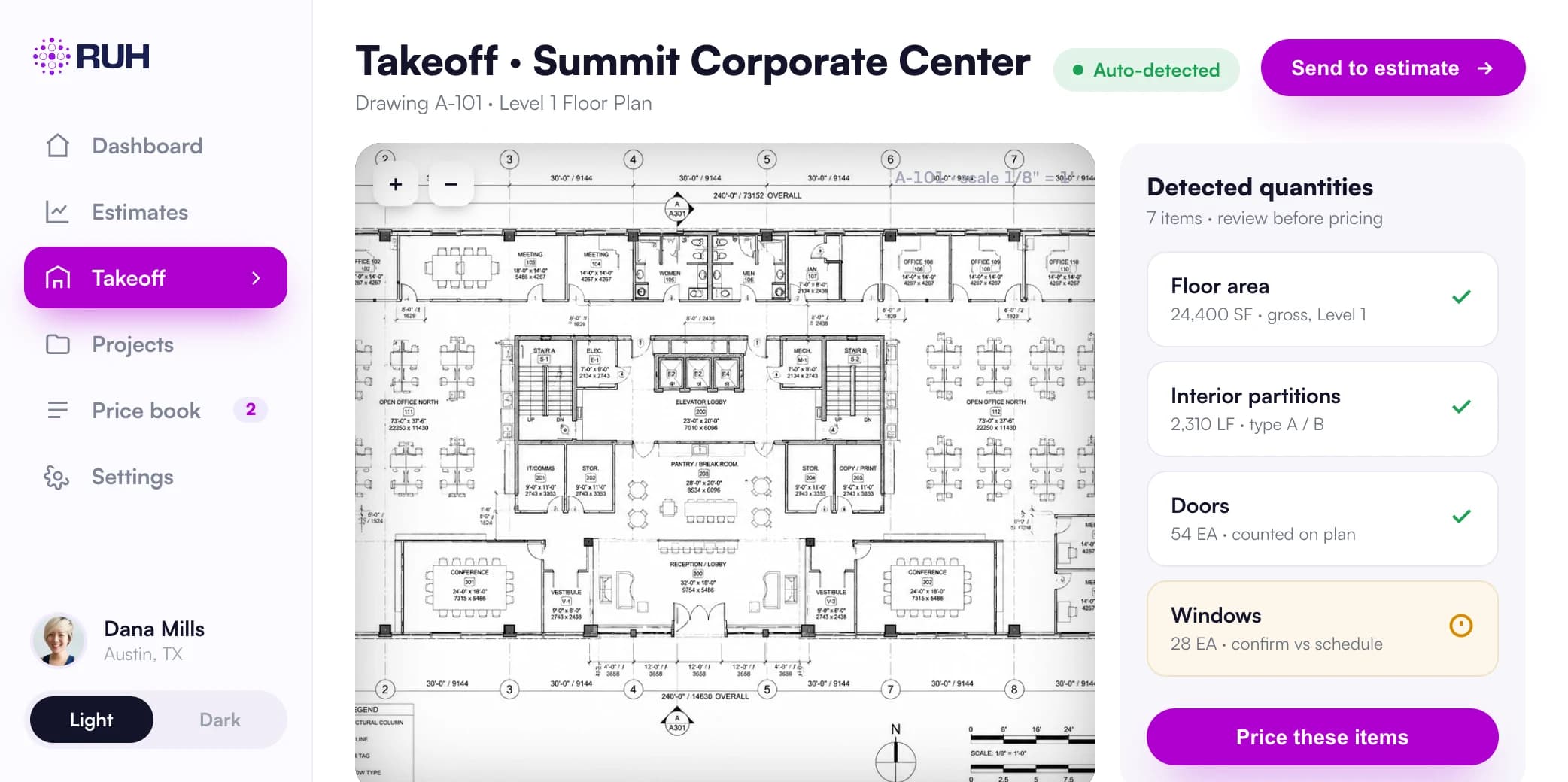
Ruh pulls the type tags from the fixture schedule, counts every fixture on the lighting plans by type, and prices each type line against the contractor's own price book. The estimator receives a draft with counts broken out per type, including the EM variants, reviews it against the schedule, and signs off.

See AI construction takeoff and estimating software

Lighting fixture: frequently asked questions

What is the difference between a lighting fixture and a luminaire?+

They are the same thing. Luminaire is the formal term used in specifications, photometric data, and most fixture schedules (you will see luminaire schedule on the electrical sheets), while fixture is the everyday word in the field and in estimating. When a spec section references luminaires and the plans say fixtures, no scope difference is intended; the type tags tie the two together.

How are lighting fixtures counted in a takeoff?+

Each, by type tag. The estimator counts every Type A on the plans, then every Type B, and so on, keeping one line per type because each type has its own material and labor cost. Counts come off the lighting plans or the RCP, never both added together, and any quantity column printed on the fixture schedule gets treated as a cross-check, not a takeoff; the plans govern.

What makes one lighting fixture cost more to install than another?+

Mounting and access drive the labor side: lay-in grid is fastest, recessed cans in hard lid are slower, and anything suspended at height needs lifts and more crew time. On the material side, the driver and controls matter as much as the housing; dimming drivers, integral sensors, and emergency battery packs all add cost. Ceiling height alone can change labor noticeably, which is why the RCP belongs next to the lighting plan during takeoff.

Still measuring by hand? Your next takeoff can run while you review this one.

See it on your plans

Related terms

Keep going: read the full guide or explore AI construction takeoff and estimating software.

The MEP estimating cheat sheet
Every unit, waste factor, and conversion on one page. Free PDF.

See Ruh price a bid from your own drawings.

AI takeoff and estimating on your price book, your estimator signs off.

Figures on this page are illustrative. Construction estimates depend on project-specific conditions, source documents, market pricing, and professional judgment. Ruh's AI assists the estimator and does not replace professional review: your team reviews, validates, and approves every estimate, bid, and pricing decision.