
100% money-backBook a walkthrough

Construction glossary · MEP

What is GFCI in construction?

A GFCI, or ground fault circuit interrupter, is an electrical protective device that compares the current leaving on the hot conductor with the current returning on the neutral and shuts the circuit off when they differ, meaning current is leaking to ground, possibly through a person. The National Electrical Code requires GFCI protection in locations such as bathrooms, kitchens, outdoors, and near sinks. In a takeoff, GFCI receptacles are counted each and carry a price premium over standard receptacles.

Updated June 2026 · Reviewed by the Ruh construction team

GFCI = ground-fault circuit interrupterTrips at ~5 mA leakageRequired at wet locations

How GFCI devices are counted

12 EAGFCI receptaclepower plan

Estimating mep scope this week? Watch Ruh take off a real plan in 30 minutes.

Book a walkthrough
Definition

GFCI protection shows up on the power plans as receptacle symbols tagged GFI or GFCI, with WP or WR added for exterior and wet locations, and in the panel schedules when the designer chooses GFCI breakers instead of devices. The electrical subcontractor owns the scope. The NEC drives where the tags appear: bathrooms, kitchen countertop receptacles, receptacles within 6 ft of a sink, outdoor receptacles, and a list of other damp and wet locations that has grown with each code cycle, so the adopted edition matters. Two things trip up new estimators. First, the price delta: a GFCI receptacle costs several times a standard spec-grade duplex, and pricing the whole receptacle count at one blended rate eats that delta on every device. Second, protection method: one GFCI receptacle wired feed-through can protect standard receptacles downstream on the same circuit, and a GFCI breaker protects the entire circuit from the panel, so the count of GFCI devices is not the same as the count of protected outlets. Take off what the drawings actually show, and ask when they are silent.

How it is measured

GFCI receptacles are counted each (ea) off the power plans, kept on their own line separate from standard duplex receptacles because the device cost differs. What drives the unit cost: device grade and type (a weather-resistant GFCI for exterior use costs more than an interior one, and exterior locations also need an in-use cover), tamper-resistant requirements, and whether protection comes from the receptacle or from a GFCI breaker in the panelboard, which is priced per circuit instead of per outlet. Labor per device runs close to a standard receptacle, slightly longer for the line and load side terminations and the test after energizing. The takeoff line lands in the estimate next to the receptacle counts, inside the branch devices section of the electrical scope.

Worked example

Worked example

A retail tenant improvement shows 84 receptacles. The power plan tags 16 of them GFCI: 10 interior (break room counter, restrooms, mop sink wall, all within 6 ft of a sink) and 6 exterior under WP in-use covers. Price the delta against a standard duplex at an illustrative $4 device cost. Interior GFCI device at $22: the material delta is $22 - $4 = $18, plus an extra 0.05 hr of labor at $78 per hour = $3.90, so $21.90 per device, and 10 x $21.90 = $219.00. Exterior weather-resistant GFCI at $28 plus a $15 in-use cover: ($28 - $4) + $15 + $3.90 = $42.90, and 6 x $42.90 = $257.40. Total premium: $219.00 + $257.40 = $476.40 over pricing all 84 as standard duplexes. A small number, but miss it on every job and the electrical bids run consistently thin on exactly the devices the inspector checks first.

100%

Try Ruh on a real bid. 100% money-back guarantee if you are not satisfied.*

*Scoped delivery, terms apply. Read the guarantee terms

Start with a walkthrough
How Ruh handles it

How Ruh handles GFCI

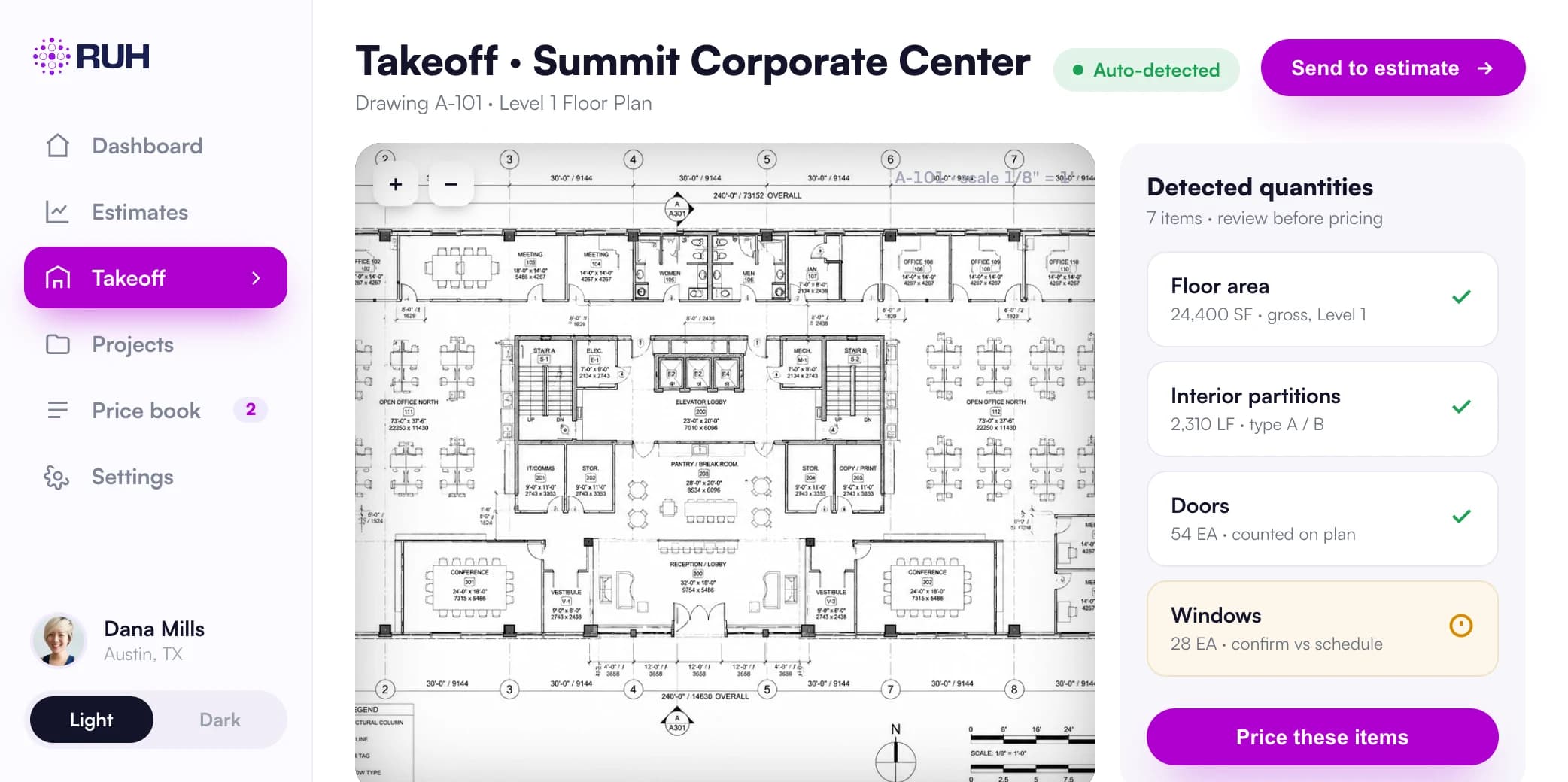
When Ruh performs the electrical takeoff, it reads the power plans and keeps GFCI receptacles on their own count line, separate from standard duplexes and with the exterior weather-resistant variants broken out. Each line is priced from the contractor's own price book, and the estimator reviews the counts and device pricing before signing off on the bid.

See AI construction takeoff and estimating software

GFCI: frequently asked questions

Where does the NEC require GFCI protection?+

The familiar commercial locations are bathrooms, kitchen and countertop receptacles, receptacles within 6 ft of a sink, outdoor receptacles, and rooftops; dwelling units add garages, unfinished basements, and more. The list has expanded over successive code editions, so the answer depends on which NEC edition the jurisdiction has adopted. For takeoff purposes, count what the drawings tag, and flag an obvious miss (an untagged receptacle beside a sink) with an RFI.

Should I price a GFCI receptacle or a GFCI breaker?+

Price what the documents show. A GFCI receptacle protects itself plus any standard receptacles wired downstream on its load side; a GFCI breaker protects the whole circuit from the panelboard and costs noticeably more than a standard breaker, but only one is needed per circuit. Designers choose breakers where the receptacle would be hard to reach for resetting. When the plans and the panel schedules conflict, ask before bidding.

What is the difference between GFCI and AFCI?+

A GFCI protects people from shock by detecting current leaking to ground; under UL 943, Class A devices trip when the leak reaches the 4 to 6 milliamp range. An AFCI protects against fire by detecting the signature of arcing faults in wiring. They solve different problems, and some locations call for both, which is why dual-function breakers exist. In commercial takeoff, GFCI appears far more often, with AFCI concentrated in residential occupancies.

Still measuring by hand? Your next takeoff can run while you review this one.

See it on your plans

Related terms

Keep going: read the full guide or explore AI construction takeoff and estimating software.

The MEP estimating cheat sheet
Every unit, waste factor, and conversion on one page. Free PDF.

See Ruh price a bid from your own drawings.

AI takeoff and estimating on your price book, your estimator signs off.

Figures on this page are illustrative. Construction estimates depend on project-specific conditions, source documents, market pricing, and professional judgment. Ruh's AI assists the estimator and does not replace professional review: your team reviews, validates, and approves every estimate, bid, and pricing decision.