
Construction glossary · MEP
What is low voltage in construction?
Low voltage in construction refers to the cabling, devices, and head end equipment for systems that do not run on line voltage power: data networks, security and access control, audiovisual, building controls, and fire alarm. It is usually a separate scope from the electrical contract, carried by one or more specialty subcontractors, and estimators count it in drops and devices (ea) plus linear feet of cable. On the drawings it lives on technology, security, and fire alarm sheets rather than the power plans.
Updated June 2026 · Reviewed by the Ruh construction team
Where low voltage sits on the scale
Estimating mep scope this week? Watch Ruh take off a real plan in 30 minutes.
Book a walkthroughLow voltage covers the systems specified in Division 27 (communications) and Division 28 (electronic safety and security), plus Division 25 controls on many jobs: structured cabling, wireless access points, cameras, card readers, intrusion, AV, paging, and fire alarm. Ownership is the first thing to pin down, because the scope often splits across several subs: a structured cabling vendor, a security integrator, a fire alarm contractor tied to the specified manufacturer, and a controls contractor. The classic gap in commercial bids is the pathway split: the electrical sub typically provides conduit sleeves, back boxes with mud rings, J hooks or cable tray, and pull strings, while the low voltage sub pulls and terminates cable. If neither bid clearly carries the pathways, the GC eats the gap at buyout. New estimators also miss that fire alarm usually requires manufacturer specific design and licensed, often NICET certified, technicians, so it cannot be priced like generic cabling. A clean low voltage takeoff lists drops by type, devices by type, head end equipment per room, and the lf of cable behind all of it.
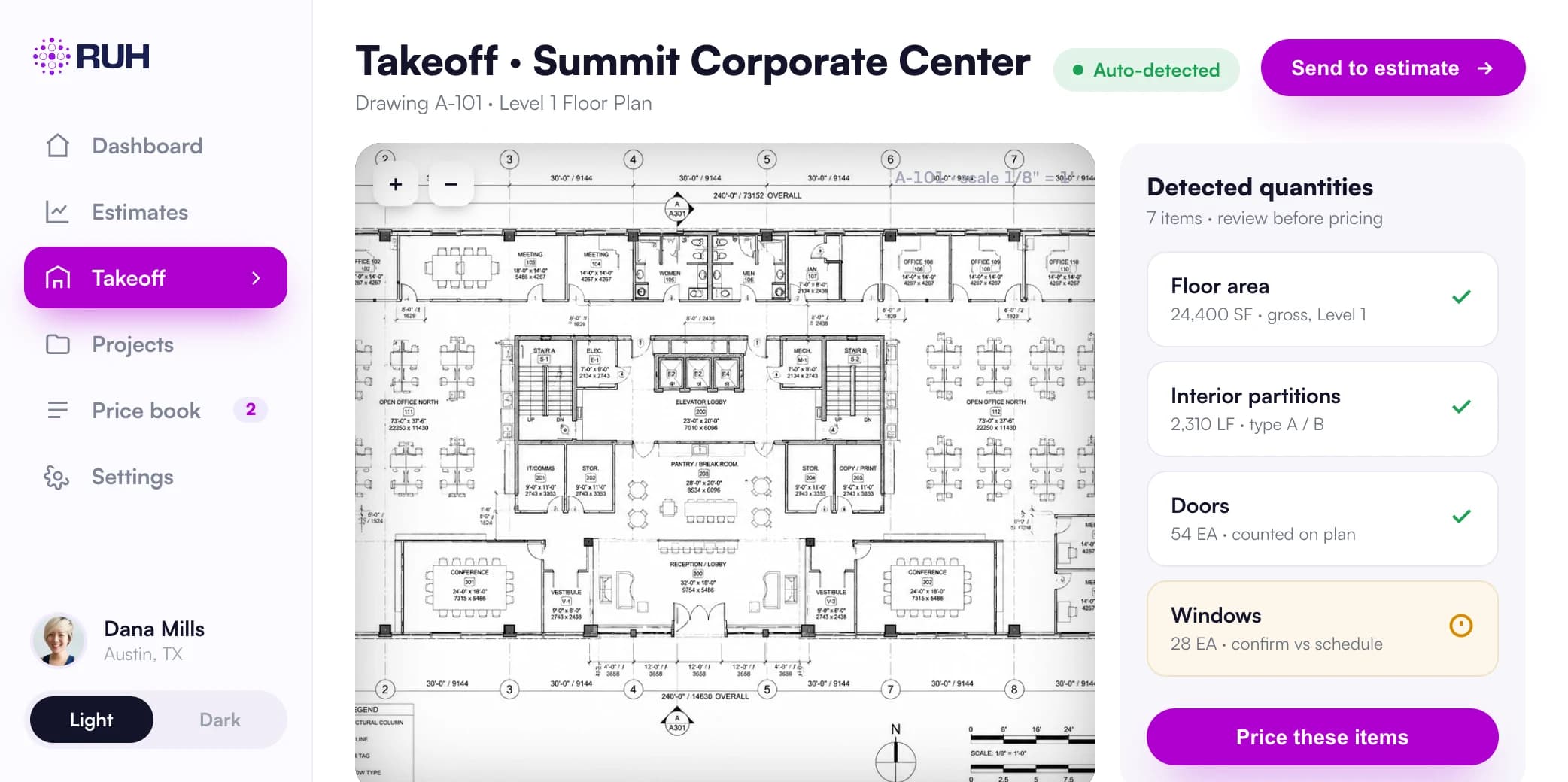
Low voltage is counted in drops and devices, each (ea), plus linear feet of cable. A drop is one cable run from the nearest IDF or MDF to an outlet, and one work area outlet commonly carries two cables, so the cable count is locations times cables per location. Devices (cameras, card readers, speakers, detectors, wireless access points) are counted from the technology and fire alarm plans, each implying its own cable run. Cable lf is estimated as cable count times an average run length to the closest IDF, since actual routing is rarely drawn. Head end gear (racks, patch panels) and termination, testing, and labeling per cable round out the pricing. Pathways are taken off separately and assigned to whichever sub owns them.
Worked example
An office tenant improvement shows 60 workstations with two Cat6 drops each: 60 x 2 = 120 cables. The average run to the IDF measures 150 ft, plus 10 ft of slack and termination allowance, so 120 x 160 ft = 19,200 lf of cable. Cat6 ships in 1,000 ft boxes: 19,200 / 1,000 = 19.2, carry 20 boxes. At an illustrative $135 per box of plenum rated Cat6, material is 20 x $135 = $2,700. Labor, terminations, jacks, faceplates, patch panel ports, and testing at an illustrative $140 per cable: 120 x $140 = $16,800. Total: $2,700 + $16,800 = $19,500, which works out to $19,500 / 120 = $162.50 per drop, a number the estimator can sanity check against historical per drop pricing before adding racks, switches, and the fire alarm and security device counts as their own sections.
Try Ruh on a real bid. 100% money-back guarantee if you are not satisfied.*
*Scoped delivery, terms apply. Read the guarantee terms
How Ruh handles low voltage
Ruh reads the technology and fire alarm sheets alongside the power plans, counts the drops and devices, and estimates the cable footage behind them, then prices the whole scope on the contractor's own price book. The draft keeps low voltage as its own section so the estimator can see the pathway split, adjust the average run length assumptions, and sign off before the bid goes out.
See AI construction takeoff and estimating softwareLow voltage: frequently asked questions
Is fire alarm part of the low voltage scope?+
Often, but not always, and the answer drives the bid structure. Fire alarm cabling is low voltage, yet the system usually requires manufacturer specific design, permitting, and licensed or NICET certified technicians, so it is frequently a standalone subcontract rather than part of the structured cabling package. Some electrical subs carry fire alarm through a preferred vendor. Confirm at bid time who owns it, because assuming the data cabling sub covers fire alarm is a common scope gap.
What is a drop in low voltage estimating?+
A drop is a single cable run from the IDF or MDF to an outlet or device, terminated and tested on both ends. One workstation outlet often carries two drops (two cables to one faceplate), so 60 desks can mean 120 drops. Per drop pricing typically includes the cable, jack, faceplate, patch panel port, labeling, and testing, but usually excludes pathways, racks, and network electronics, so check what a quoted per drop number actually covers.
Who provides conduit and boxes for low voltage, the electrician or the low voltage sub?+
On most US commercial jobs the electrical contractor provides the pathways: conduit sleeves and stub ups, back boxes with mud rings, J hooks or cable tray, and pull strings, while the low voltage sub furnishes, pulls, and terminates the cable. But the split varies by spec and by region, and it is the most common place for a scope gap between the two bids. The GC's scope sheets should name the pathway owner explicitly.
Still measuring by hand? Your next takeoff can run while you review this one.
See it on your plansRelated terms
Keep going: read the full guide or explore AI construction takeoff and estimating software.
See Ruh price a bid from your own drawings.
AI takeoff and estimating on your price book, your estimator signs off.
Figures on this page are illustrative. Construction estimates depend on project-specific conditions, source documents, market pricing, and professional judgment. Ruh's AI assists the estimator and does not replace professional review: your team reviews, validates, and approves every estimate, bid, and pricing decision.