100% money-backBook a walkthrough

Construction glossary · MEP

What is raceway in construction?

A raceway in construction is any enclosed channel designed to hold and route wires and cables, a National Electrical Code umbrella term that covers conduit (EMT, RMC, IMC, PVC), surface raceway, wireway, and underfloor duct. Every conduit is a raceway, but not every raceway is conduit. Estimators take raceway off in linear feet by system type and size, since each system carries its own material and labor cost.

Updated June 2026 · Reviewed by the Ruh construction team

Encloses conductors/cableIncludes conduit, tray, wirewayMeasured in LF

How surface raceway is supported

per manufacturerraceway runsurface-mounted

Estimating mep scope this week? Watch Ruh take off a real plan in 30 minutes.

Book a walkthrough
Definition

Raceway is the National Electrical Code umbrella term for any enclosed channel that routes conductors: all the conduit types (EMT, RMC, IMC, PVC), plus surface raceway, wireway (the rectangular gutter in electrical rooms), and underfloor systems. Specifiers use the word deliberately. A Division 26 spec that says route branch circuits in raceway leaves the contractor to pick from the approved list, while a spec that names EMT does not. One practitioner detail worth knowing: the NEC classifies cable tray as a support system, not a raceway, even though estimators usually bundle it into the same scope. The electrical subcontractor owns raceway scope, with low voltage contractors often installing their own surface raceway and pathways. The mistake new estimators make is flattening every raceway foot into one unit price: surface metal raceway in a finished classroom wall can run several times the installed cost of concealed EMT, and wireway is priced as a fitting-heavy assembly, so a takeoff that does not split lf by system type misprices the job even when the total footage is right.

How it is measured

Raceway is measured in linear feet (lf), split by system type, then by size within each system: conduit by trade size, surface raceway by series and channel count, wireway by cross section. The split matters because the installed cost per lf swings widely between systems doing the same electrical job. Fittings are counted each, and on surface raceway and wireway the fittings (corners, tees, device brackets, end caps) often drive more cost than the straight channel. Surface raceway routes show on floor plans and interior elevations in renovation sets; wireway shows in electrical room details and panel layouts. Supports and fasteners follow the lf at the spacing the system requires.

Worked example

Worked example

A school renovation cannot fish the existing masonry walls, so power and data run in two-channel surface metal raceway around three classroom perimeters. Plan measurement: 3 rooms x 80 lf = 240 lf of raceway. Devices sit at 8 ft spacing, so 240 / 8 = 30 device brackets. Each room has 4 internal corners: 4 x 3 = 12 corner fittings. At an illustrative installed price of $14 per lf for the two-channel raceway, the channel extends to 240 x $14 = $3,360, and 30 device assemblies at an illustrative $22 each add $660, so the system carries $4,020 before the wiring devices themselves. Concealed EMT would price lower per foot, but it is not buildable here without cutting and patching masonry, which is the comparison the estimator should note on the bid.

100%

Try Ruh on a real bid. 100% money-back guarantee if you are not satisfied.*

*Scoped delivery, terms apply. Read the guarantee terms

Start with a walkthrough
How Ruh handles it

How Ruh handles raceway

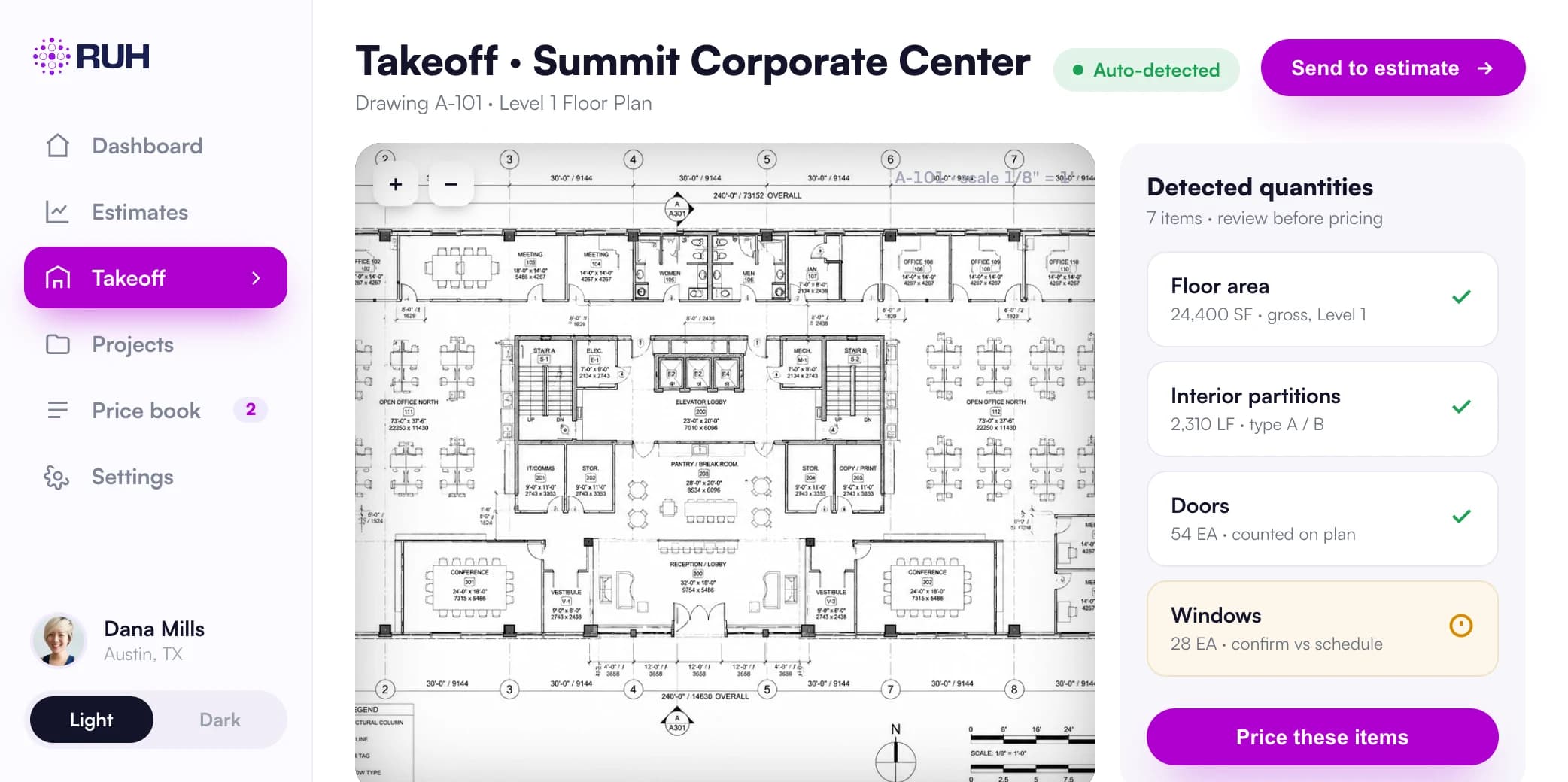
Ruh identifies each raceway system in the drawings and specs, takes off the lf by type and size, and counts the corners, brackets, and device hardware that follow the footage. The quantities are priced on the contractor's own price book, and the estimator checks the system splits before signing off on the estimate.

See AI construction takeoff and estimating software

Raceway: frequently asked questions

Is conduit the same thing as a raceway?+

Every conduit is a raceway, but not every raceway is conduit. Raceway is the NEC umbrella term for enclosed wiring channels, and the family includes EMT, RMC, IMC, and PVC conduit alongside surface raceway, wireway, and underfloor systems. When a spec says raceway, the contractor selects from the approved types; when it names a specific conduit type, that type governs. Estimators should split the takeoff by system, not lump it.

Is cable tray considered a raceway?+

No. The NEC classifies cable tray as a support system for cables, not a raceway, because the tray is open and the cables are laid in rather than pulled through an enclosed channel. The distinction matters for which cable types are permitted in the tray. In estimating practice, though, tray usually rides in the same Division 26 scope package as the raceway systems and gets taken off in lf the same way.

When is surface raceway used instead of conduit in a wall?+

Mostly in renovations and finished spaces where walls cannot be opened or fished: masonry classrooms, historic buildings, occupied offices. Surface raceway is a two-piece channel mounted on the wall face, often with separate compartments for power and data, with device boxes built into the system. It costs more per foot than concealed EMT and the device fittings drive the price, but it avoids demolition and patching entirely.

Still measuring by hand? Your next takeoff can run while you review this one.

See it on your plans

Related terms

Keep going: read the full guide or explore AI construction takeoff and estimating software.

The MEP estimating cheat sheet
Every unit, waste factor, and conversion on one page. Free PDF.

See Ruh price a bid from your own drawings.

AI takeoff and estimating on your price book, your estimator signs off.

Figures on this page are illustrative. Construction estimates depend on project-specific conditions, source documents, market pricing, and professional judgment. Ruh's AI assists the estimator and does not replace professional review: your team reviews, validates, and approves every estimate, bid, and pricing decision.