
Construction glossary · MEP
What is receptacle in construction?
A receptacle in construction is the contact device installed at an outlet for plugging in cord-connected equipment, what most people call an electrical outlet, typically a 120 V duplex on US commercial jobs. Estimators count receptacles each (ea) from the power plans, with standard duplex, GFCI, isolated ground, and floor box receptacles carried as separate line items because their installed costs differ sharply.
Updated June 2026 · Reviewed by the Ruh construction team
How receptacles are counted
Estimating mep scope this week? Watch Ruh take off a real plan in 30 minutes.
Book a walkthroughReceptacles live on the power plans as symbols keyed to a legend: standard duplex, GFCI, isolated ground (IG) for sensitive equipment, dedicated and special purpose receptacles for appliances, and floor boxes in open office areas. The electrical subcontractor (Division 26) owns the scope. The device itself is the cheap part; in an estimate, a receptacle is really an assembly: the box and mud ring, the device, the plate, the connection labor, and a share of the branch circuit feeding it, which is why estimators talk about cost per opening rather than the price of the device on the shelf. New estimators get burned three ways. They count every symbol as a standard duplex and miss the GFCI and IG premiums. They treat floor boxes like wall devices, when a flush floor box in a slab can cost many times a wall receptacle. And they skip the mounting height and condition notes, where counter height, above counter, and weatherproof exterior devices change the box, ring, and cover details. Count by type, every type, as its own line, and tie the count back to the panel schedules as a cross check.
Receptacles are counted each (ea) from the power plans, separated by type: standard duplex, GFCI, isolated ground, controlled receptacles required for some plug loads under energy codes, special purpose (208 V, twist lock, hospital grade), and floor boxes or poke throughs as their own line items. The symbol legend and the panel schedules are the cross check: circuiting on the plans ties receptacle groups to breakers, which helps catch missed devices. Cost drivers are device grade (residential, commercial spec, hospital), the GFCI premium, mounting condition (wall, counter, floor, exterior with weatherproof cover), and circuit length back to the panel. The count also drives downstream quantities: boxes, plates, and lf of branch wiring all scale off the receptacle count.
Worked example
A power plan count for a 12,000 sf office TI comes back: 84 standard duplex, 12 GFCI, 6 isolated ground, and 4 flush floor boxes, 106 devices total. Use illustrative installed assembly costs covering box, ring, device, plate, and connection labor, with branch wiring carried separately: standard at $95 each, GFCI at $145, IG at $165, and floor boxes at $850 each, the floor box price reflecting core drilling and a flush finish cover. Extensions: 84 x $95 = $7,980; 12 x $145 = $1,740; 6 x $165 = $990; 4 x $850 = $3,400. Total: $7,980 + $1,740 + $990 + $3,400 = $14,110. The lesson is in the mix: floor boxes are under 4 percent of the count (4 of 106) but $3,400 / $14,110 is about 24 percent of the device cost. Miss them and the line is busted even though roughly 96 percent of the symbols were counted correctly.
Try Ruh on a real bid. 100% money-back guarantee if you are not satisfied.*
*Scoped delivery, terms apply. Read the guarantee terms
How Ruh handles receptacle
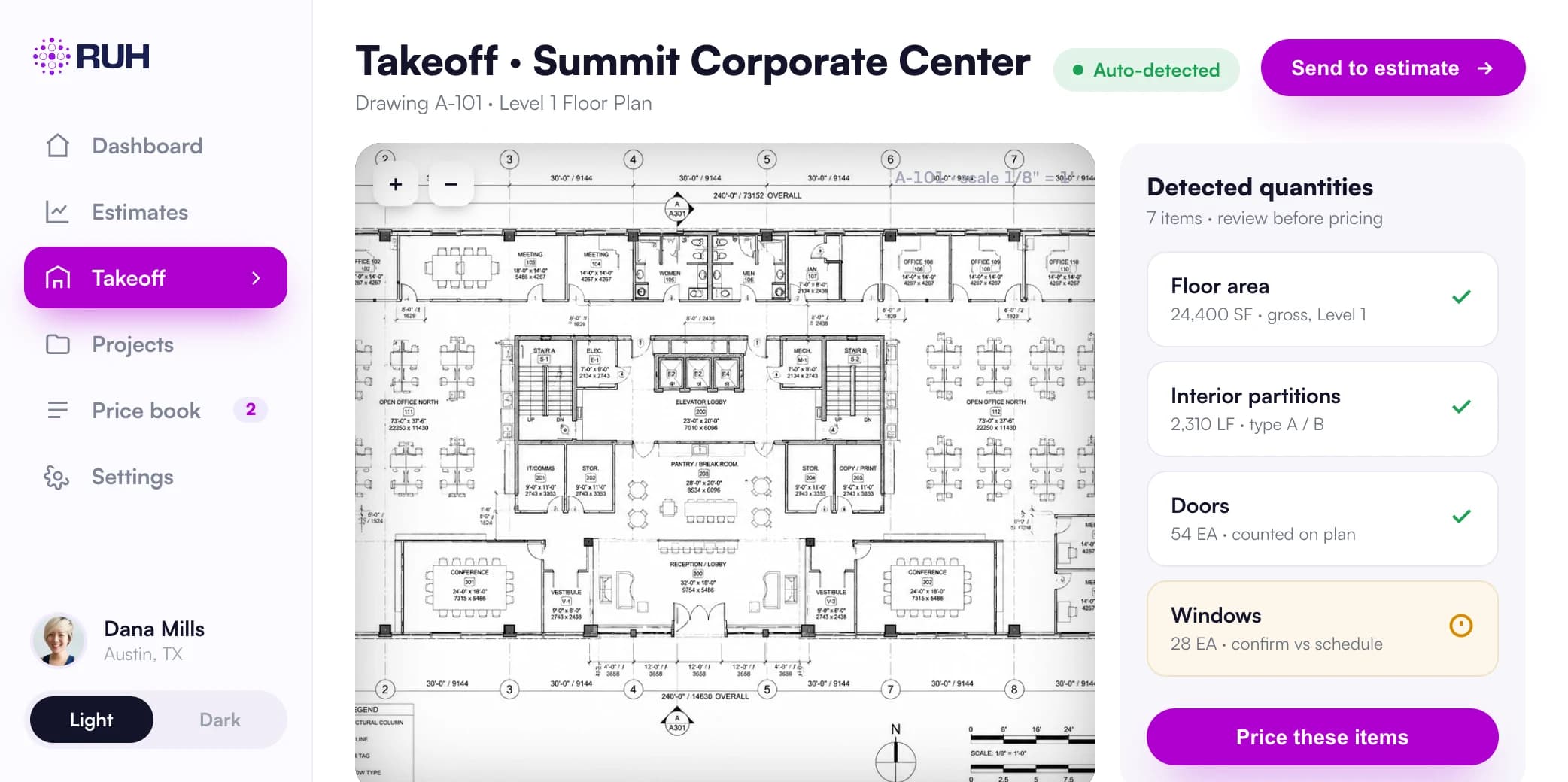
Ruh performs the receptacle count straight from the power plans, keeping standard, GFCI, isolated ground, and floor box devices as separate line items, then prices each type against the contractor's own price book. The estimator reviews the counts, checks them against the panel schedules, and signs off on the draft before it feeds the bid.
See AI construction takeoff and estimating softwareReceptacle: frequently asked questions
What is the difference between a receptacle and an outlet?+
In NEC language, an outlet is any point on the wiring system where current is taken to supply equipment, which includes lighting outlets and hardwired connections, while a receptacle is the specific contact device you plug a cord into. In the field the words get used interchangeably, but the distinction matters in scope documents: an outlet count includes things that are not receptacles, so a quote per outlet and a quote per receptacle can describe different quantities.
Where are GFCI receptacles required in commercial buildings?+
NEC 210.8(B) drives GFCI protection in nonresidential occupancies for locations such as bathrooms, kitchens and areas with sinks, rooftops, and outdoor receptacles, and the list has expanded over recent code cycles. The takeoff consequence is that restrooms, break rooms, and roof equipment areas carry the GFCI premium, either as GFCI devices or as GFCI breakers in the panel. Check which approach the engineer specified, because protecting at the breaker moves the cost to the panelboard line.
Why do floor box receptacles cost so much more than wall receptacles?+
A wall receptacle is a box, a device, and a plate in a stud wall. A flush floor box in a commercial slab needs coordination and placement before the pour or core drilling of an existing slab, a listed floor box body, fire rating considerations on elevated decks, and a flush finish cover rated for the flooring. Each step adds material and labor, which is why floor boxes and poke throughs are always their own line item, never blended with wall devices.
Still measuring by hand? Your next takeoff can run while you review this one.
See it on your plansRelated terms
Keep going: read the full guide or explore AI construction takeoff and estimating software.
See Ruh price a bid from your own drawings.
AI takeoff and estimating on your price book, your estimator signs off.
Figures on this page are illustrative. Construction estimates depend on project-specific conditions, source documents, market pricing, and professional judgment. Ruh's AI assists the estimator and does not replace professional review: your team reviews, validates, and approves every estimate, bid, and pricing decision.