
Construction glossary · Steel and structural
What is wide flange beam in construction?
A wide flange beam is a hot rolled structural steel member with an H shaped cross section, designated by a W followed by its nominal depth in inches and its weight in pounds per linear foot, so a W12x26 is nominally 12 inches deep and weighs 26 lb per foot. It is the most common beam and column shape in US commercial steel framing. Estimators take it off from the framing plans by counting members and converting lengths to pounds and tons.
Updated June 2026 · Reviewed by the Ruh construction team
Wide flange (W-shape) section
Estimating steel and structural scope this week? Watch Ruh take off a real plan in 30 minutes.
Book a walkthroughThe wide flange beam, or W shape, is the workhorse of structural steel in US commercial construction. The designation reads nominal depth then weight: a W12x26 is nominally 12 inches deep and weighs 26 pounds per linear foot. W shapes appear on the structural framing plans (S sheets), in beam and column schedules, and throughout the connection details. The steel fabricator details them on shop drawings, the erector sets them in the field, and the GC's estimator or the steel sub's estimator turns the framing plan into tonnage at bid time. New estimators trip over three things: assuming the nominal depth is the actual depth (a W12x26 is actually about 12.2 inches deep, and heavy column shapes in a series run deeper still), double counting members that show on both a partial plan and an enlarged plan, and forgetting that the lb/ft number in the designation is the conversion factor that turns measured length into weight. Miss the weight conversion and the whole steel bid is wrong, because structural steel is bought and sold by the ton.
Wide flange beams are taken off in linear feet per member, then converted to pounds and tons. The routine: count the members on the structural framing plans, record the length and designation of each, multiply length by the lb/ft in the designation to get weight, and divide total pounds by 2,000 to get short tons. Beam and column schedules confirm sizes, and the general notes flag camber and steel grade. There is no cut waste in the usual sense because the fabricator buys mill lengths, but estimators add a connection allowance, often in a typical range of 5 to 10 percent of net weight, to cover clip angles, plates, and bolts. The estimate carries the result as tons of structural steel, priced per ton for material, fabrication, and erection as separate or combined lines.
Worked example
A framing plan shows 20 typical bay beams, all W12x26, each spanning 30 ft. Step 1, total length: 20 beams x 30 ft = 600 lf. Step 2, convert to weight using the designation: 600 lf x 26 lb/ft = 15,600 lb. Step 3, convert to tons: 15,600 lb / 2,000 lb per ton = 7.8 tons. Step 4, add a connection allowance for clip angles, shear plates, and bolts: 7.8 tons x 1.10 = 8.58 tons, carried as 8.6 tons. Step 5, price it: at an illustrative combined rate of $4,500 per ton for material, fabrication, and erection, 8.6 tons x $4,500 = $38,700 for this beam package. The takeoff itself is steps 1 through 3 and is pure arithmetic from the plan; the 10 percent connection allowance and the per ton rate are estimator judgment that should stay visible in the estimate.
Try Ruh on a real bid. 100% money-back guarantee if you are not satisfied.*
*Scoped delivery, terms apply. Read the guarantee terms
How Ruh handles wide flange beam
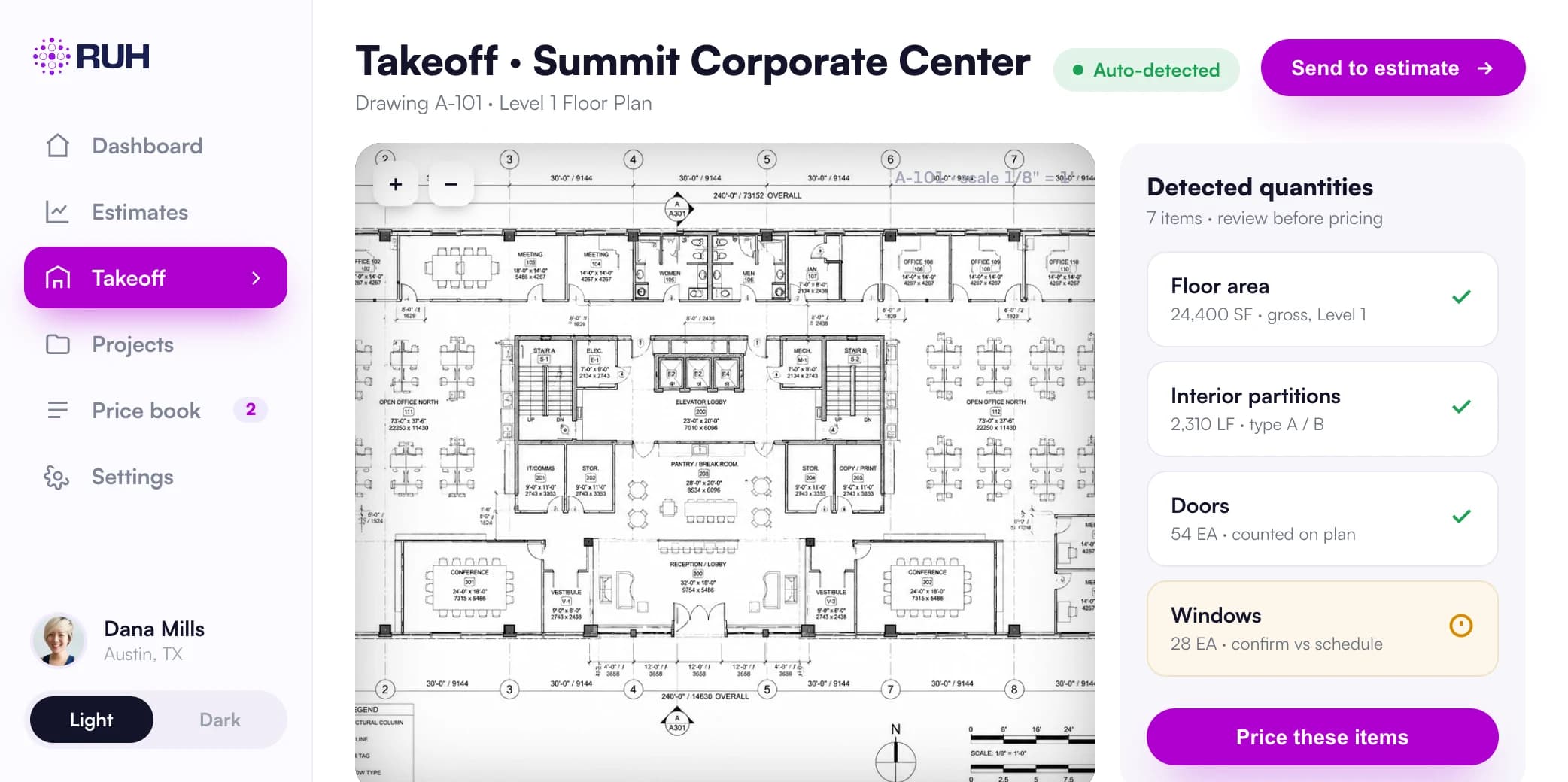
Ruh reads the structural framing plans and schedules in the contractor's drawing set, counts every wide flange member, and runs the length times lb/ft conversion to build the steel tonnage. It then prices that tonnage against the contractor's own price book, using their real per ton rates instead of generic numbers. The estimator reviews the member counts, allowances, and pricing and signs off before anything goes into the bid.
See construction estimating softwareWide flange beam: frequently asked questions
Is a W12x26 actually 12 inches deep?+
No. The 12 is a nominal depth; a W12x26 is actually about 12.2 inches deep, and depths vary within a series because heavier shapes in the same nominal group are rolled deeper. Always pull the actual depth from the AISC Steel Construction Manual or the shop drawings when checking clearances, deck bearing, or MEP routing, never from the designation alone.
Are wide flange beams priced per foot or per ton?+
Structural steel is conventionally bought and priced per short ton of 2,000 pounds, with fabrication and erection quoted per ton as well, so the takeoff converts every member length to pounds using the lb/ft in its designation. Small packages and miscellaneous steel sometimes price per pound or per piece, but the per ton convention dominates US commercial work.
What is the difference between a wide flange beam and an I beam?+
In the field, people call both an I beam, but they are different rolled shapes. The W shape has wide flanges with nearly parallel faces and carries most modern beam and column work, while the American Standard S shape has narrower flanges with sloped inner faces and shows up mainly in older buildings, crane rails, and monorails. Schedules call out the exact designation, so take off whatever letter the schedule shows.
Still measuring by hand? Your next takeoff can run while you review this one.
See it on your plansRelated terms
Keep going: read the full guide or explore construction estimating software.
See Ruh price a bid from your own drawings.
AI takeoff and estimating on your price book, your estimator signs off.
Figures on this page are illustrative. Construction estimates depend on project-specific conditions, source documents, market pricing, and professional judgment. Ruh's AI assists the estimator and does not replace professional review: your team reviews, validates, and approves every estimate, bid, and pricing decision.