100% money-backBook a walkthrough

Construction glossary · Steel and structural

What is weld types in construction?

Weld types are the categories of welded connections called out on structural steel drawings, mainly fillet welds, which are triangular welds sized by leg dimension such as 1/4 in or 5/16 in, and groove welds, which come as complete joint penetration (CJP) or partial joint penetration (PJP). The weld symbol on each connection detail tells the fabricator or erector exactly which type and size to make. Estimators care because weld type and size drive fabrication and field labor cost.

Updated June 2026 · Reviewed by the Ruh construction team

Two families fillet & grooveFillet sized by leg (e.g. 1/4 in)Groove partial or full pen

Fillet vs groove weld section

Member AWeld throatMember B1/4 in filletleg size

Estimating steel and structural scope this week? Watch Ruh take off a real plan in 30 minutes.

Book a walkthrough
Definition

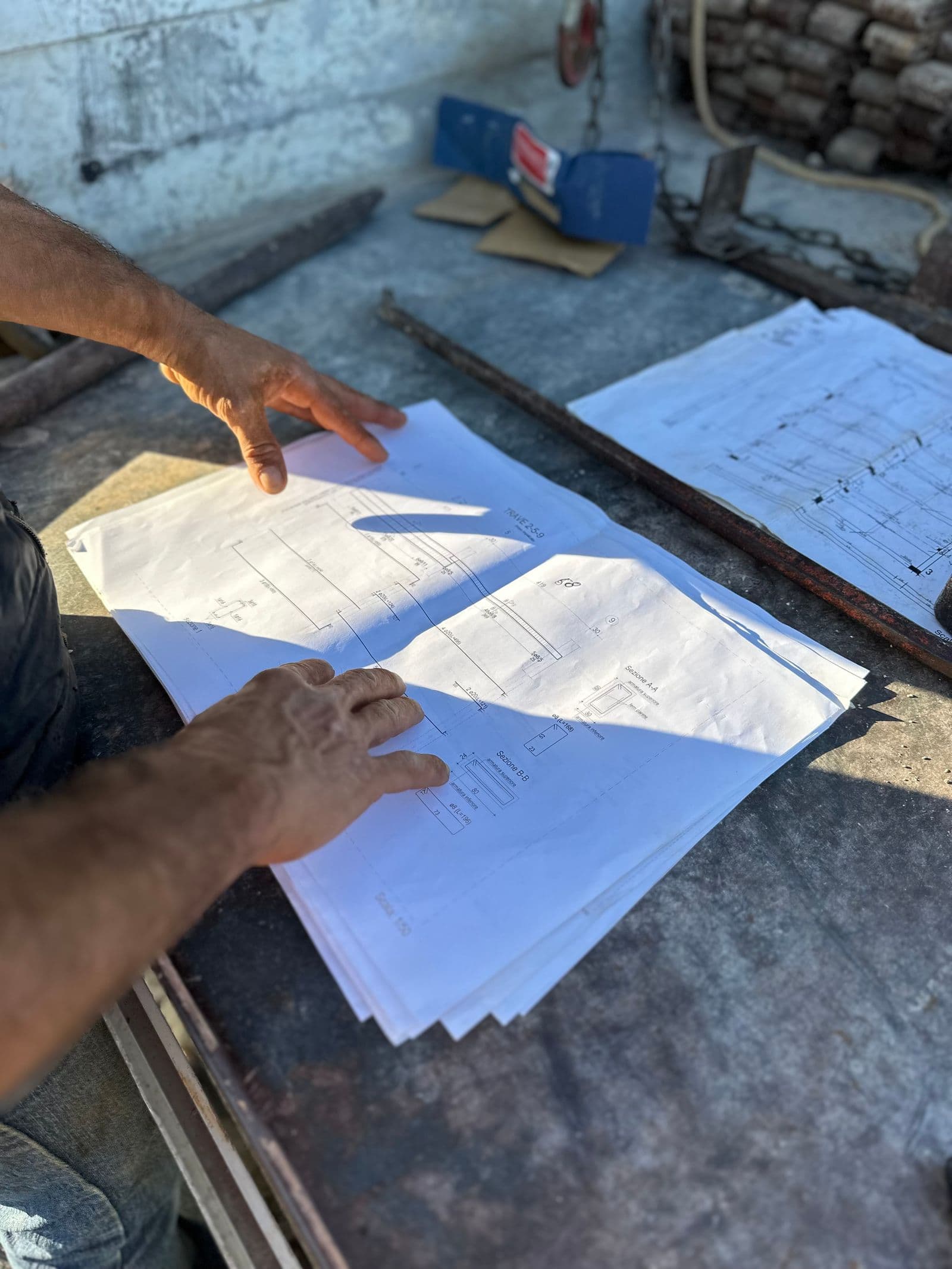
Weld types show up all over the S-series connection details, typical details, and general notes of a commercial steel package. The two families that matter to an estimator are fillet welds, triangular welds sized by their leg dimension (1/4 in, 5/16 in, 3/8 in), and groove welds, which fuse the joint itself and come as complete joint penetration (CJP) or partial joint penetration (PJP). The fabricator makes most welds in the shop, the erector makes the field welds flagged on the erection drawings, and the detailer translates the engineer's weld symbols into shop drawings. Weld type and size drive labor: fillet weld volume and cost grow roughly with the square of the leg size, and CJP welds trigger ultrasonic (UT) inspection that fillets and PJP welds usually do not. New estimators predictably stumble three ways: pricing every weld inch the same regardless of size, missing the UT inspection cost that rides along with every CJP moment connection, and double counting welding that is already buried inside the per-ton fabrication labor rate.

How it is measured

Welds are taken off in weld inches or weld feet, broken out by size and type: 80 ft of 1/4 in fillet, 24 ft of 5/16 in fillet, 12 ea CJP flange welds. The quantities come from the connection details and typical details on the structural sheets, or from approved shop drawings when they exist. Many shops never take off shop welds at all and instead carry welding inside the per-ton fabrication labor rate built from historical jobs; field welds are almost always taken off explicitly because field labor is the expensive variable. CJP welds carry a UT inspection allowance, priced per weld or per foot. In the estimate, welding lands either as its own labor lines by size or rolled into the steel tonnage line.

Worked example

Worked example

Take a floor with 40 beam-to-column shear tab connections. The typical detail shows a 12 in long tab welded to the column flange with a 1/4 in fillet on both sides. Step 1, weld per connection: 12 in x 2 sides = 24 in. Step 2, total length: 40 connections x 24 in = 960 in, and 960 / 12 = 80 ft of 1/4 in fillet weld. Step 3, price it: at an illustrative shop rate of $9 per ft for 1/4 in fillet, 80 ft x $9 = $720. Step 4, test the size sensitivity: fillet volume grows with the square of the leg, and 0.3125 / 0.25 = 1.25, so a 5/16 in weld carries 1.25 x 1.25 = 1.5625 times the weld metal. The same 80 ft now prices at $720 x 1.5625 = $1,125, carried as $1,125. One callout size on one typical detail moved the line about 56 percent.

100%

Try Ruh on a real bid. 100% money-back guarantee if you are not satisfied.*

*Scoped delivery, terms apply. Read the guarantee terms

Start with a walkthrough
How Ruh handles it

How Ruh handles weld types

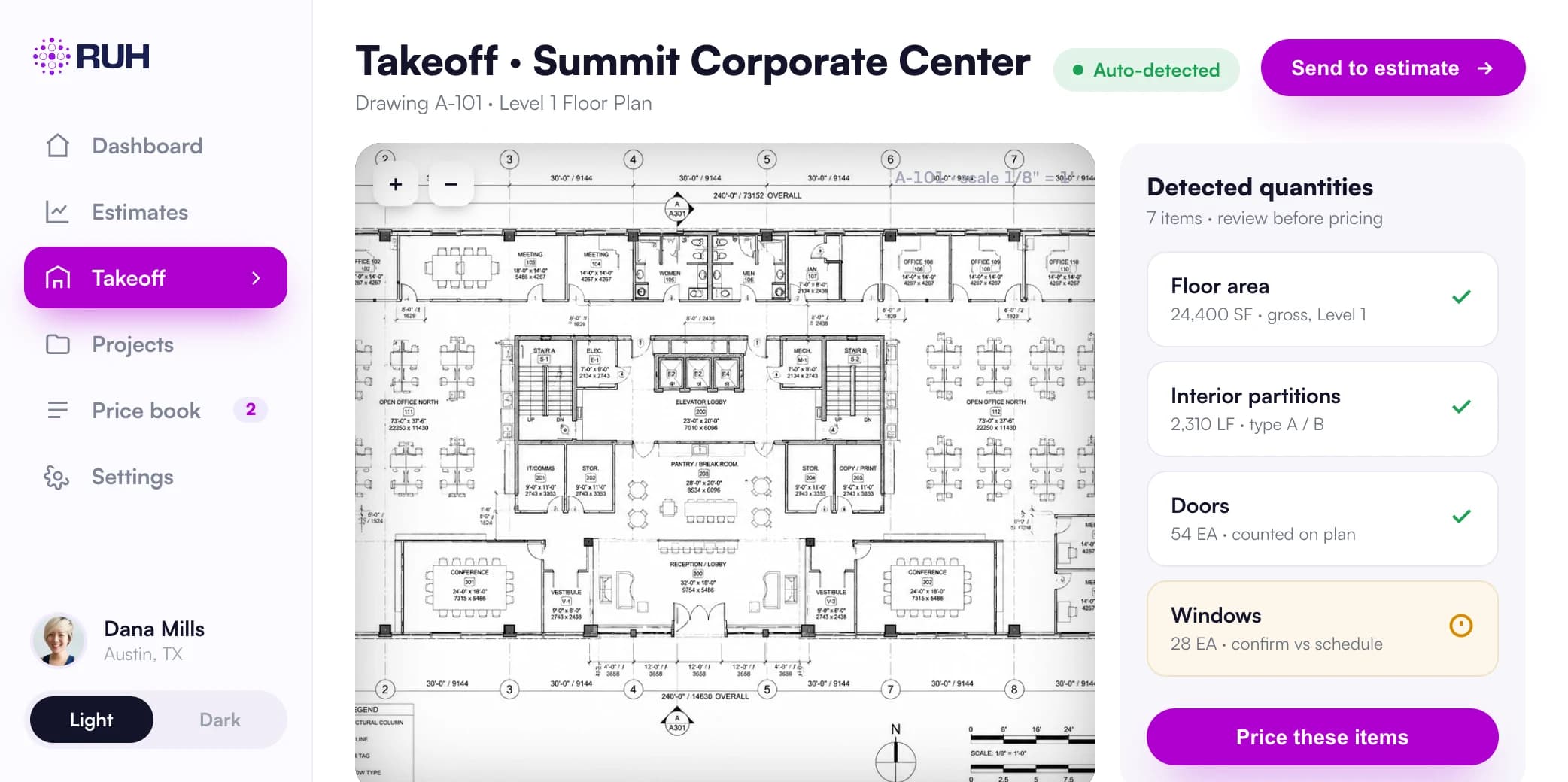
Ruh reads the connection details and typical details in the contractor's drawing set, takes off weld lengths by size and type, and flags the CJP welds that carry inspection cost. It then prices those quantities against the contractor's own price book, their actual shop and field welding rates, and returns a draft of the welding lines. The estimator reviews the quantities and size calls and signs off before anything reaches the bid.

See construction estimating software

Weld types: frequently asked questions

What is the difference between CJP and PJP groove welds?+

A complete joint penetration (CJP) weld fuses the full thickness of the joined material and develops the full strength of the connected part, which is why moment connection flange welds are usually CJP. A partial joint penetration (PJP) weld only fuses to a specified depth, takes less weld metal and labor, and is used where full strength is not required. The cost difference is bigger than the weld metal alone: CJP welds typically require ultrasonic (UT) inspection, which adds a testing line to the estimate that PJP and fillet welds usually avoid.

Why does going from a 1/4 in to a 3/8 in fillet weld cost so much more?+

Fillet weld cross section, and therefore weld metal volume and arc time, grows roughly with the square of the leg size, so a 3/8 in fillet carries about 2.25 times the metal of a 1/4 in fillet, not 1.5 times. There is also a pass break: many shops run 5/16 in as the largest single-pass fillet, so stepping up to 3/8 in often means multiple passes with cleaning between them, which moves labor more than the volume ratio suggests.

Do estimators really take off every inch of weld on a steel job?+

Usually not. Most fabricators carry routine shop welding inside their per-ton fabrication labor rate, built from historical job costs, and only break welds out when a job is connection-heavy or unusual. Field welds are the exception: they are almost always taken off explicitly by size and length from the erection drawings and connection details, because field welding labor, access, and inspection are what blow up a steel erection budget.

Still measuring by hand? Your next takeoff can run while you review this one.

See it on your plans

Related terms

Keep going: read the full guide or explore construction estimating software.

The Steel and structural estimating cheat sheet
Every unit, waste factor, and conversion on one page. Free PDF.

See Ruh price a bid from your own drawings.

AI takeoff and estimating on your price book, your estimator signs off.

Figures on this page are illustrative. Construction estimates depend on project-specific conditions, source documents, market pricing, and professional judgment. Ruh's AI assists the estimator and does not replace professional review: your team reviews, validates, and approves every estimate, bid, and pricing decision.