Construction glossary · Steel and structural
What is shear stud in construction?
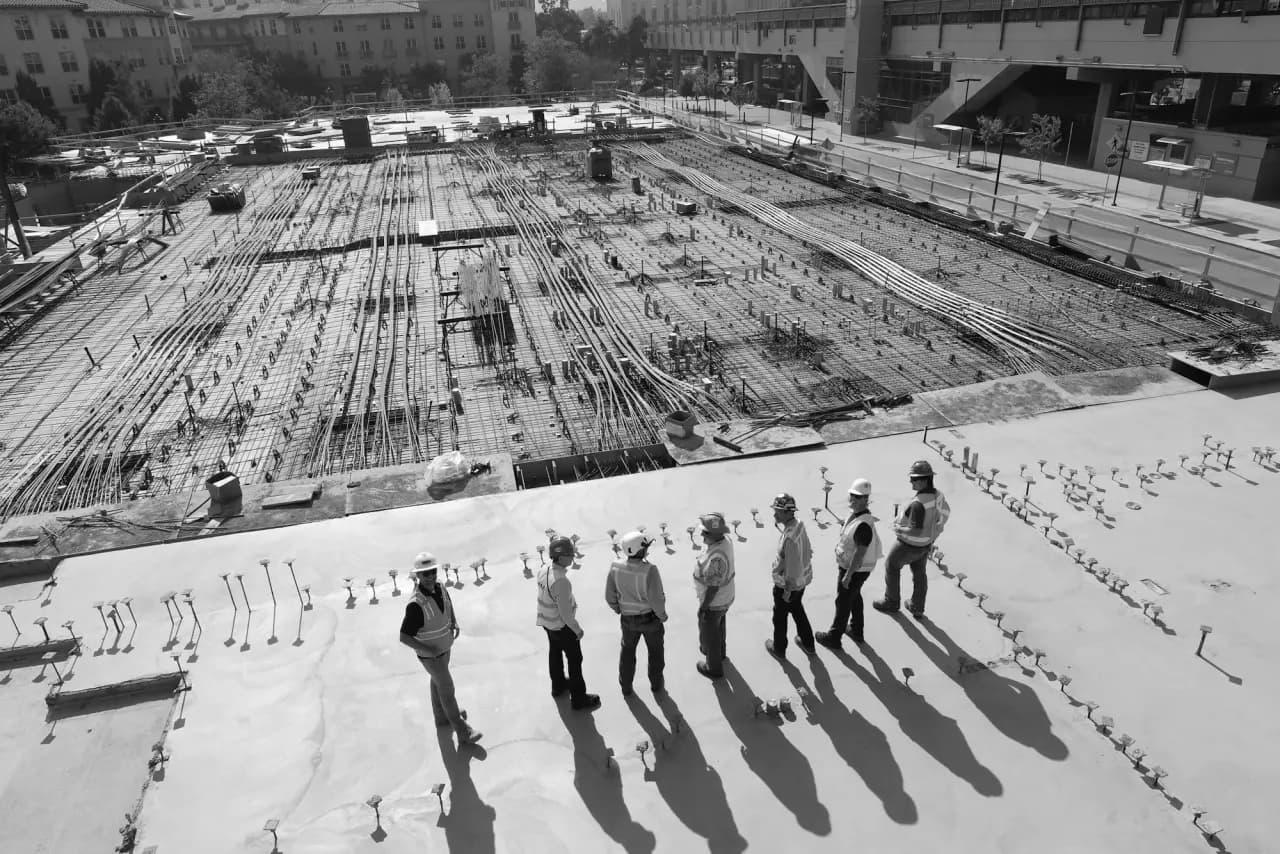
A shear stud is a headed steel anchor, most commonly 3/4 inch in diameter, welded through the metal deck to the top flange of a steel beam so the concrete slab and the beam act together as one composite member. The studs transfer horizontal shear between the slab and the steel, which lets the design use a lighter beam than the steel could carry alone. On framing plans they appear as a count in parentheses next to each composite beam, such as (24) studs.
Updated June 2026 · Reviewed by the Ruh construction team
How shear studs are spaced on a beam
Estimating steel and structural scope this week? Watch Ruh take off a real plan in 30 minutes.
Book a walkthroughShear studs, also called headed studs, shear connectors, or Nelson studs after the dominant brand of welding gun, are short steel anchors with a forged head, welded to the beam top flange so the concrete slab on the metal deck acts compositely with the steel frame. On structural framing plans each composite beam carries a parenthetical callout, such as W18x35 (24), meaning 24 studs spaced along that member, and the structural general notes fix the diameter and the length after weld. The studs are installed in the field, after the deck is laid, by the steel erector or a specialty stud welding subcontractor, so the cost sits at the seam between the structural steel and concrete scopes. New estimators make predictable mistakes here: reading a camber callout like C=3/4 as part of the stud count, missing the segmented callouts on girders such as (12)(20)(12) that must be summed per member, and assuming studs ride in the fabricator's shop price when they are almost always a separate field installed line.
Shear studs are taken off and priced per each (ea), at a per stud installed rate. The counts come straight off the structural framing plans, where every composite member carries a parenthetical stud count, and the general notes or typical details confirm diameter and length. Girders often carry segmented callouts that must be summed for the member. There is no measuring involved, only careful counting, so estimators tally member by member and multiply repeated typical bays, then extend per level. A small allowance, often 2 to 3 percent, covers studs that fail the bend test and get replaced. In the estimate the line lands as total studs x the unit price, or inside the steel erection labor buildup with stud material carried separately.
Worked example
Take one floor of a composite steel building. The framing plan shows 18 infill beams each called out as (24) studs and 6 girders each called out as (16)(12)(16). Step 1, beams: 18 x 24 = 432 studs. Step 2, girders: 16 + 12 + 16 = 44 studs per girder, so 6 x 44 = 264 studs. Step 3, floor total: 432 + 264 = 696 studs. Step 4, add a 2 percent allowance for studs that fail the bend test: 696 x 1.02 = 709.92, carried as 710 studs. Step 5, price it: at an illustrative installed rate of $4.50 per stud, 710 x $4.50 = $3,195 for the floor. Step 6, sanity check the labor: a stud welder placing a typical 500 studs per day needs 710 / 500 = 1.42 days, so carry a day and a half of welder time. The count is pure plan reading; the allowance and the rate are estimator judgment.
Try Ruh on a real bid. 100% money-back guarantee if you are not satisfied.*
*Scoped delivery, terms apply. Read the guarantee terms
How Ruh handles shear stud
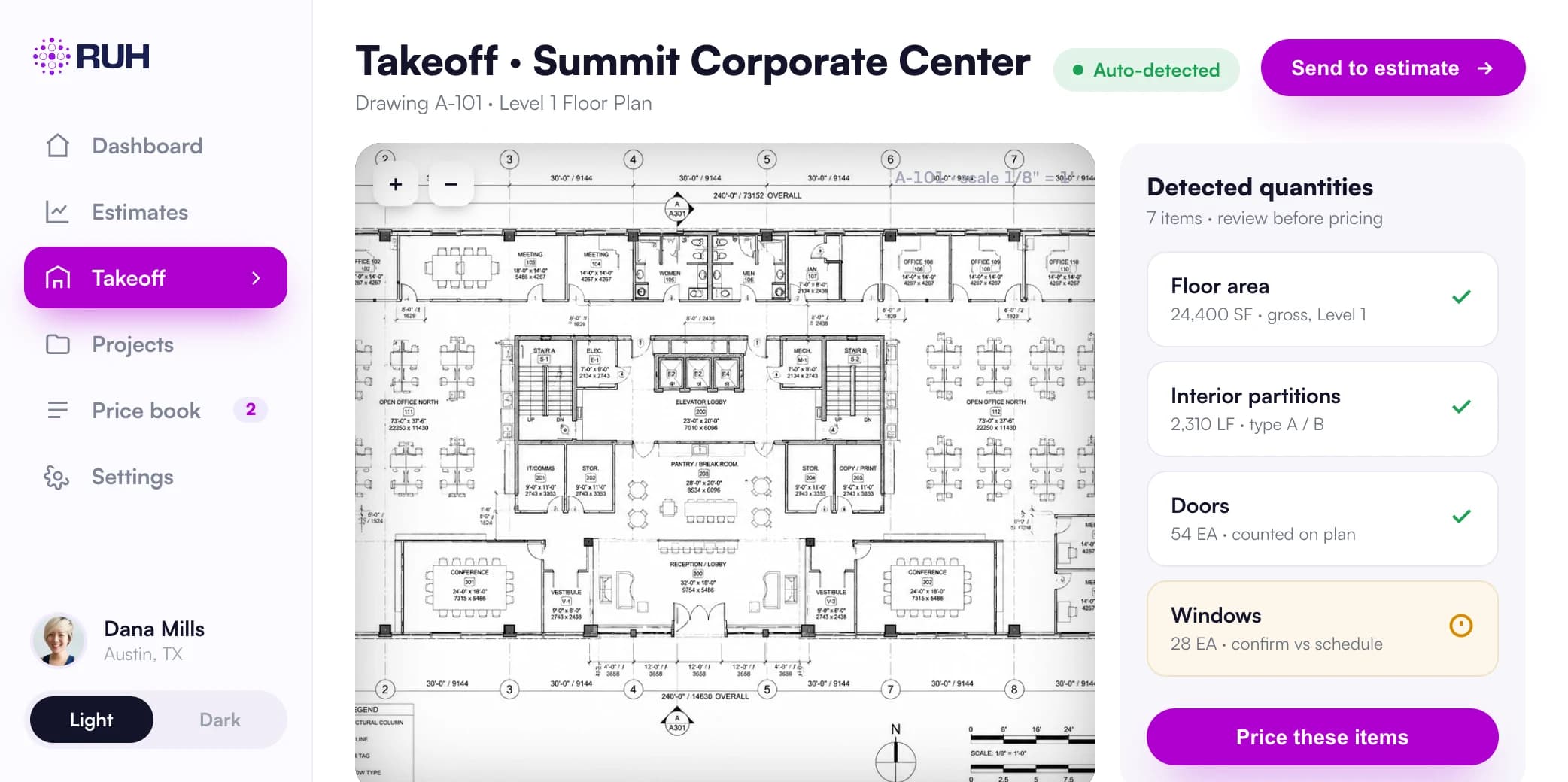
Ruh reads the contractor's framing plans, picks up every stud callout including the segmented girder counts, and totals the studs member by member and level by level the way an estimator would. It then prices the count against the contractor's own price book, their real per stud installed cost, and returns the line as a draft. The estimator reviews the tally, adjusts the weld failure allowance if needed, and signs off before it enters the bid.
See construction estimating softwareShear stud: frequently asked questions
Are shear studs included in the steel fabricator's price or installed by someone else?+
They are almost never shop applied, because studs on the flange would block the deck from sitting flat and would get beaten up in shipping. The studs are field welded through the deck after it is laid, by the erector's crew or a specialty stud welding subcontractor, so at bid time confirm whose number carries the studs. Scope gaps between the fabricator, erector, and decking sub on this line are a classic buyout problem.
Why are shear studs welded through the metal deck instead of directly to the beam flange?+
The deck goes down first so crews have a working surface, and the stud gun arc burns through the sheet into the flange in one shot, which is what makes production rates of hundreds of studs per day per welder possible. Through deck welding does carry limits from AWS D1.1 and the design standard on deck thickness and on galvanized coating weight, and the flange must be clean and dry, so wet or heavily galvanized deck can slow the work or force burning holes first.
What happens when a stud weld fails inspection, and how do I cover that in the bid?+
Field inspection typically bends a sample of studs about 15 degrees with a hammer or pipe; a sound weld bends without cracking, while a failed stud snaps off and must be replaced with a new stud welded adjacent. Failure rates are low when the deck and flange are clean, but they are never zero, so most estimators carry a 2 to 3 percent allowance on the counted quantity rather than pricing the neat count alone.
Still measuring by hand? Your next takeoff can run while you review this one.
See it on your plansRelated terms
Keep going: read the full guide or explore construction estimating software.
See Ruh price a bid from your own drawings.
AI takeoff and estimating on your price book, your estimator signs off.
Figures on this page are illustrative. Construction estimates depend on project-specific conditions, source documents, market pricing, and professional judgment. Ruh's AI assists the estimator and does not replace professional review: your team reviews, validates, and approves every estimate, bid, and pricing decision.