100% money-backBook a walkthrough

Construction glossary · Steel and structural

What is KSI (kips per square inch) in construction?

KSI (kips per square inch) is the unit US structural engineers use to state the strength of steel, and since a kip is 1,000 pounds, 1 ksi equals 1,000 psi. Common values on commercial drawings are 36 ksi yield for A36 plate and angle, 50 ksi yield for A992 wide flange shapes, and 120 ksi tensile for A325 bolts. For estimators, the ksi grade sets the material price per pound while the takeoff quantity stays the same.

Updated June 2026 · Reviewed by the Ruh construction team

1 ksi = 1,000 psiA992 yield 50 ksiA36 yield 36 ksi

Steel strength on the KSI scale

36 ksi (A36)46 ksi50 ksi (A992)58 ksi65 ksi50 ksi yield, modern wide flange

Estimating steel and structural scope this week? Watch Ruh take off a real plan in 30 minutes.

Book a walkthrough
Definition

Ksi stands for kips per square inch, where a kip is 1,000 pounds of force, so 1 ksi equals 1,000 psi. It is the standard unit for structural steel strength in US commercial work: A36 plate and angle carry a yield strength Fy of 36 ksi, A992 wide flange shapes carry Fy of 50 ksi, and A325 high strength bolts carry a tensile strength Fu of 120 ksi. The values live in the structural general notes, the column and beam schedules, and the connection details, and the fabricator, detailer, erector, and estimator all work from those grades. The estimator's job is to catch the grade, because ksi drives what the steel costs per pound, not how many pounds there are. New estimators trip on two predictable things: assuming every plate is A36 when the notes upgrade specific members to 50 ksi material, and confusing ksi with psi when concrete (specified in psi) and steel (specified in ksi) sit in the same general notes block. Misreading the grade does not change the tonnage, but it quietly changes the unit price on every steel line.

How it is measured

Ksi is not a takeoff quantity; it is a material property that rides along with the quantities. Steel is taken off in pounds and tons from the framing plans and member schedules, and each line item carries a grade tag such as A36 or A992 pulled from the structural general notes. Pricing happens per pound or per ton, and the ksi grade selects which unit price applies, since higher strength and specialty grades carry different mill and fabrication pricing. The working convention is to confirm grades in the general notes before pricing, flag any members the schedules upgrade to a higher ksi, and carry bolts and welds with their own strength callouts. In the finished estimate, ksi appears as the grade column next to the tonnage, never as a quantity of its own.

Worked example

Worked example

Check a tension brace plate that is 6 in wide and 0.5 in thick carrying a 90 kip load. Step 1, cross section area: 6 in x 0.5 in = 3.0 sq in. Step 2, stress: 90 kips / 3.0 sq in = 30 ksi. Step 3, compare to grade: A36 plate yields at Fy = 36 ksi, so 30 ksi sits below yield (the engineer applies code safety factors on top of this raw check). Step 4, weight for pricing: steel weighs 490 lb per cubic foot, and 490 / 144 = 3.4 lb per foot per square inch of section, carried as 3.4. So 3.0 sq in x 3.4 lb = 10.2 lb per ft, and a 10 ft plate weighs 10.2 x 10 = 102 lb. Step 5, price it: at an illustrative $1.10 per lb fabricated, 102 lb x $1.10 = $112.20. If the notes spec 50 ksi material instead, the weight stays 102 lb but the unit price moves, which is exactly how ksi hits an estimate: grade, not quantity.

100%

Try Ruh on a real bid. 100% money-back guarantee if you are not satisfied.*

*Scoped delivery, terms apply. Read the guarantee terms

Start with a walkthrough
How Ruh handles it

How Ruh handles KSI (kips per square inch)

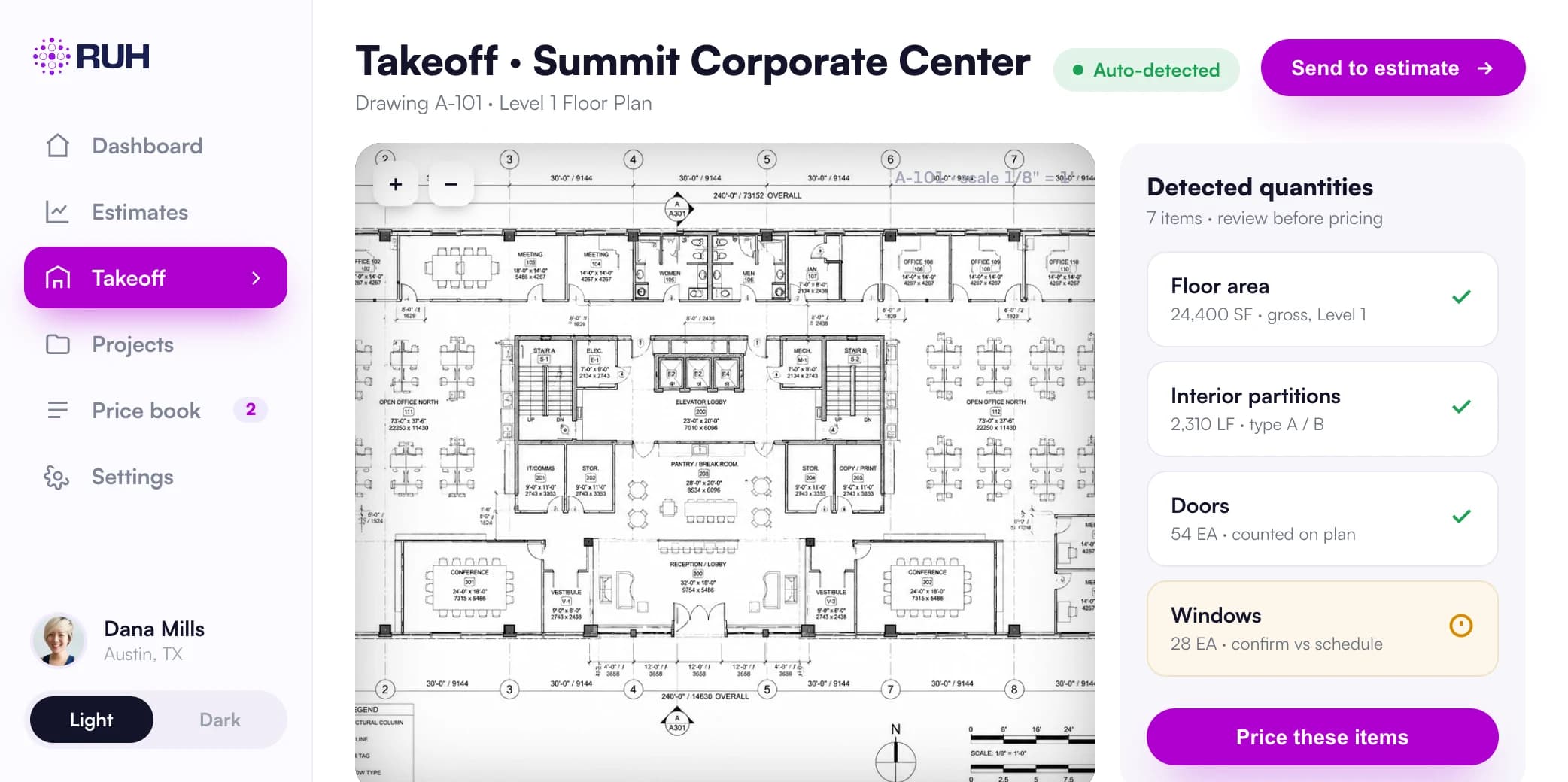
Ruh reads the structural sheets the way an estimator does, pulling steel quantities off the framing plans and tagging each member with the grade called out in the general notes and schedules. It then prices the resulting tonnage against the contractor's own price book, so a 50 ksi wide flange line and an A36 plate line each land on the contractor's real unit costs. The estimator reviews the grades and quantities and signs off before anything reaches the bid.

See construction estimating software

KSI (kips per square inch): frequently asked questions

Why is structural steel specified in ksi but concrete in psi?+

It is convention driven by the size of the numbers. Concrete compressive strengths run 3,000 to 5,000 psi on typical commercial jobs, which read cleanly in psi, while steel strengths of 36,000 or 50,000 psi compress neatly to 36 and 50 ksi. Both units measure the same thing, force per square inch, so converting is just multiplying or dividing by 1,000.

Does a higher ksi grade change the steel tonnage in my takeoff?+

No. Tonnage comes from the member sizes and lengths on the framing plans, and those do not change because the grade is higher. What changes is the unit price per pound, and sometimes availability and lead time, so the same 40 ton takeoff can price differently as A36 versus 50 ksi material. Confirm the grade in the general notes before applying a price.

Where do ksi values show up in a typical drawing set?+

Start with the structural general notes, usually on the first S-series sheet, which list design strengths for every material: shapes, plates, bolts, welds, and concrete. Member schedules and connection details can override the general notes for specific pieces, so scan those too. If a schedule calls out 50 ksi material on certain girders while the notes default plate to A36, the estimate needs to carry both grades.

Still measuring by hand? Your next takeoff can run while you review this one.

See it on your plans

Related terms

Keep going: read the full guide or explore construction estimating software.

The Steel and structural estimating cheat sheet
Every unit, waste factor, and conversion on one page. Free PDF.

See Ruh price a bid from your own drawings.

AI takeoff and estimating on your price book, your estimator signs off.

Figures on this page are illustrative. Construction estimates depend on project-specific conditions, source documents, market pricing, and professional judgment. Ruh's AI assists the estimator and does not replace professional review: your team reviews, validates, and approves every estimate, bid, and pricing decision.