Construction glossary · Envelope and finishes
What is EPDM roofing in construction?
EPDM roofing is a single-ply synthetic rubber membrane for low-slope commercial roofs, supplied in large sheets and seamed with seam tape rather than heat welds. It is measured in square feet of membrane plus lineal feet of seam tape. The estimator separates field area from perimeter and penetration flashing.
Updated June 2026 · Reviewed by the Ruh construction team
EPDM rubber roof assembly
Estimating envelope and finishes scope this week? Watch Ruh take off a real plan in 30 minutes.
Book a walkthroughEPDM (ethylene propylene diene monomer) is a single-ply rubber roofing membrane, commonly 45, 60, or 90 mil, supplied in wide sheets (often 10 ft and 20 ft, and larger) and installed mechanically fastened, fully adhered, or ballasted. Unlike TPO, EPDM laps are joined with seam tape and primer rather than hot-air welds, so the seam takeoff is measured in lineal feet of tape and counted as its own material line. On the estimate, the EPDM line is driven by net roof area plus a lap and waste factor, with seam tape quantified from the number and length of sheet seams across the roof. Bonding adhesive (for adhered systems), fasteners and plates (for mechanically fastened systems), cover board, insulation, and perimeter and penetration flashing are separate lines. A senior estimator lays out the sheet runs from the roof plan to count seams, since the seam tape quantity follows directly from how the large sheets are placed.
Measured in square feet of net field area (plus a lap and waste factor) and in lineal feet of seam tape. Lay out sheet runs across the roof from the roof plan to count seams: number of seams equals runs minus one, and seam tape lineal feet equals seam count times run length, with a small waste add. Read parapet, curb, and penetration heights off the roof details for separate flashing lineal footage. Confirm membrane thickness, sheet width, and attachment method from the specification, since sheet width sets how many seams occur and therefore the tape quantity.
Worked example
A 9,000 sf roof measures 90 ft by 100 ft. Using 10 ft wide EPDM sheets run the 100 ft direction, that is 90 ft / 10 ft = 9 runs, giving 9 - 1 = 8 seams. Each seam is 100 ft long, so seam tape totals 8 x 100 ft = 800 lf, plus an illustrative 10 percent waste: 800 lf x 1.10 = 880 lf of seam tape. The membrane itself, with a 10 percent lap and waste factor, is 9,000 sf x 1.10 = 9,900 sf to order. At an illustrative installed rate of 4.75 dollars/sf, the field membrane line is 9,000 sf x 4.75 dollars = 42,750 dollars. Seam tape, flashing, insulation, and any adhesive or fasteners are added as separate lines.
Try Ruh on a real bid. 100% money-back guarantee if you are not satisfied.*
*Scoped delivery, terms apply. Read the guarantee terms
How Ruh handles EPDM roofing
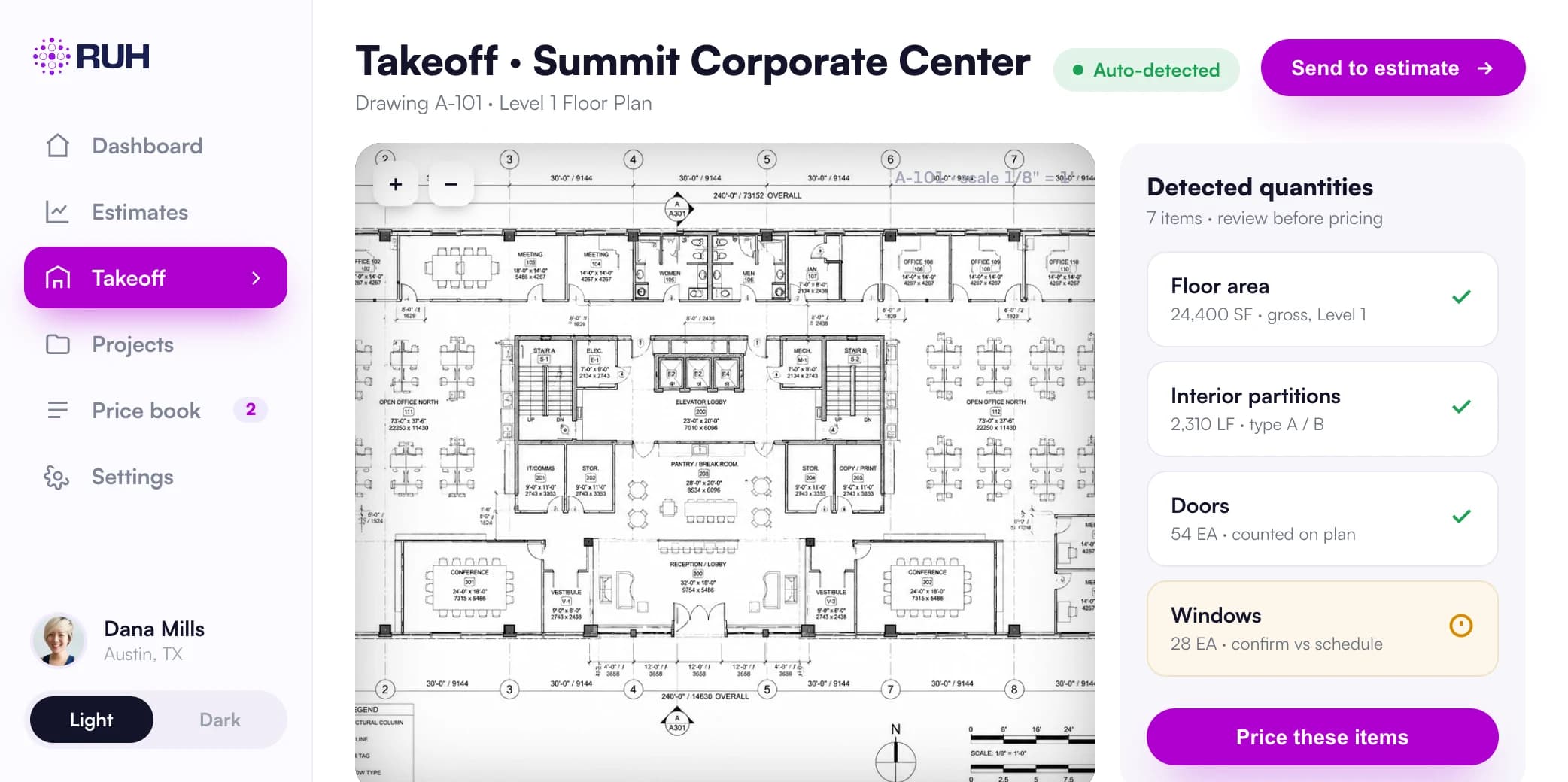
Ruh reads the roof plan and roofing details, lays out the EPDM sheet runs to count seams, and takes the field membrane in sf with a lap and waste factor and the seam tape in lineal feet. It prices the membrane, seam tape, and accessories on the contractor's own price book and pulls flashing as separate lineal lines. The estimator confirms the sheet layout, seam count, and attachment method, then signs off.
See construction estimating softwareEPDM roofing: frequently asked questions
How are EPDM seams different from TPO?+
EPDM seams use seam tape and primer, measured in lineal feet, while TPO seams are hot-air welded. That changes the accessory takeoff: EPDM carries a seam-tape line that TPO does not.
How do you estimate seam tape quantity?+
Lay out the sheet runs on the roof plan. Seams equal runs minus one, and tape lineal feet equals seam count times run length, plus a small waste add.
Is EPDM priced by the square foot or the square?+
Both. Net area is taken in sf and converted to squares (100 sf each) for ordering and labor, with a lap and waste factor applied before ordering.
Still measuring by hand? Your next takeoff can run while you review this one.
See it on your plansRelated terms
Keep going: read the full guide or explore construction estimating software.
See Ruh price a bid from your own drawings.
AI takeoff and estimating on your price book, your estimator signs off.
Figures on this page are illustrative. Construction estimates depend on project-specific conditions, source documents, market pricing, and professional judgment. Ruh's AI assists the estimator and does not replace professional review: your team reviews, validates, and approves every estimate, bid, and pricing decision.