100% money-backBook a walkthrough

Construction glossary · Envelope and finishes

What is TPO roofing in construction?

TPO roofing is a single-ply thermoplastic polyolefin membrane, the most widely specified low-slope commercial roof in the US, installed in mechanically fastened, fully adhered, or induction-welded systems with heat-welded seams. It is measured in square feet and roofing squares, plus fasteners and plates or bonding adhesive. The estimator separates field membrane from flashing and accessories.

Updated June 2026 · Reviewed by the Ruh construction team

Installed cost $5.50 to $9 / sfMembrane 45 / 60 / 80 milSeam weld Hot-air, 1.5 inReflectivity White, SRI 90+

TPO single-ply roof assembly

TPO membrane (60 mil)Heat-welded seamsCover boardPolyiso insulationRoof deck

Estimating envelope and finishes scope this week? Watch Ruh take off a real plan in 30 minutes.

Book a walkthrough
Definition

TPO (thermoplastic polyolefin) is a single-ply roofing membrane, typically 45, 60, or 80 mil, supplied in rolls (commonly 10 ft and 12 ft wide) and seamed with hot-air welds rather than tape or adhesive at the laps. It is the most common single-ply commercial roofing membrane in the US because of its cost, reflectivity, and weldability. On the estimate, the TPO line is driven by net roof area increased for laps and waste, plus the attachment takeoff: mechanically fastened systems need fasteners and plates on a row spacing set by wind uplift; fully adhered systems need bonding adhesive priced by coverage rate. Cover board, insulation, perimeter and penetration flashing, termination bars, and pipe boots are taken separately. A senior estimator reads the wind uplift and attachment requirements off the roofing details before settling the fastener density, since that quantity moves the labor and material more than the membrane itself.

How it is measured

Measured in square feet of net field area and roofing squares (1 square = 100 sf), with a lap and waste factor added. The attachment method on the roofing detail drives the accessory takeoff: fastener and plate counts come from the uplift-driven row spacing for mechanically fastened systems, and bonding adhesive comes from the membrane area divided by the product coverage rate (sf per gallon) for fully adhered systems. Take field area off the roof plan and read parapet, curb, and penetration heights off the details for separate flashing lineal footage. Confirm membrane thickness (mil) and roll width from the specification, since width affects the lap factor.

Worked example

Worked example

A low-slope roof has 12,000 sf of net field area, or 12,000 / 100 = 120 squares. For a mechanically fastened 60-mil system, an illustrative density of one fastener and plate per 4 sf gives 12,000 sf / 4 = 3,000 fasteners and 3,000 plates. If the same roof were fully adhered instead, bonding adhesive at an illustrative coverage of 60 sf per gallon needs 12,000 sf / 60 = 200 gallons. At an illustrative installed rate of 5.50 dollars/sf, the field membrane line is 12,000 sf x 5.50 dollars = 66,000 dollars, with material ordered against the lapped quantity (12,000 sf x 1.10 = 13,200 sf). Flashing, cover board, and insulation are separate lines, and the attachment accessories are added per the chosen system.

100%

Try Ruh on a real bid. 100% money-back guarantee if you are not satisfied.*

*Scoped delivery, terms apply. Read the guarantee terms

Start with a walkthrough
How Ruh handles it

How Ruh handles TPO roofing

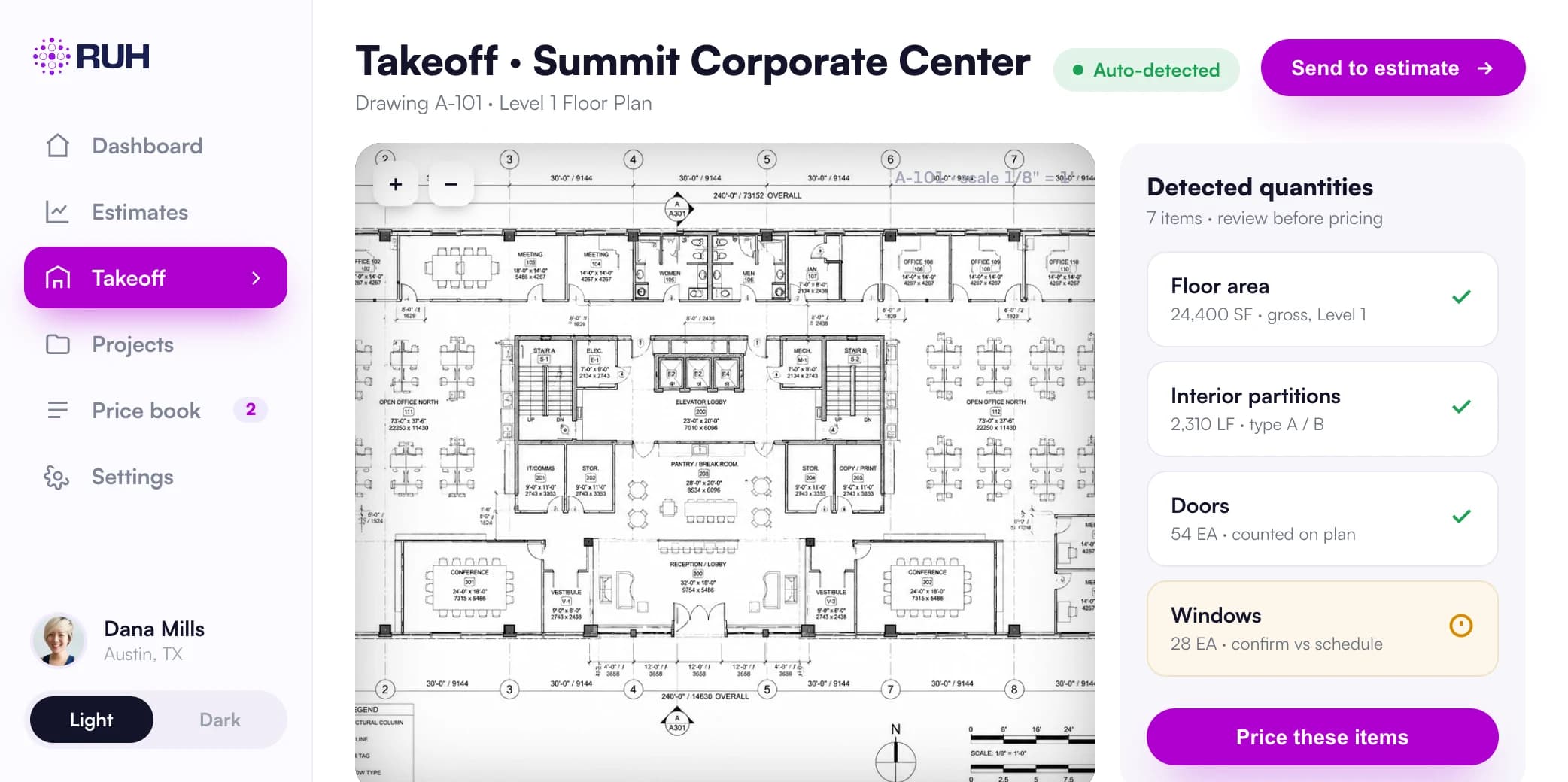
Ruh reads the roof plan and roofing details, takes the TPO field area in sf and squares with a lap and waste factor, and builds the attachment takeoff (fastener and plate counts or adhesive gallons) from the detailed system. It prices the membrane and accessories on the contractor's own price book and pulls flashing as separate lineal lines. The estimator confirms the uplift-driven fastener density and signs off.

See construction estimating software

TPO roofing: frequently asked questions

How are TPO seams joined?+

TPO laps are joined by hot-air welding, which fuses the membrane into a continuous sheet. This is different from EPDM, which uses seam tape, and it affects both labor and accessory takeoff.

What drives fastener quantity on a mechanically fastened TPO roof?+

Wind uplift requirements set the row and fastener spacing on the roofing detail. Higher uplift zones at corners and perimeters tighten spacing and raise the fastener and plate count.

How do you quantify adhesive for fully adhered TPO?+

Divide the membrane area by the product coverage rate in sf per gallon. For example, 12,000 sf at 60 sf per gallon needs 200 gallons of bonding adhesive.

Still measuring by hand? Your next takeoff can run while you review this one.

See it on your plans

Related terms

Keep going: read the full guide or explore construction estimating software.

The Envelope and finishes estimating cheat sheet
Every unit, waste factor, and conversion on one page. Free PDF.

See Ruh price a bid from your own drawings.

AI takeoff and estimating on your price book, your estimator signs off.

Figures on this page are illustrative. Construction estimates depend on project-specific conditions, source documents, market pricing, and professional judgment. Ruh's AI assists the estimator and does not replace professional review: your team reviews, validates, and approves every estimate, bid, and pricing decision.