100% money-backBook a walkthrough

Construction glossary · Envelope and finishes

What is House wrap (WRB) in construction?

House wrap, more precisely a weather resistive barrier or WRB, is the sheet membrane applied over exterior sheathing to shed bulk water and air while still letting the wall dry outward. In commercial work it is measured in square feet of wall area plus the seam and flashing tape it takes to make the laps and openings continuous. The estimator scopes it from the exterior elevations and wall sections, not from the floor plan alone.

Updated June 2026 · Reviewed by the Ruh construction team

Roll coverage 9 ft x 100 ftPerm rating 10 to 50 permsLap overlap 6 in vert / 12 in horizInstalled cost $0.40 to $0.80 / sf

WRB house wrap in wall layers

Siding / claddingRainscreen gapHouse wrap (WRB)Exterior sheathingStud framing

Estimating envelope and finishes scope this week? Watch Ruh take off a real plan in 30 minutes.

Book a walkthrough
Definition

House wrap, the trade name most people use for a weather resistive barrier (WRB), is the drainage and air-control layer that sits behind the cladding and over the sheathing on an exterior wall. It is the building's secondary water barrier: bulk water that gets past the veneer or panel runs down the wrap and out at flashing. In US commercial construction the WRB is specified in division 07 and may be a mechanically fastened sheet, a self-adhered membrane, or a fluid-applied coating, but for sheet wrap the takeoff logic is the same. You scope the field area of wall, then add coverage for horizontal and vertical laps, then carry seam tape and flashing tape separately in linear feet because openings, transitions, and terminations all get taped. Penetration and opening counts come off the window and door schedules. The product class drives both unit price and the lap dimensions the manufacturer requires.

How it is measured

Measured in square feet of gross exterior wall area, with seam tape and flashing tape carried separately in linear feet. Take wall area off the exterior elevations and wall sections, measuring height by length for each elevation and deducting large openings only if the spec allows. Apply a coverage factor, commonly 10 to 15 percent, for the horizontal and vertical laps the manufacturer requires. Tape is figured from the number of horizontal sheet laps times their run, plus vertical end laps, plus the perimeter of every opening from the window and door schedules. Confirm the WRB type and required lap width in the division 07 spec, since that sets the unit price and the tape quantity.

Worked example

Worked example

Take 3,000 sf of exterior wall. Apply a 12 percent lap allowance: 3,000 sf x 1.12 = 3,360 sf of wrap to buy. Seam tape: say the wall is 150 lf of horizontal sheet laps plus 17 vertical end laps at 20 ft each, so 150 lf + (17 x 20 ft) = 150 + 340 = 490 lf of tape. Price it illustratively, US market: wrap material at 0.55 per sf gives 3,360 x 0.55 = 1,848.00, and tape at 0.45 per lf gives 490 x 0.45 = 220.50. Combined material is roughly 2,069 before labor and opening flashing. Note that opening flashing tape from the window and door schedules is a separate detail line, not part of this field tape. The estimator confirms the WRB type and required lap width against the spec before locking the unit price.

100%

Try Ruh on a real bid. 100% money-back guarantee if you are not satisfied.*

*Scoped delivery, terms apply. Read the guarantee terms

Start with a walkthrough
How Ruh handles it

How Ruh handles House wrap (WRB)

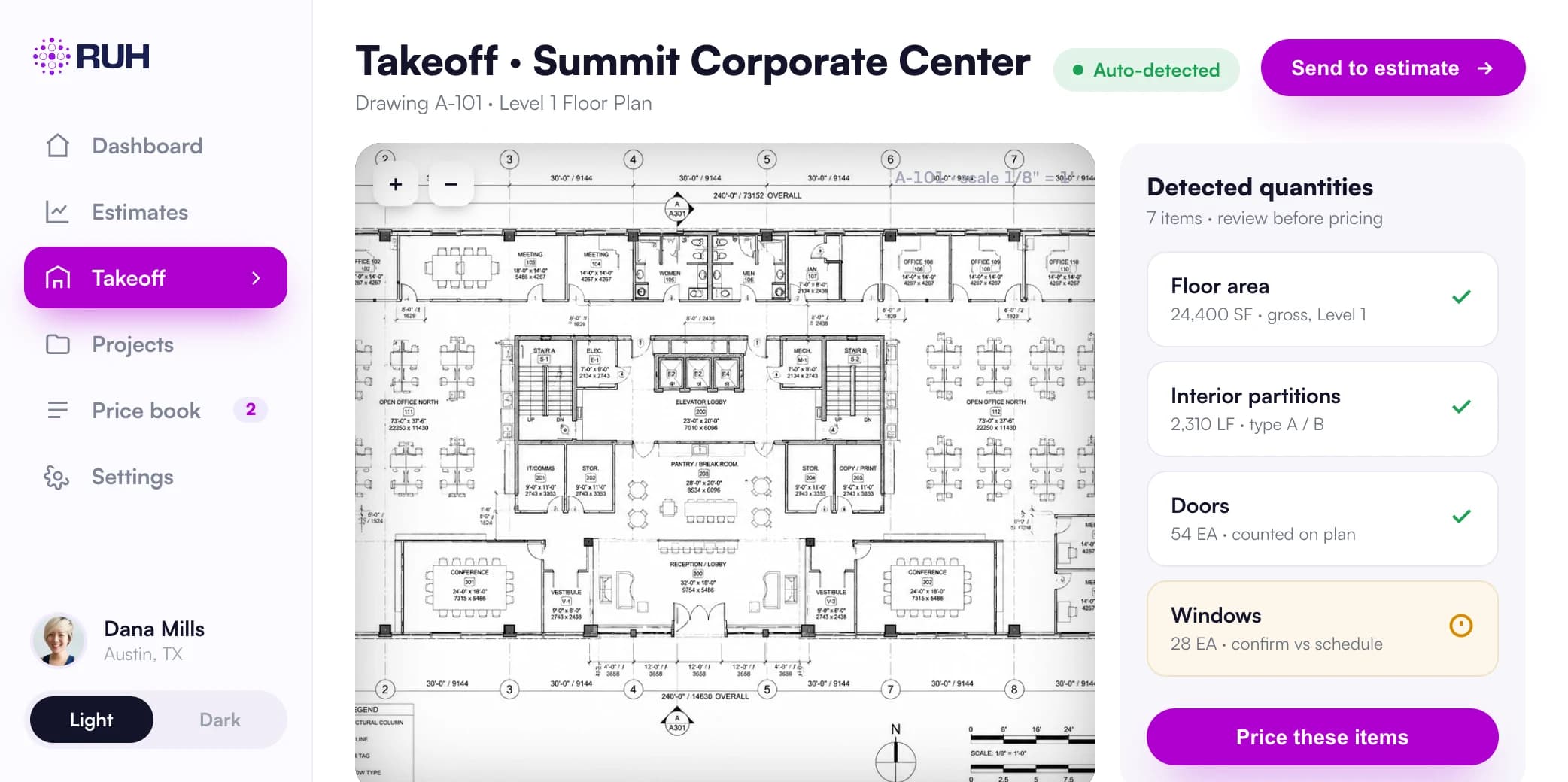
Ruh reads the exterior elevations, wall sections, and the division 07 WRB spec, takes the gross wall area as square feet, and applies the manufacturer's lap allowance to produce the wrap quantity. It pulls opening counts from the window and door schedules and carries seam and flashing tape as linear feet, then prices the line on your own price book for the specified WRB type. The estimator reviews the area, the lap factor, and the tape logic, then signs off.

See construction estimating software

House wrap (WRB): frequently asked questions

Is house wrap the same thing as a vapor barrier?+

No. A WRB controls bulk water and air from the outside while still allowing the wall to dry outward, so it is vapor-permeable by design. A vapor barrier stops diffusion and is low-perm. Putting a true vapor barrier on the wrong side of a wall traps moisture, so the two are scoped and located differently.

Do I deduct window and door openings from the wall area?+

Only if the spec allows it. Many estimators carry gross wall area because the wrap detail returns into the openings and the offcuts become waste anyway. Check the section and decide once, then apply it consistently across every elevation.

Why is flashing tape kept off the field tape line?+

Because opening flashing is a detail item priced per opening from the schedule, with its own labor and a wider, often self-adhered tape. The field seam tape is the simpler running lap. Splitting them keeps the opening labor visible instead of buried in a square-foot rate.

Still measuring by hand? Your next takeoff can run while you review this one.

See it on your plans

Related terms

Keep going: read the full guide or explore construction estimating software.

The Envelope and finishes estimating cheat sheet
Every unit, waste factor, and conversion on one page. Free PDF.

See Ruh price a bid from your own drawings.

AI takeoff and estimating on your price book, your estimator signs off.

Figures on this page are illustrative. Construction estimates depend on project-specific conditions, source documents, market pricing, and professional judgment. Ruh's AI assists the estimator and does not replace professional review: your team reviews, validates, and approves every estimate, bid, and pricing decision.