Construction glossary · Envelope and finishes
What is drywall types in construction?
In US commercial construction, drywall types are the different gypsum board products specified by core, thickness, and facing for a given assembly: standard 1/2 inch, fire-rated 5/8 inch Type X, moisture-resistant (MR) board, mold-resistant board, abuse-resistant board, and shaftliner. The estimator reads the wall types schedule and fire ratings to pick the right product for each partition. The board type drives both the unit cost and the labor for fastening and finishing.
Updated June 2026 · Reviewed by the Ruh construction team
Common gypsum board types by use
Estimating envelope and finishes scope this week? Watch Ruh take off a real plan in 30 minutes.
Book a walkthroughDrywall types are gypsum panels distinguished by core formulation, thickness, and face paper. Standard 1/2 inch board is the default for non-rated interior partitions. Type X is a 5/8 inch panel whose gypsum core has glass fibers added to resist fire, which is what lets a single layer help achieve a one-hour rating in tested assemblies; Type C is a higher-performance fire core used in some two-hour and shaft assemblies. MR (moisture-resistant, green) board and mold-resistant board go in wet or humid areas such as restrooms and janitor closets. Abuse-resistant and impact-resistant board go in corridors, gyms, and high-traffic walls. Shaftliner (1 inch) goes in elevator and mechanical shafts. The estimator matches each wall type tag to its UL or GA assembly, then counts the square feet by type. Getting the type wrong understates both material cost and the screw and finishing labor.
Quantify drywall by the square foot of board, separated by type and by number of layers, because a two-layer rated wall doubles the board on that face. Pull wall lengths from the floor plan and heights from the partition schedule or section details, then multiply length by height for each face. Read the wall types legend and the life-safety plan to assign Type X versus standard versus MR to each run. Add a waste factor (commonly 8 to 12 percent) for cuts and breakage. Convert square feet to 4x8 (32 sf) or 4x12 (48 sf) sheets for ordering. Note ceiling board separately, and flag soffits and furring that add board not shown in linear wall takeoff.
Worked example
Illustrative, US market. A one-hour corridor partition runs 80 lf at 10 ft tall, board both faces. One face is 80 x 10 = 800 sf, so two faces are 1,600 sf. The wall type calls for single-layer 5/8 inch Type X to meet the rating, not 1/2 inch standard. At 32 sf per 4x8 sheet, 1,600 sf needs 50 sheets net; at a 10 percent waste factor that rounds to 55 sheets of 5/8 Type X. The material delta of choosing Type X over standard matters: at an illustrative 0.55 vs 0.42 per sf, the upgrade adds (0.55 - 0.42) x 1,600 = 208 dollars in board alone, before the heavier 5/8 board's added hanging labor. Specifying 1/2 inch standard here would have failed the rating and undercounted the bid.
Try Ruh on a real bid. 100% money-back guarantee if you are not satisfied.*
*Scoped delivery, terms apply. Read the guarantee terms
How Ruh handles drywall types
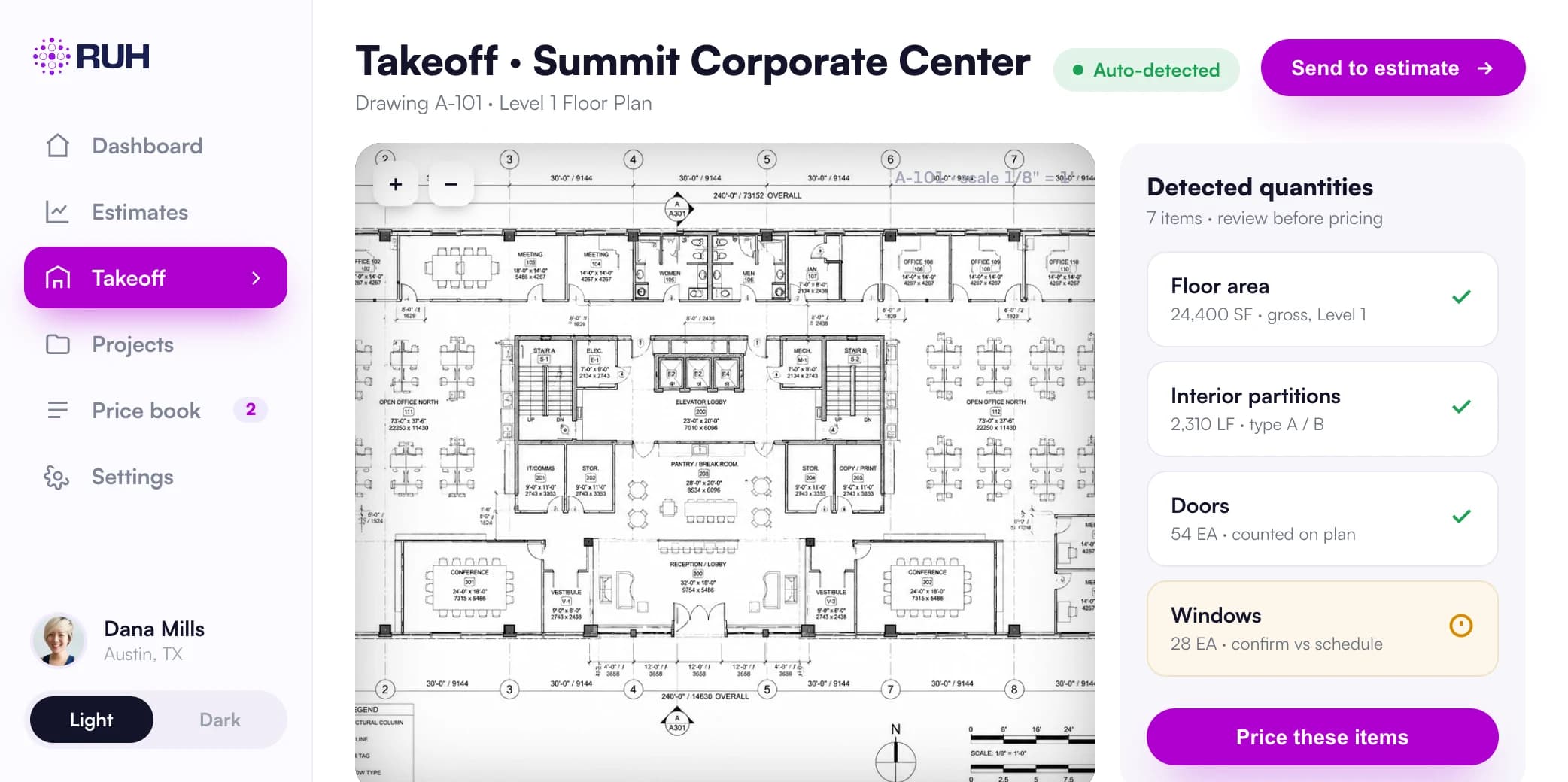
Ruh reads the wall types schedule, the life-safety plan, and the partition details, then takes off board area face by face, splitting square feet by drywall type and layer count so Type X, MR, and standard are each their own line. It prices the board, screws, and finishing on the contractor's own price book and converts to sheet counts with the firm's waste factor. The estimator reviews the type assignments against the ratings and signs off.
See construction estimating softwareDrywall types: frequently asked questions
When do I need 5/8 Type X instead of 1/2 inch standard?+
Use 5/8 Type X anywhere the wall type tag references a fire-rated assembly, typically corridors, demising walls, shafts, and stair enclosures. Standard 1/2 inch is fine only for non-rated partitions. Always confirm against the specific UL or GA assembly the design team listed, since the rating depends on the whole assembly, not the board alone.
Is mold-resistant board the same as moisture-resistant (green) board?+
No. MR (green) board resists moisture in the core and paper; mold-resistant board adds treated paperless or fiberglass facing to resist mold growth. Specs increasingly call for mold-resistant board in restrooms and behind tile, so read the spec rather than defaulting to green board.
Do drywall types change my finishing labor?+
Yes. The 5/8 inch board is heavier to hang, and abuse-resistant and impact-resistant panels are denser and slower to cut and screw. Type also interacts with finish level, so price hanging and finishing as separate line items rather than one blended square-foot rate.
Still measuring by hand? Your next takeoff can run while you review this one.
See it on your plansRelated terms
Keep going: read the full guide or explore construction estimating software.
See Ruh price a bid from your own drawings.
AI takeoff and estimating on your price book, your estimator signs off.
Figures on this page are illustrative. Construction estimates depend on project-specific conditions, source documents, market pricing, and professional judgment. Ruh's AI assists the estimator and does not replace professional review: your team reviews, validates, and approves every estimate, bid, and pricing decision.