Construction glossary · Envelope and finishes
What is batt insulation in construction?
Batt insulation is pre-cut fiberglass or mineral wool friction-fit into framing cavities, sized by width to the stud spacing and by R-value to the cavity depth. It is measured in square feet of cavity area at a given R-value, which converts to bags or bundles by coverage. The estimator scopes it from the wall types and the room or partition schedule, matching R-value to the spec.
Updated June 2026 · Reviewed by the Ruh construction team
Fiberglass batt R-value by cavity depth
Estimating envelope and finishes scope this week? Watch Ruh take off a real plan in 30 minutes.
Book a walkthroughBatt insulation is the cut-to-length blanket of fiberglass or mineral wool that fills the cavity between studs, joists, or rafters. It is the workhorse cavity insulation in US commercial interiors and exterior framed walls, and it is identified by two things: the width that matches the framing (15 inch for 16 inch on-center, 23 inch for 24 inch on-center) and the R-value that matches the cavity depth (R-13 and R-15 for 2x4, R-19 and R-21 for 2x6). Some assemblies also use batts for acoustic separation rather than thermal performance, and the spec will say so. As an estimator you take the cavity area in square feet at each R-value, keep R-values on separate lines because they price differently, and convert square feet to bags using the manufacturer's coverage per bag. Faced versus unfaced and fire-rating requirements for mineral wool both affect the unit price.
Measured in square feet of cavity area, separated by R-value, then converted to bags or bundles by coverage. Take the wall area from the wall types and partition schedule or the reflected plan for ceilings, multiply length by height for each wall type, and apply a small waste factor, commonly 5 to 10 percent, for cuts and fitting around blocking. Keep each R-value on its own line because R-13, R-19, and R-21 carry different unit prices and different coverage per bag. Read the spec to confirm faced versus unfaced, mineral wool versus fiberglass, and whether the batt is thermal or acoustic, since that decides the product and the price.
Worked example
Take 2,400 sf of 2x6 wall calling for R-19 batts. Apply an 8 percent waste factor for cuts and blocking: 2,400 sf x 1.08 = 2,592 sf to install. A common R-19 fiberglass bag covers about 49 sf, so 2,592 sf divided by 49 = 52.9, round up to 53 bags. Price it illustratively, US market: material at 0.85 per sf gives 2,592 x 0.85 = 2,203.20. If the spec switched this wall to mineral wool for fire or acoustic reasons, the same 2,592 sf at an illustrative 1.65 per sf would run 2,592 x 1.65 = 4,276.80, which is why R-value and product type stay on separate lines. The estimator confirms width, R-value, and faced versus unfaced against the wall types before locking the unit price.
Try Ruh on a real bid. 100% money-back guarantee if you are not satisfied.*
*Scoped delivery, terms apply. Read the guarantee terms
How Ruh handles batt insulation
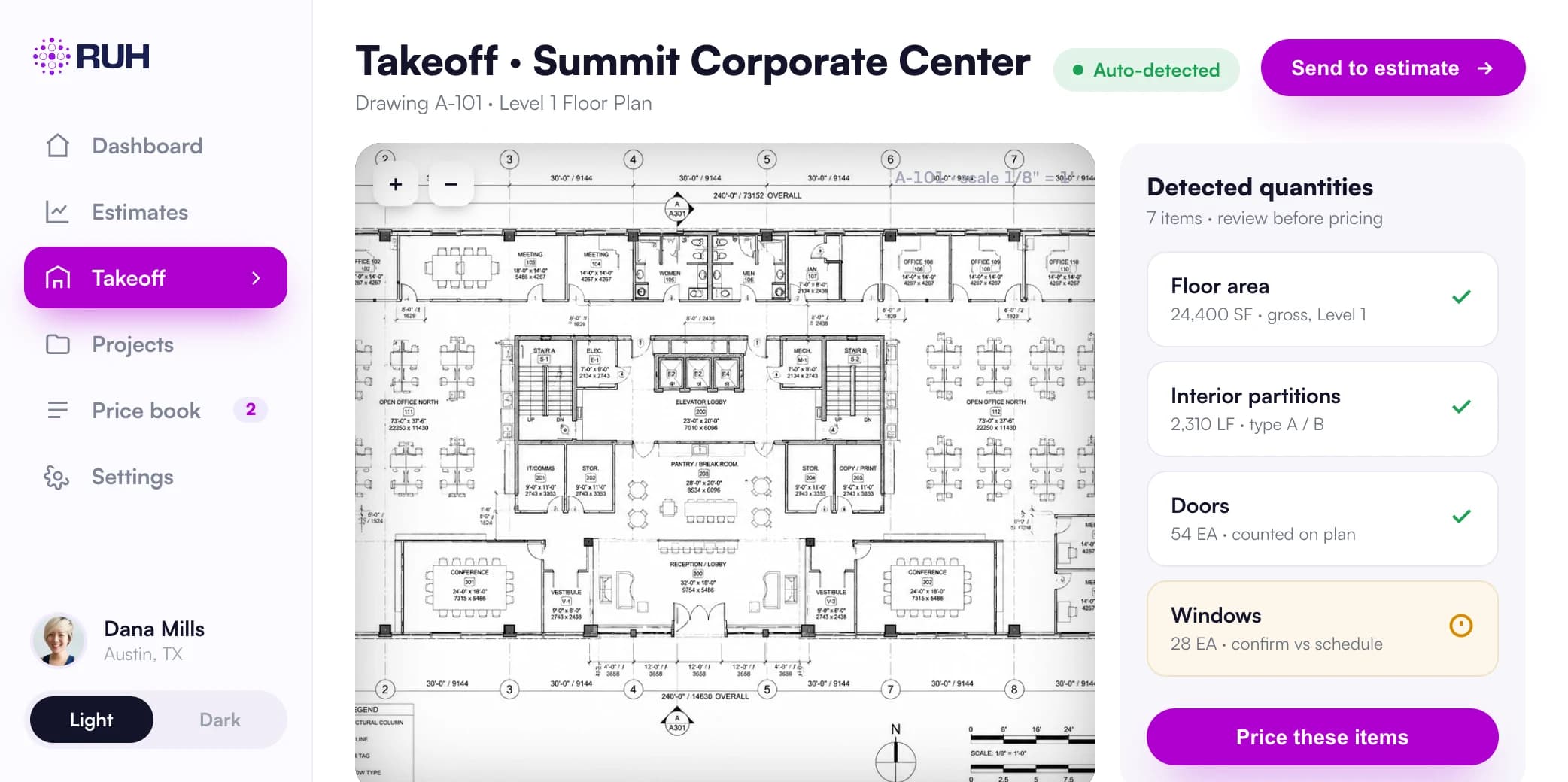
Ruh reads the wall types, partition schedule, and the division 07 insulation spec, takes each wall area as square feet, and groups it by R-value so each line prices on its own. It applies the cuts-and-fitting waste factor, converts square feet to bags using the coverage in your own price book, and flags faced versus unfaced and any mineral wool callouts. The estimator reviews the R-value grouping, the bag conversion, and the product type, then signs off.
See construction estimating softwareBatt insulation: frequently asked questions
Why convert square feet to bags instead of just bidding square feet?+
Because batts are bought by the bag and each bag covers a fixed area at a given R-value. The crew installs square feet but you purchase bags, so the conversion is what ties your material buy to the wall. Round up per R-value, not across the whole job.
Does an R-19 batt actually give the wall R-19?+
The batt is rated R-19, but the wall is less because the wood studs are a thermal bridge at a lower R-value. The whole-wall effective number is what matters for energy compliance, which is why continuous insulation is often added. See r-value.
When do I use mineral wool instead of fiberglass batts?+
When the spec calls for fire resistance or acoustic performance, mineral wool is denser and rated for it, and it costs more per square foot. Read the wall type and the spec, because a fire-rated or sound partition can change the product and roughly double the material line.
Still measuring by hand? Your next takeoff can run while you review this one.
See it on your plansRelated terms
Keep going: read the full guide or explore construction estimating software.
See Ruh price a bid from your own drawings.
AI takeoff and estimating on your price book, your estimator signs off.
Figures on this page are illustrative. Construction estimates depend on project-specific conditions, source documents, market pricing, and professional judgment. Ruh's AI assists the estimator and does not replace professional review: your team reviews, validates, and approves every estimate, bid, and pricing decision.