100% money-backBook a walkthrough

Construction glossary · Envelope and finishes

What is membrane roofing in construction?

Membrane roofing is a single-ply or built-up waterproofing sheet installed over low-slope commercial roofs, measured in square feet and in roofing squares (one square equals 100 sf). The category covers TPO, EPDM, PVC, and modified bitumen membranes. Estimators add laps and waste to the net roof area to get the material quantity.

Updated June 2026 · Reviewed by the Ruh construction team

Installed cost $6 to $12 / sfMembrane 45 to 80 milService life 20 to 30 yrsLow-slope min 1/4 in per ft

Single-ply membrane roof buildup

Membrane (45 to 80 mil)Cover board (1/2 in)Polyiso insulation (R-30)Vapor retarderMetal roof deck

Estimating envelope and finishes scope this week? Watch Ruh take off a real plan in 30 minutes.

Book a walkthrough
Definition

Membrane roofing is the waterproofing layer on a low-slope (flat) commercial roof, supplied as a flexible sheet rather than shingles or tiles. The common single-ply membranes are TPO, PVC, and EPDM; modified bitumen is the common multi-ply alternative. On the estimate, the membrane line is driven by net roof area, then increased for side and end laps and field waste, and converted to roofing squares for ordering and labor. Membrane is one part of the assembly: the estimator also takes cover board, insulation, fasteners or adhesive, perimeter and penetration flashing, and termination bars as separate lines. Attachment method (mechanically fastened, fully adhered, or ballasted) changes both the membrane waste factor and the accessory takeoff. A senior estimator keys the membrane to the roof plan and roof details, separating field area from parapet, curb, and penetration flashing so the right unit rates apply to each.

How it is measured

Measured in square feet of net roof area, then in roofing squares (1 square = 100 sf), with a lap and waste factor added (commonly 5 to 15 percent depending on sheet width and roof geometry). Take field area off the roof plan, deduct large openings, and read parapet, curb, and penetration heights off the roof details for separate flashing lineal footage. The attachment method on the roofing detail sets the fastener or adhesive takeoff. Confirm slope, drains, and tapered insulation layout from the roof plan and crickets, since these affect both membrane area and accessory quantities.

Worked example

Worked example

A low-slope roof has a net field area of 12,000 sf. Converting to squares: 12,000 sf / 100 = 120 squares. Applying an illustrative 10 percent factor for side and end laps plus field waste: 12,000 sf x 1.10 = 13,200 sf of membrane to order, or 132 squares. Perimeter and penetration flashing are taken separately off the roof details, not from this field number. At an illustrative installed rate of 5.50 dollars/sf for the membrane and its attachment, the field line is 12,000 sf x 5.50 dollars = 66,000 dollars, with material ordered against the 13,200 sf lapped quantity. Cover board, insulation, and flashing carry their own lines so the assembly total is not just the membrane rate.

100%

Try Ruh on a real bid. 100% money-back guarantee if you are not satisfied.*

*Scoped delivery, terms apply. Read the guarantee terms

Start with a walkthrough
How Ruh handles it

How Ruh handles membrane roofing

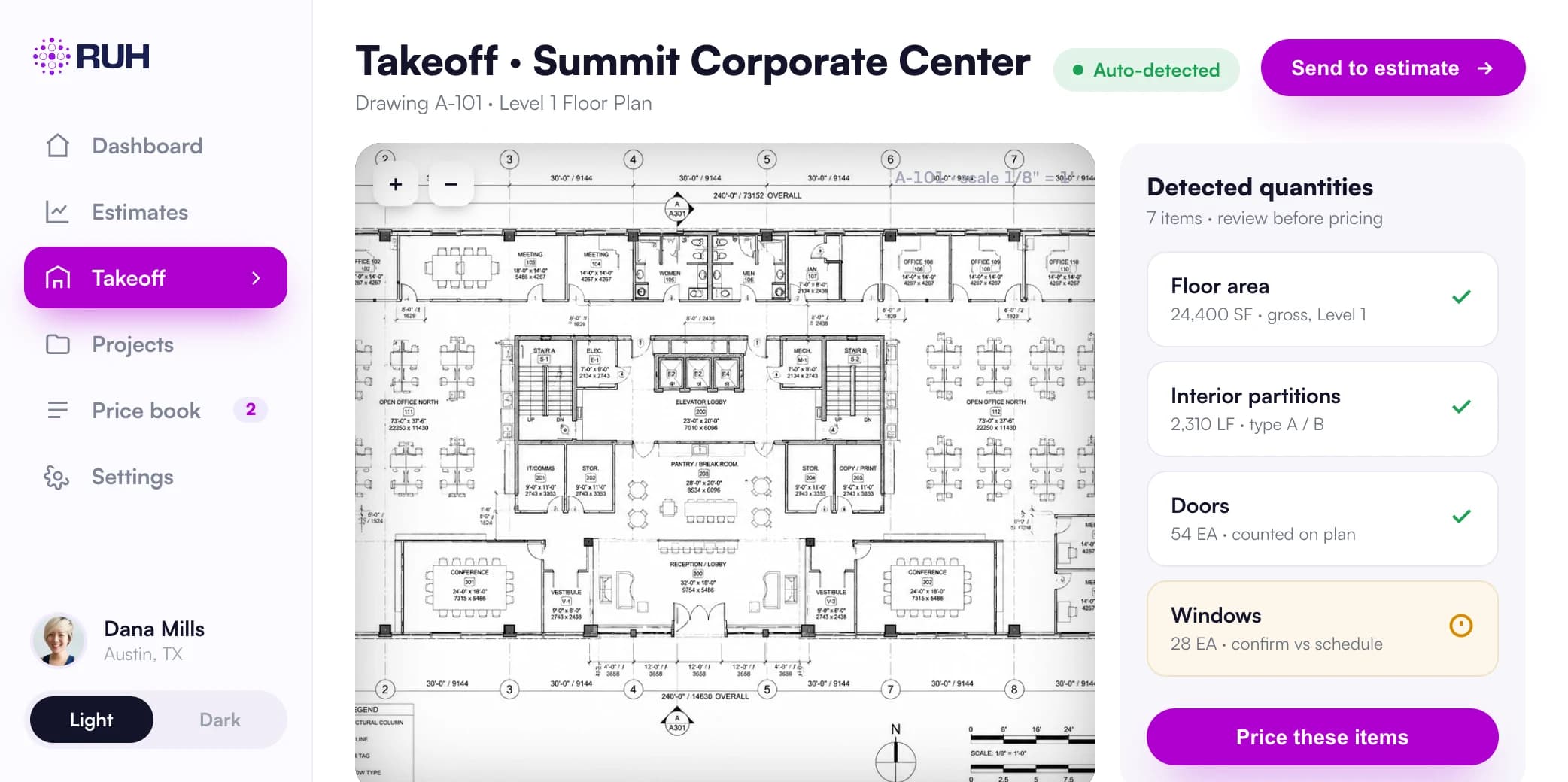
Ruh reads the roof plan and roofing details, takes the field membrane in sf and converts to squares, then applies the lap and waste factor for the ordering quantity. It pulls parapet, curb, and penetration flashing as separate lineal lines and prices the membrane and accessories on the contractor's own price book. The estimator confirms the attachment method, waste factor, and flashing scope, then signs off.

See construction estimating software

Membrane roofing: frequently asked questions

What is a roofing square?+

One roofing square equals 100 square feet of roof area. Membrane material and labor are commonly ordered and priced by the square, so net sf is divided by 100.

Why add a lap and waste factor?+

Single-ply sheets overlap at side and end seams and produce field cutoffs. A factor of roughly 5 to 15 percent over net area covers laps and waste so the ordered quantity is not short.

Is flashing included in the membrane sf?+

No. Perimeter, curb, and penetration flashing are taken off the roof details as separate lineal items because they carry different unit rates than field membrane.

Still measuring by hand? Your next takeoff can run while you review this one.

See it on your plans

Related terms

Keep going: read the full guide or explore construction estimating software.

The Envelope and finishes estimating cheat sheet
Every unit, waste factor, and conversion on one page. Free PDF.

See Ruh price a bid from your own drawings.

AI takeoff and estimating on your price book, your estimator signs off.

Figures on this page are illustrative. Construction estimates depend on project-specific conditions, source documents, market pricing, and professional judgment. Ruh's AI assists the estimator and does not replace professional review: your team reviews, validates, and approves every estimate, bid, and pricing decision.