100% money-backBook a walkthrough

Construction glossary · MEP

What is panelboard in construction?

A panelboard in construction is a wall-mounted electrical distribution assembly that accepts one incoming feeder and splits it into branch circuits, each protected by its own circuit breaker. It is the gray box behind a hinged door in an electrical room or corridor wall, commonly a 42-circuit, 208Y/120V panel in US commercial work. Estimators count panelboards each (ea) from the one-line diagram and panel schedules, then price the breakers, feeder, and connections that go with each one.

Updated June 2026 · Reviewed by the Ruh construction team

Distributes branch circuitsCommon size 42-circuitCounted from panel schedule

How panelboard circuits are counted

+ 30 more42 circuitsBranch circuitpanel schedule

Estimating mep scope this week? Watch Ruh take off a real plan in 30 minutes.

Book a walkthrough
Definition

A panelboard is where power distribution gets local: a feeder lands on the main lugs or main breaker, and branch breakers send circuits out to receptacles, lighting, and equipment. The term lives in three places in the documents: the one-line diagram (which shows every panel and what feeds it), the panel schedules (one per panel, listing each circuit, breaker size, and load), and the electrical floor plans (which show physical locations). The scope belongs to the Division 26 electrical contractor. Standard commercial products come in 18, 30, and 42 circuit sizes; the 42-circuit, 225 A, 208Y/120V panel is the workhorse of tenant improvement work. New estimators make two predictable mistakes. They count panels off the floor plan and never open the panel schedules, missing the difference between a main breaker panel and a main lug only (MLO) panel, the breaker fill, and feed-through lugs, all of which move price. And they price the box but forget what connects to it: the feeder conduit and wire, plywood backing or supports, and the typed circuit directory the spec requires at closeout.

How it is measured

Panelboards are counted each (ea) from the one-line diagram, then verified against the panel schedules, which carry the data that drives cost: voltage (208Y/120V versus 480Y/277V), ampere rating (100 A, 225 A, 400 A), number of circuits, main breaker versus main lug only, bus material (copper versus aluminum), and enclosure type (NEMA 1 indoors, NEMA 3R outdoors). The breaker fill is taken off line by line from the schedule, since a panel can arrive with anywhere from a handful of breakers to a full 42. Feeders to each panel are measured separately in linear feet of conduit and wire. A complete takeoff line for one panel reads: quantity 1 ea, plus its breakers, plus its feeder length.

Worked example

Worked example

Count the gear for a three-story office tenant improvement off the one-line. The diagram shows one 480Y/277V distribution panel at the electrical room and three 225 A, 42-circuit, 208Y/120V panelboards, one per floor, each fed through a step-down transformer. The count is 3 ea branch panelboards plus 1 ea distribution panel, 4 panels total. Price it with illustrative numbers: each 42-circuit 208Y/120V MLO panel at $2,800 installed gives 3 x $2,800 = $8,400. The 480V distribution panel runs $6,500 ea. The schedules show each branch panel filled with 30 breakers averaging $15 each: 3 x 30 x $15 = $1,350. The gear subtotal is $8,400 + $6,500 + $1,350 = $16,250, before the feeders and the step-down transformers, which are taken off as their own lines.

100%

Try Ruh on a real bid. 100% money-back guarantee if you are not satisfied.*

*Scoped delivery, terms apply. Read the guarantee terms

Start with a walkthrough
How Ruh handles it

How Ruh handles panelboard

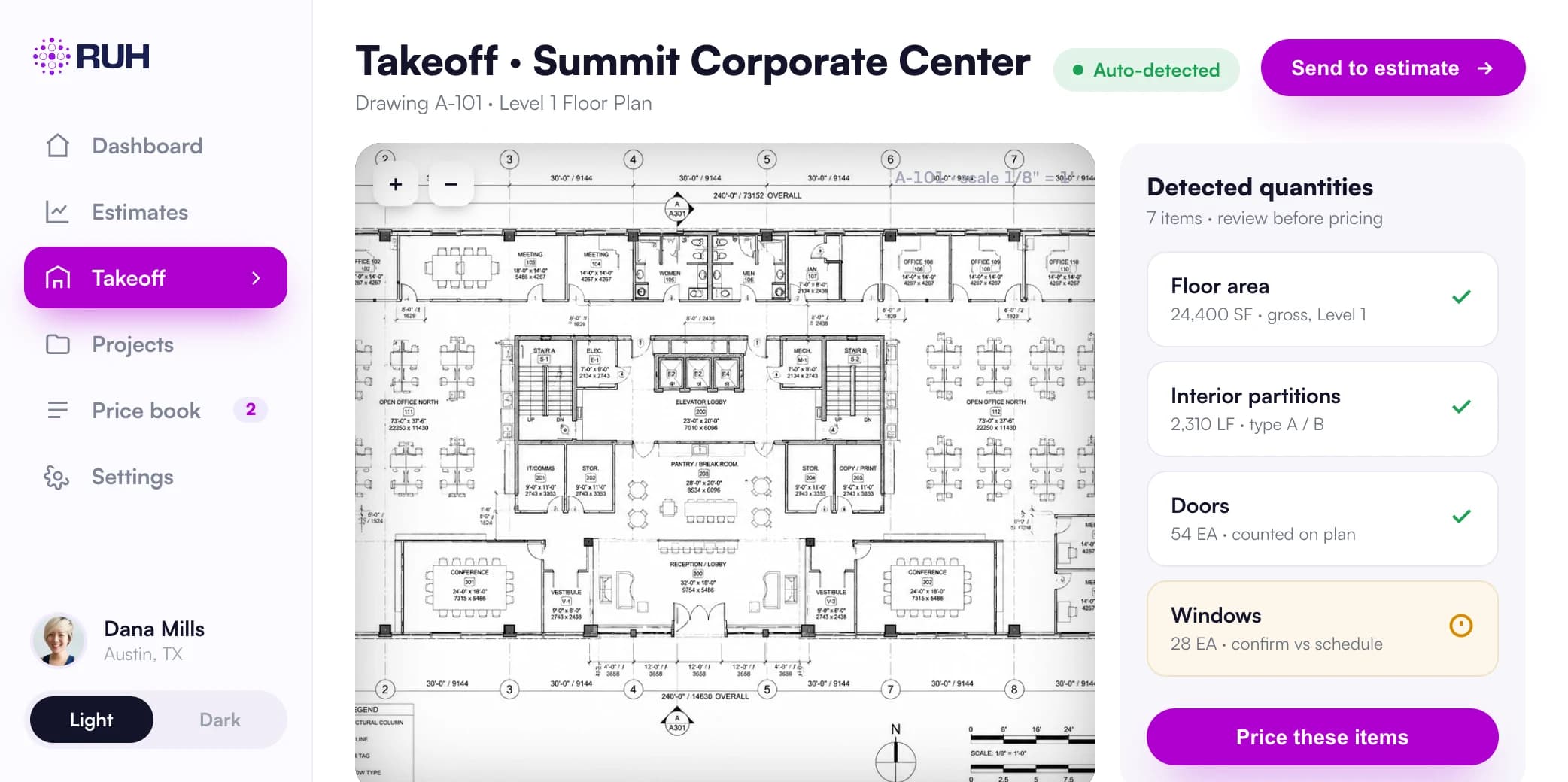
Ruh reads the one-line diagram and panel schedules from the contractor's drawing set, counts every panelboard with its breaker fill, and prices the gear against the contractor's own price book rather than generic cost data. The estimator gets a line-item draft, checks the counts against the schedules, adjusts for project conditions, and signs off.

See AI construction takeoff and estimating software

Panelboard: frequently asked questions

What is the difference between a panelboard and a switchboard?+

A panelboard is wall-mounted (flush or surface), accessed and serviced from the front only, and listed to UL 67. A switchboard is free-standing floor gear, often rear-accessible, listed to UL 891, and built for larger services. On a one-line they can look similar, so check the equipment schedule and specifications before pricing: a switchboard costs several times what a panelboard does and needs a housekeeping pad and rigging.

What does MLO mean on a panel schedule?+

MLO stands for main lug only: the feeder conductors land directly on the panel bus lugs with no main breaker inside the panel. Protection comes from the feeder breaker upstream. A main breaker panel costs more than the equivalent MLO panel and is required in some applications, such as service entrance use, so the takeoff should record which type each panel schedule calls for.

Why are commercial panelboards 42 circuits?+

Older editions of the National Electrical Code capped lighting and appliance panelboards at 42 overcurrent devices, and manufacturers standardized on 18, 30, and 42 circuit products. The hard limit was later removed from the code, but 42-circuit panels remain the standard commercial size, so panel schedules and price books are still built around them. Larger circuit counts exist but price as special order.

Still measuring by hand? Your next takeoff can run while you review this one.

See it on your plans

Related terms

Keep going: read the full guide or explore AI construction takeoff and estimating software.

The MEP estimating cheat sheet
Every unit, waste factor, and conversion on one page. Free PDF.

See Ruh price a bid from your own drawings.

AI takeoff and estimating on your price book, your estimator signs off.

Figures on this page are illustrative. Construction estimates depend on project-specific conditions, source documents, market pricing, and professional judgment. Ruh's AI assists the estimator and does not replace professional review: your team reviews, validates, and approves every estimate, bid, and pricing decision.