100% money-backBook a walkthrough

Construction glossary · MEP

What is transformer in construction?

A transformer in construction is electrical distribution equipment that changes voltage between systems, most commonly stepping a commercial building's 480V distribution down to 208Y/120V for receptacles and general loads. Transformers are rated in kilovolt-amperes (kVA), with 75 kVA dry-type units among the most common in US commercial work. Estimators count them each (ea) from the one-line diagram, where every transformer appears with its kVA rating and its primary and secondary voltages.

Updated June 2026 · Reviewed by the Ruh construction team

Steps voltage up/downRated in kVACounted from the e-schedule

How transformers are counted

6 EADry-type transformerelectrical schedule

Estimating mep scope this week? Watch Ruh take off a real plan in 30 minutes.

Book a walkthrough
Definition

In commercial buildings the transformer an estimator prices most often is the dry-type distribution transformer: a 480V delta primary, 208Y/120V wye secondary unit sitting in an electrical room, stepping power down for the local panelboard. Transformers live on the one-line diagram, which states kVA, voltages, and what each unit feeds; the floor plans show physical locations, and the specifications carry the details that move price (K-rating for harmonic loads, temperature rise, winding material, sound limits). The scope belongs to the Division 26 electrical contractor. Standard dry-type kVA sizes step 15, 30, 45, 75, 112.5, 150, 225, 300. New estimators get burned by what surrounds the unit rather than the unit itself: the housekeeping pad and vibration isolation for floor-mounted units, seismic anchorage where required, and the secondary feeder, which is the expensive surprise. Stepping 480V down to 208V multiplies the current, so the secondary conduit and conductors are far heavier than the primary side, and pricing both feeders at the primary size will sink the line item.

How it is measured

Transformers are counted each (ea) from the one-line diagram, with the kVA rating carried on every takeoff line because kVA drives both the equipment price and the feeder sizes around it. The other cost drivers come from the specifications and equipment schedule: K-rated versus standard units, copper versus aluminum windings, temperature rise rating, enclosure type, and mounting (wall, trapeze-hung, or floor-set on a housekeeping pad). The primary and secondary feeders are measured separately in linear feet of conduit and wire, and the pad, vibration isolators, and seismic anchors are their own lines. A transformer line on the takeoff reads: 1 ea, 75 kVA, 480V to 208Y/120V, floor mounted, plus its supporting items.

Worked example

Worked example

Take one 75 kVA dry-type transformer, 480V primary, 208Y/120V secondary, from the one-line. First the current math that drives the feeders. Secondary full load amps: 75,000 VA / (208V x 1.732) = 75,000 / 360.3 = 208.2 A. Primary full load amps: 75,000 / (480V x 1.732) = 75,000 / 831.4 = 90.2 A. The secondary carries more than twice the current of the primary, which is why the secondary feeder conductors are much larger. Now price the unit with illustrative numbers: transformer material at $4,200, housekeeping pad and vibration isolation at $350, and setting and connection labor of 16 hours x $95 = $1,520. The installed line is $4,200 + $350 + $1,520 = $6,070 ea, before the primary and secondary feeders, which are taken off separately in linear feet. A handy field check: a 75 kVA unit at 208Y/120V lands at roughly 208 A on the secondary, an easy number to remember.

100%

Try Ruh on a real bid. 100% money-back guarantee if you are not satisfied.*

*Scoped delivery, terms apply. Read the guarantee terms

Start with a walkthrough
How Ruh handles it

How Ruh handles transformer

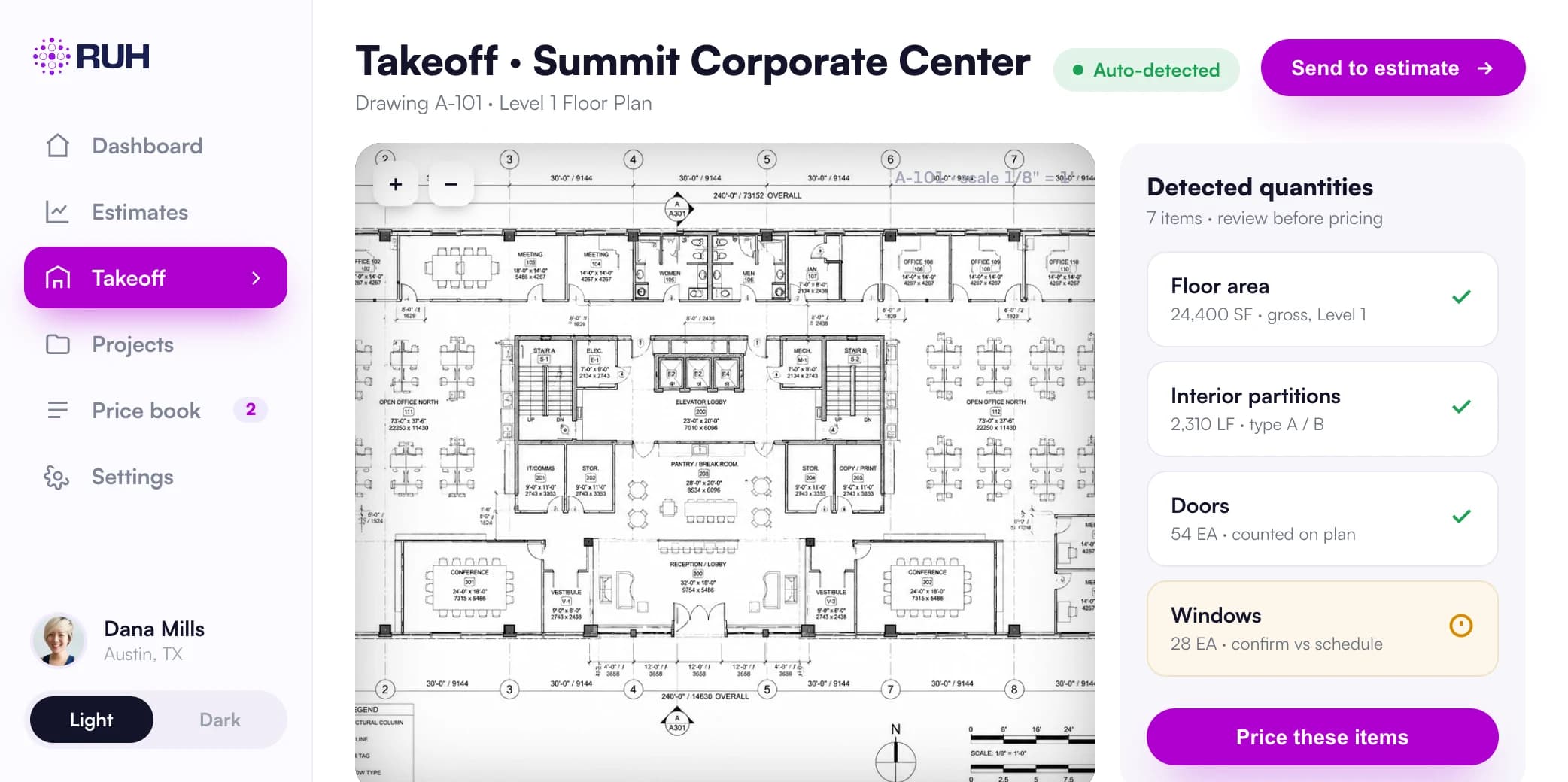
Ruh reads the one-line and equipment schedules, picks up each transformer with its kVA rating and mounting, and prices the unit and its supporting items from the contractor's own price book. The draft estimate goes to the estimator, who verifies the kVA counts against the one-line, checks the feeder assumptions on both sides of each unit, and signs off.

See AI construction takeoff and estimating software

Transformer: frequently asked questions

How is a transformer sized in kVA?+

The electrical engineer sizes it from the connected load on the secondary panel with applicable demand factors, then rounds up to a standard rating (15, 30, 45, 75, 112.5, 150, 225, or 300 kVA for common dry-type units). The estimator does not size transformers; the takeoff prices exactly the kVA shown on the one-line. If a load study changes the size during design, the one-line revision is the trigger to reprice.

What is the difference between a dry-type and a pad-mounted transformer?+

Dry-type transformers are air-cooled units installed indoors in electrical rooms, owned by the building, and priced in the electrical contractor's scope. Pad-mounted transformers are liquid-filled units sitting outdoors on a concrete pad at the service entrance, usually owned by the utility, with the contractor providing the pad, the conduit, and sometimes the secondary conductors per the utility's requirements. Confirming who furnishes what is a bid-day question worth asking twice.

What is a K-rated transformer and why does it cost more?+

A K-rated transformer is built to handle the extra heating caused by harmonic-rich loads such as variable frequency drives and electronic equipment, using heavier windings and an oversized neutral. The K-factor rating (K-4, K-13, and so on) appears in the specifications or on the one-line. It adds meaningfully to the unit price, so a takeoff that assumes standard units when the spec calls for K-rated ones will be low on every transformer line.

Still measuring by hand? Your next takeoff can run while you review this one.

See it on your plans

Related terms

Keep going: read the full guide or explore AI construction takeoff and estimating software.

The MEP estimating cheat sheet
Every unit, waste factor, and conversion on one page. Free PDF.

See Ruh price a bid from your own drawings.

AI takeoff and estimating on your price book, your estimator signs off.

Figures on this page are illustrative. Construction estimates depend on project-specific conditions, source documents, market pricing, and professional judgment. Ruh's AI assists the estimator and does not replace professional review: your team reviews, validates, and approves every estimate, bid, and pricing decision.