Construction glossary · MEP
What is circuit breaker in construction?
A circuit breaker in construction is an overcurrent protective device that automatically opens a circuit when the current exceeds its rating, protecting the conductors and equipment downstream from overloads and short circuits. Unlike a fuse, it resets instead of being replaced. In commercial buildings breakers live inside panelboards, switchboards, and switchgear, and estimators count them each (ea) from the panel schedules and the one-line diagram.
Updated June 2026 · Reviewed by the Ruh construction team
How breakers are counted in a panel
Estimating mep scope this week? Watch Ruh take off a real plan in 30 minutes.
Book a walkthroughCircuit breakers are the most numerous piece of distribution equipment on any commercial electrical takeoff. Branch breakers (the single-pole 20 A units feeding receptacles and lighting) appear line by line on the panel schedules; feeder and main breakers (larger frames feeding panels and equipment) appear on the one-line diagram. The Division 26 electrical contractor owns the scope. Price is driven less by amp rating than new estimators expect: the frame size, the number of poles, and above all the interrupting rating (AIC, the fault current the breaker can safely clear) separate a breaker costing around $15 from one closer to $850. The classic mistakes: double counting breakers that arrive factory-installed in gear already priced as an assembly, missing GFCI, AFCI, or shunt trip types called out in the schedule notes, treating spares and spaces as identical (a spare is an installed breaker, a space is an empty slot in the bus), and skipping the AIC column entirely, which can understate the whole gear package by thousands of dollars.
Breakers are counted each (ea), grouped by poles (1P, 2P, 3P), trip rating in amperes, frame size, mounting style (bolt-on is standard in commercial panels), and interrupting rating in kAIC. Branch breakers come straight off the panel schedules, one line per circuit. Feeder and main breakers come off the one-line diagram and the distribution equipment schedules. Special function breakers (GFCI, ground fault equipment protection, shunt trip for kitchen hoods and elevator circuits) are flagged in schedule notes and priced separately because they can cost several times the standard unit. The takeoff also records whether each breaker is loose material for field installation or factory-installed in gear already carried elsewhere in the estimate.
Worked example
Price the breaker fill for one 42-circuit, 208Y/120V panel from its schedule. The schedule lists 18 single-pole 20 A breakers for receptacles and lighting, 6 two-pole 30 A breakers for equipment, and 3 three-pole 40 A breakers for mechanical loads. Pole check: 18 + (6 x 2) + (3 x 3) = 18 + 12 + 9 = 39 poles used of 42, leaving 3 spaces. With illustrative bolt-on pricing of $14 for the 1P 20 A, $55 for the 2P 30 A, and $120 for the 3P 40 A: 18 x $14 = $252, 6 x $55 = $330, 3 x $120 = $360. Material for the fill totals $252 + $330 + $360 = $942. For contrast, the single 3-pole 100 A feeder breaker serving this panel from the distribution board, at a higher interrupting rating, carries an illustrative $850 by itself. Frame size and AIC, not quantity, drive breaker dollars.
Try Ruh on a real bid. 100% money-back guarantee if you are not satisfied.*
*Scoped delivery, terms apply. Read the guarantee terms
How Ruh handles circuit breaker
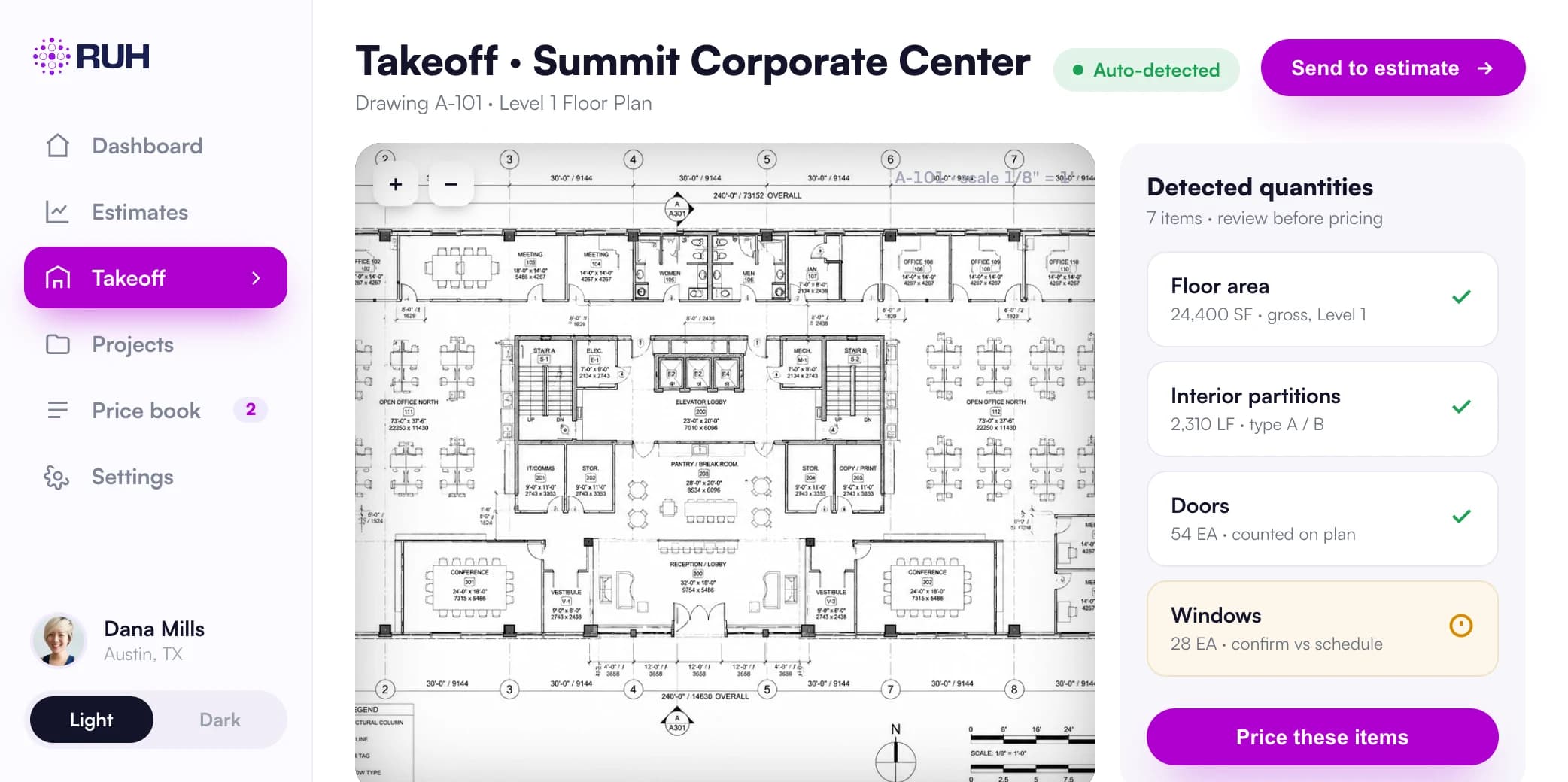
Ruh takes the panel schedules and one-line from the drawing set, counts every breaker by poles, trip rating, and type, and prices them from the contractor's own price book, flagging which units are factory-installed in gear versus loose material. The estimator reviews the counts, confirms the interrupting rating assumptions, and signs off before the numbers reach the bid.
See AI construction takeoff and estimating softwareCircuit breaker: frequently asked questions
What does the AIC rating on a circuit breaker mean?+
AIC (ampere interrupting capacity) is the maximum fault current a breaker can safely interrupt, commonly 10, 22, or 65 kAIC in commercial work. The engineer's fault current study sets the requirement, and the breaker rating has to meet or exceed the available fault current at its location. Higher AIC means a meaningfully higher price, so pricing a whole job at standard interrupting ratings when the one-line calls for higher ones leaves the estimate badly low.
Are circuit breakers included in the price of a panelboard?+
It depends on how the gear is bought. Panelboards are often quoted as a factory-assembled package with the breaker fill from the schedule included, but interiors, enclosures, and breakers can also be bought separately, and circuits added during construction are field-installed. The takeoff should state which convention it used, because pricing breakers inside the panel assembly and again as loose material is one of the most common ways an electrical estimate double counts.
What is the difference between a circuit breaker and a fuse?+
Both interrupt fault current, but a breaker is a mechanical device that trips and resets, while a fuse melts and must be replaced. Commercial branch circuits are almost always breaker-protected because resetting is cheaper than restocking fuses, but fused disconnects still appear at equipment connections, often because the equipment nameplate requires fuse protection. The takeoff prices those as fused switches with their fuses, a separate line from breakers.
Still measuring by hand? Your next takeoff can run while you review this one.
See it on your plansRelated terms
Keep going: read the full guide or explore AI construction takeoff and estimating software.
See Ruh price a bid from your own drawings.
AI takeoff and estimating on your price book, your estimator signs off.
Figures on this page are illustrative. Construction estimates depend on project-specific conditions, source documents, market pricing, and professional judgment. Ruh's AI assists the estimator and does not replace professional review: your team reviews, validates, and approves every estimate, bid, and pricing decision.