Construction glossary · MEP
What is switchgear in construction?
Switchgear in construction is the heavy, free-standing electrical distribution equipment at the top of a building's power system: an assembly of vertical sections housing the main and feeder circuit breakers, bussing, and metering. In commercial estimating the word matters because switchgear, switchboards, and panelboards are different products at very different price points and lead times. Estimators count switchgear each (ea), or per lineup, from the one-line diagram.
Updated June 2026 · Reviewed by the Ruh construction team
How switchgear lineups are counted
Estimating mep scope this week? Watch Ruh take off a real plan in 30 minutes.
Book a walkthroughSwitchgear sits at the service entrance or the top of the distribution tree on the one-line diagram, and it is the single most expensive piece of electrical equipment on most jobs that have it. True low-voltage switchgear is built to ANSI/IEEE switchgear standards with draw-out power circuit breakers that rack out for maintenance, individual breaker compartments, and rear access; switchboards (listed to UL 891) use fixed or group-mounted breakers and cost a fraction as much. The scope is Division 26, but it touches everyone: the gear needs a concrete housekeeping pad, rigging to set multi-section lineups, utility coordination, and room clearances the GC has to protect. Two estimating mistakes dominate. First, reading the word loosely: if the one-line and specification actually describe a switchboard, pricing true draw-out switchgear (or the reverse) misses by a multiple, not a percentage. Second, ignoring procurement: switchgear is engineered to order with lead times that frequently run many months, often the longest-lead item on the project, so bid-day pricing needs escalation and the schedule needs the delivery date.
Switchgear is counted from the one-line diagram as a lineup (1 ea) with its attributes recorded: voltage class (480Y/277V is typical for low-voltage commercial gear), main bus ampacity (1,600 A, 2,000 A, 3,000 A, 4,000 A), interrupting rating, number of vertical sections, and the count and frame size of every breaker in the lineup, taken from the one-line and the gear elevation. Options drive real money: utility metering compartments, surge protective devices, ground fault systems, and spare breakers or prepared spaces. Beyond the gear itself, the takeoff carries the housekeeping pad, rigging and setting, and the incoming service conduits, each as separate lines.
Worked example
Count the service gear for a mid-rise office building off the one-line. The diagram shows one 2,000 A, 480Y/277V low-voltage switchgear lineup: three vertical sections, one 2,000 A draw-out main breaker, and eight feeder breakers serving distribution panels and mechanical equipment. The count is 1 ea lineup, 3 sections, 9 breakers total (1 main + 8 feeders). Price it with illustrative numbers: the lineup furnished at $145,000, rigging and setting the three sections at $8,500, and the housekeeping pad at $1,200, for $145,000 + $8,500 + $1,200 = $154,700 before the service and feeder conduits. The same one-line scope built as a UL 891 switchboard might be furnished at an illustrative $60,000 instead, an $85,000 swing on a single line item. That spread is the whole reason estimators read the specification section before pricing, not just the one-line symbol.
Try Ruh on a real bid. 100% money-back guarantee if you are not satisfied.*
*Scoped delivery, terms apply. Read the guarantee terms
How Ruh handles switchgear
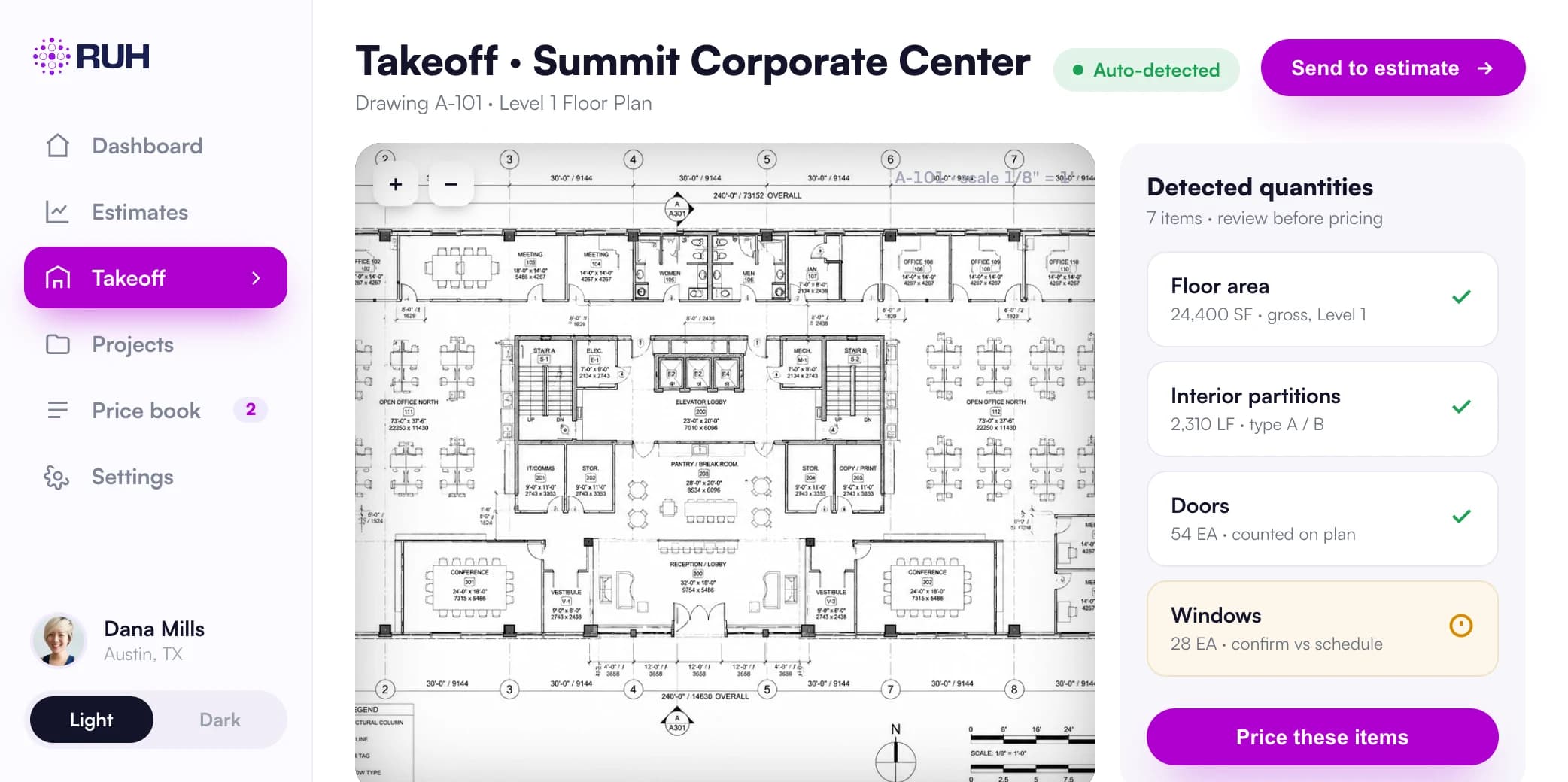
Ruh performs the distribution gear takeoff from the one-line, identifying the lineup, its sections, and every breaker, and prices the package using the contractor's own price book so the draft reflects their real cost history rather than database averages. The estimator then confirms whether the spec calls for switchgear or a switchboard, layers in current vendor quotes and lead times, and signs off on the final number.
See AI construction takeoff and estimating softwareSwitchgear: frequently asked questions
What is the difference between switchgear and a switchboard?+
Switchgear uses individually compartmented, draw-out power circuit breakers built to ANSI/IEEE switchgear standards, is rear-accessible, and is designed so breakers can be racked out and serviced without shutting down the bus. A switchboard, listed to UL 891, uses fixed or group-mounted breakers, is usually front-accessible, and costs far less. Hospitals, data centers, and critical facilities specify switchgear for maintainability; most ordinary commercial buildings are served by switchboards.
Why does switchgear have such long lead times?+
Switchgear is engineered to order: each lineup is custom configured, the submittal and approval cycle happens before fabrication starts, and utility metering requirements add coordination. Lead times of many months are routine, and the gear is often the item that sets the building's power-on date. Estimators flag the lead time at bid, and project teams often release the gear submittal first for exactly this reason.
Does switchgear need a concrete pad and rigging?+
Yes. Free-standing gear sits on a concrete housekeeping pad, typically a few inches tall, coordinated between the electrical and concrete scopes. Multi-section lineups are heavy enough to need rigging equipment, a planned route into the electrical room, and sometimes a wall or slab opening left out of sequence. Those costs belong in the estimate as separate lines, and forgetting them is a classic takeoff miss.
Still measuring by hand? Your next takeoff can run while you review this one.
See it on your plansRelated terms
Keep going: read the full guide or explore AI construction takeoff and estimating software.
See Ruh price a bid from your own drawings.
AI takeoff and estimating on your price book, your estimator signs off.
Figures on this page are illustrative. Construction estimates depend on project-specific conditions, source documents, market pricing, and professional judgment. Ruh's AI assists the estimator and does not replace professional review: your team reviews, validates, and approves every estimate, bid, and pricing decision.