100% money-backBook a walkthrough

Construction glossary · MEP

What is cable tray in construction?

Cable tray in construction is an open, ladder or trough shaped support system that carries runs of cables overhead, used where many circuits travel a common route, such as data centers, industrial plants, and electrical rooms. Unlike conduit, the tray supports the cables rather than enclosing them, so circuits can be added or rerouted without pulling through a closed raceway. Estimators measure cable tray in linear feet by width and type, with fittings, supports, and covers counted separately.

Updated June 2026 · Reviewed by the Ruh construction team

Routes power & low-voltage cableMeasured in LFWidth 6 to 36 in

How cable tray is supported & measured

5 ft o.c.tray runoverhead routing

Estimating mep scope this week? Watch Ruh take off a real plan in 30 minutes.

Book a walkthrough
Definition

Cable tray is an open support structure, ladder rungs or a ventilated trough between two side rails, that carries cables in bulk along a common route. It shows up on electrical power plans with width callouts, in riser diagrams, and in the Division 26 specs; data centers and industrial plants often carry a dedicated tray layout sheet. The electrical subcontractor typically owns power tray, while wire mesh basket tray for structured cabling often belongs to the low voltage contractor, a scope split worth confirming at bid time. Because the tray is open, the cables in it must be rated for tray use, and the NEC treats the tray itself as a support system rather than a raceway. New estimators reliably underprice the route geometry: straight tray is the cheap part, while horizontal elbows, tees, vertical risers, trapeze supports on threaded rod, grounding jumpers, and covers are each-count items that can rival the straight footage cost on a route with many turns.

How it is measured

Cable tray is measured in linear feet (lf) by width (commonly 6 to 36 in), depth, and type (ladder, ventilated trough, solid bottom, wire mesh basket). Straight sections come in standard lengths, so the lf converts to a piece count, and every change of direction becomes an each item: horizontal 90s and 45s, tees, crosses, and vertical inside and outside risers. Supports are counted at the spacing the spec and load class require, usually trapeze hangers on threaded rod. Cost drivers are width, material (galvanized steel, aluminum, stainless), installation height, and fitting density. Routes live on the power plans and riser diagrams, with mounting details in the electrical details sheets.

Worked example

Worked example

An electrical room to data room route calls for 18 in wide aluminum ladder tray. The plan run scales at 160 lf, plus a 20 lf vertical riser between floors: 160 + 20 = 180 lf. Straight sections come in 12 ft lengths, so 180 / 12 = 15 sections. The route geometry adds 4 horizontal 90s, 2 vertical riser fittings, and 1 tee, so 7 fittings. Trapeze supports at 8 ft spacing: 180 / 8 = 22.5, carried as 23 supports. At an illustrative installed price of $38 per lf for straight tray, the footage extends to 180 x $38 = $6,840, and at an illustrative average of $310 installed per fitting, 7 x $310 = $2,170. The route totals $9,010 before covers and grounding, and the fittings alone are nearly a third of the straight tray cost, which is why counting them matters.

100%

Try Ruh on a real bid. 100% money-back guarantee if you are not satisfied.*

*Scoped delivery, terms apply. Read the guarantee terms

Start with a walkthrough
How Ruh handles it

How Ruh handles cable tray

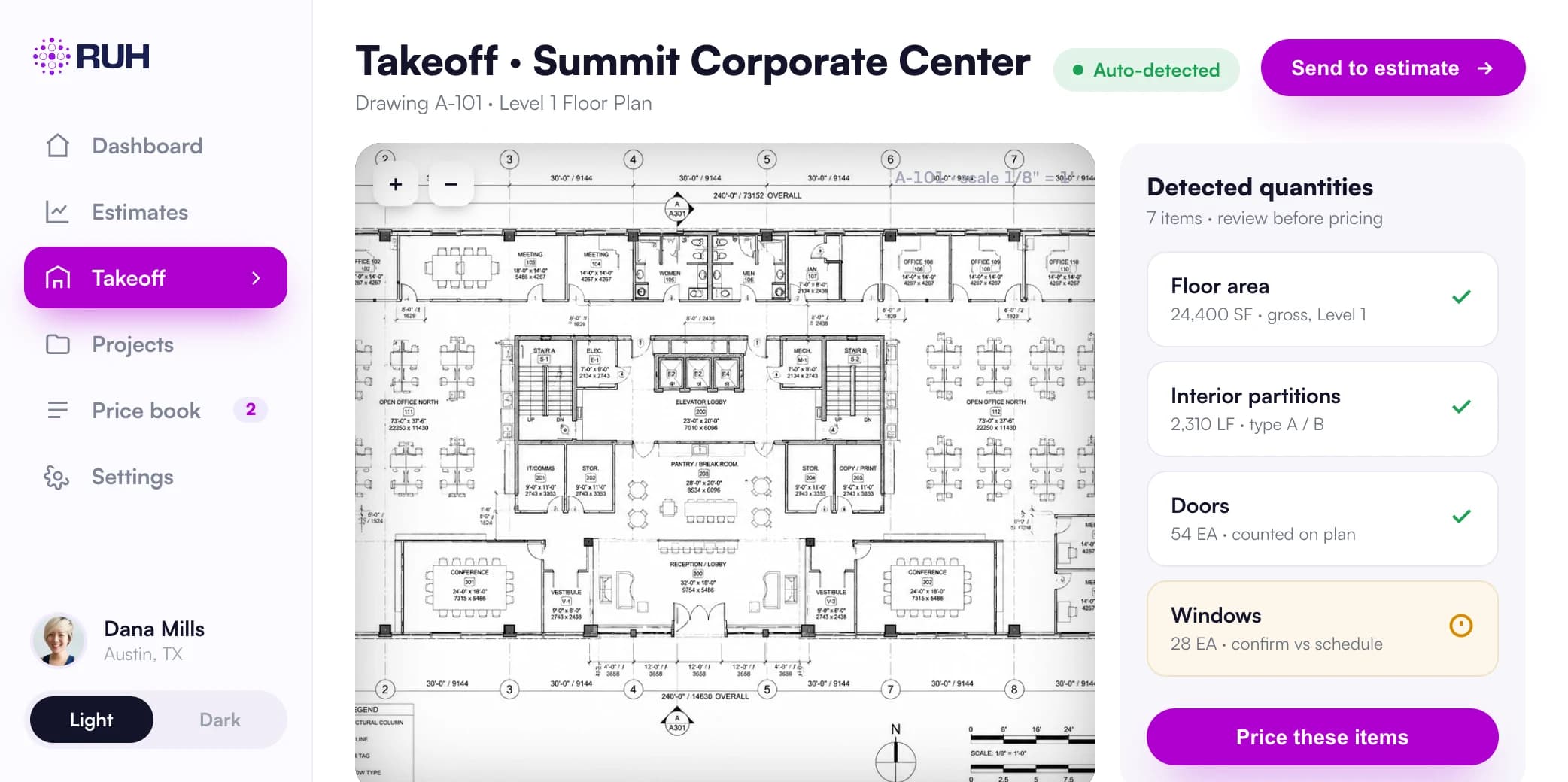
Ruh measures the tray routes off the plans, separates the lf by width and type, and counts the elbows, tees, and supports the route geometry implies. Everything prices against the contractor's own price book, and the estimator gets a draft with the fitting counts visible rather than buried in an allowance, ready to review and sign off.

See AI construction takeoff and estimating software

Cable tray: frequently asked questions

What is the difference between cable tray and conduit?+

Conduit encloses conductors in a closed tube that wires are pulled through; cable tray is an open structure that cables are laid into and secured. Tray wins where dozens of circuits share a route, because adding or rerouting a cable does not require pulling through a closed raceway, which is why data centers and industrial plants standardize on it. The cables themselves must be rated for tray installation.

What types of cable tray are there?+

Ladder tray (two side rails with rungs) is the standard for power feeders. Ventilated trough and solid bottom trays support smaller cables continuously, and wire mesh basket tray is the lightweight choice for structured cabling and low voltage pathways. Each comes in standard widths, commonly 6 to 36 in, in steel, aluminum, or stainless, and the spec assigns a load class that the supports must match.

How do you estimate cable tray on a commercial project?+

Take off the straight tray in lf by width and type from the plan routes, including the vertical risers the plan view hides. Then count fittings (horizontal and vertical elbows, tees, crosses) as each items, supports at the spacing the spec and load class require, and add covers, dividers, and grounding hardware where called out. On fitting-dense routes the each-count items can approach the cost of the straight footage.

Still measuring by hand? Your next takeoff can run while you review this one.

See it on your plans

Related terms

Keep going: read the full guide or explore AI construction takeoff and estimating software.

The MEP estimating cheat sheet
Every unit, waste factor, and conversion on one page. Free PDF.

See Ruh price a bid from your own drawings.

AI takeoff and estimating on your price book, your estimator signs off.

Figures on this page are illustrative. Construction estimates depend on project-specific conditions, source documents, market pricing, and professional judgment. Ruh's AI assists the estimator and does not replace professional review: your team reviews, validates, and approves every estimate, bid, and pricing decision.