100% money-backBook a walkthrough
Construction glossary · Sitework

What is mass excavationin construction?

Mass excavation in construction is the large, open cutting of soil that lowers a site or building pad to the elevation shown on the grading plan, as opposed to digging confined footings or trenches. Because the equipment works in the open with room to swing and load, it is the cheapest excavation per cubic yard on the job. It is quantified and priced in bank cubic yards, the in-place volume before the soil swells in the truck.

Free 30-minute walkthrough on your own drawings. No card.

Updated June 2026 · Reviewed by the Ruh construction team

Measured in bank cySwell factor 25% (common earth)Lives on grading planCost driver haul distance and volume

How mass excavation is measured

200 ft4 ft150 ft
The definition

Mass excavation, explained.

Mass excavation (also called bulk excavation or the mass cut) is the open-cut earthmoving that takes a site from existing grade down to subgrade or to the bottom of a basement. It lives on the civil grading plan as the gap between existing contours (usually screened or dashed) and proposed contours, while the Division 31 earthwork specs and the geotech report define suitable material, unsuitable material, and rock. The sitework contractor owns it, running excavators with articulated off-road trucks, scrapers on bigger sites, or dozers pushing short distances. New estimators get two things wrong. First, they price mass and structural excavation at one blended rate, when the open cut might run a fraction of the confined rate because production is so much higher. Second, they treat the cut volume as the whole story and forget to ask where the dirt goes: material reused as fill on site costs a fraction of dirt loaded, hauled, and dumped at a fee site.

How it is measured

Mass excavation is measured in bank cubic yards (bcy), computed from the difference between the existing surface and the design subgrade. Estimators build it with earthwork software comparing two surfaces, or by hand with the grid method or average end areas. Cost drivers are total volume (mobilizing big iron only pays above a threshold), push or haul distance, soil type and moisture from the geotech borings, rock, and the destination of the spoils. Trucking is sized in loose cubic yards after swell, so the same line carries two volumes: bank for the dig, loose for the haul. The grading plan, geotech report, and topographic survey are the controlling documents.

Worked example

A worked mass excavation example.

Worked example

Bank volume30,000 sf x 4 ft = 120,000 cf
Bank cy120,000 / 27 = 4,444.4, call it 4,444 bank cy
Dig and load (illustrative)4,444 x $5 = $22,220
Trucking (illustrative)397 x $110 = $43,670
Dig plus haul$22,220 + $43,670 = $65,890
How Ruh handles it

How Ruh handles mass excavation.

100%

Try Ruh on a real bid. 100% money-back guarantee if you are not satisfied.*

*Scoped delivery, terms apply. Read the guarantee terms

Start with a walkthrough

Mass excavation: frequently asked questions

What is the difference between mass excavation and structural excavation?+

Mass excavation is the open cut that lowers the whole site or pad, dug with large equipment at high production. Structural excavation is the confined digging for footings, grade beams, pits, and elevator shafts after the mass cut is done, usually slower and several times more expensive per cubic yard. Specs and bid forms often separate them so the unit prices reflect the different work, and estimators should never blend them into one rate.

What is the difference between a bank cubic yard and a loose cubic yard?+

A bank cubic yard (bcy) is soil measured in place, before excavation. Once dug, it swells: common earth at an illustrative 25 percent swell turns 1 bcy into 1.25 loose cubic yards (lcy) in the truck or stockpile. Compact it as fill and it shrinks below its bank volume. Pay quantities for mass excavation are usually bank measure, while truck counts and stockpile sizes run in loose measure.

How do estimators calculate mass excavation volume?+

By comparing two surfaces: the existing grade from the topographic survey and the design subgrade from the grading plan. Earthwork software builds both surfaces and reports the volume between them. By hand, the grid method divides the site into cells, averages cut depth at each cell's corners, and multiplies depth by cell area, while the average end area method works from cross sections. Either way the answer is in bank cubic yards.

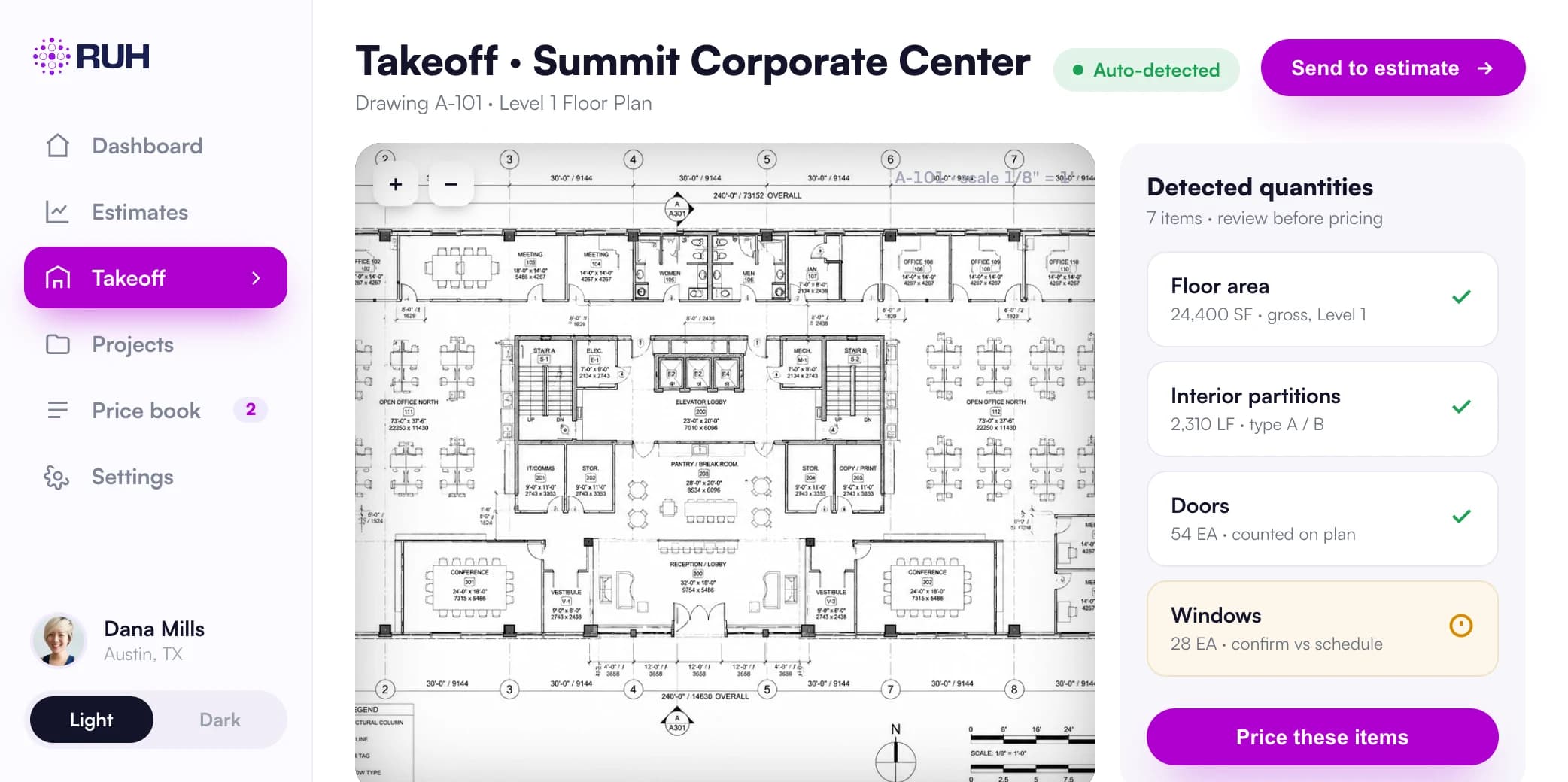
Still measuring by hand? Your next takeoff can run while you review this one.

See it on your plans

Related terms

Keep going: read the full guide or explore AI construction takeoff and estimating software.

The Sitework estimating cheat sheet
Every unit, waste factor, and conversion on one page. Free PDF.

Figures on this page are illustrative. Construction estimates depend on project-specific conditions, source documents, market pricing, and professional judgment. Ruh's AI assists the estimator and does not replace professional review: your team reviews, validates, and approves every estimate, bid, and pricing decision.
100% money-back guarantee

Try Ruh on a bid you are pricing now.

Put your next takeoff on Ruh.