100% money-backBook a walkthrough

Construction glossary · MEP

What is fire alarm in construction?

A fire alarm system in construction is the low-voltage detection and notification network, smoke detectors, pull stations, horn/strobes, and a fire alarm control panel (FACP), that senses fire and alerts occupants and the monitoring service. It is designed to NFPA 72 and installed by a licensed fire alarm or electrical subcontractor. In a takeoff, devices are counted each by type off the FA plans, and the wiring between them is measured in linear feet.

Updated June 2026 · Reviewed by the Ruh construction team

Measured in devices eachDesigned to NFPA 72Lives on FA plansCost driver total point count

How a fire alarm system is counted

+ 84 more96 pointsField devices + panel pointsFA plans + mechanical schedules

Estimating mep scope this week? Watch Ruh take off a real plan in 30 minutes.

Book a walkthrough
Definition

Fire alarm scope lives on its own FA sheets (or fire alarm layers of the electrical set) with a device legend and a riser diagram, but the contract documents are usually performance based: the licensed fire alarm contractor produces NFPA 72 shop drawings, battery calculations, and voltage drop calcs as a deferred submittal, often under a NICET certified designer. The system is more than detection and horns. Monitor modules watch sprinkler flow and tamper switches, and relay modules drive elevator recall, smoke damper closure, door holder release, and HVAC shutdown, and every one of those interface points is a priced device. That is where new estimators bleed: they count what the FA plan shows and miss the duct detectors that live on the mechanical sheets, the modules behind each interface, and the heavy back end of programming, pretesting, and the fire marshal's acceptance test, which can run days on a large system. Whether the wiring may run as free-air plenum cable or must be pulled in conduit varies by jurisdiction and spec, and that single call can swing the labor by a wide margin.

How it is measured

Devices are counted each by type straight off the FA plans against the legend: manual pull stations, smoke detectors, heat detectors, horn/strobes, strobe-only units, duct detectors, and monitor and relay modules, each carrying its own material and labor cost. The FACP, remote annunciator, and notification appliance circuit (NAC) power supplies are each-counts too. Wiring is measured or factored in lf of plenum-rated fire alarm cable, with conduit lf added where the spec or jurisdiction requires raceway. Cost drivers: total point count, addressable versus conventional hardware, voice evacuation versus horns, ceiling heights (lift labor), and whether the building stays occupied during the work. The sheets to pull: FA plans for devices, mechanical schedules for duct detectors, and the spec section for testing and monitoring requirements.

Worked example

Worked example

Field devices28 devices x 3 floors = 84 field devices
Wiring length96 x 40 = 3,840 lf (carried as 4,000 lf)
Devices (illustrative)84 x $350 = $29,400
Cable (illustrative)4,000 lf x $2.50 = $10,000
Total before programming and testing$29,400 + $8,000 + $4,500 + $10,000 = $51,900
100%

Try Ruh on a real bid. 100% money-back guarantee if you are not satisfied.*

*Scoped delivery, terms apply. Read the guarantee terms

Start with a walkthrough
How Ruh handles it

How Ruh handles fire alarm

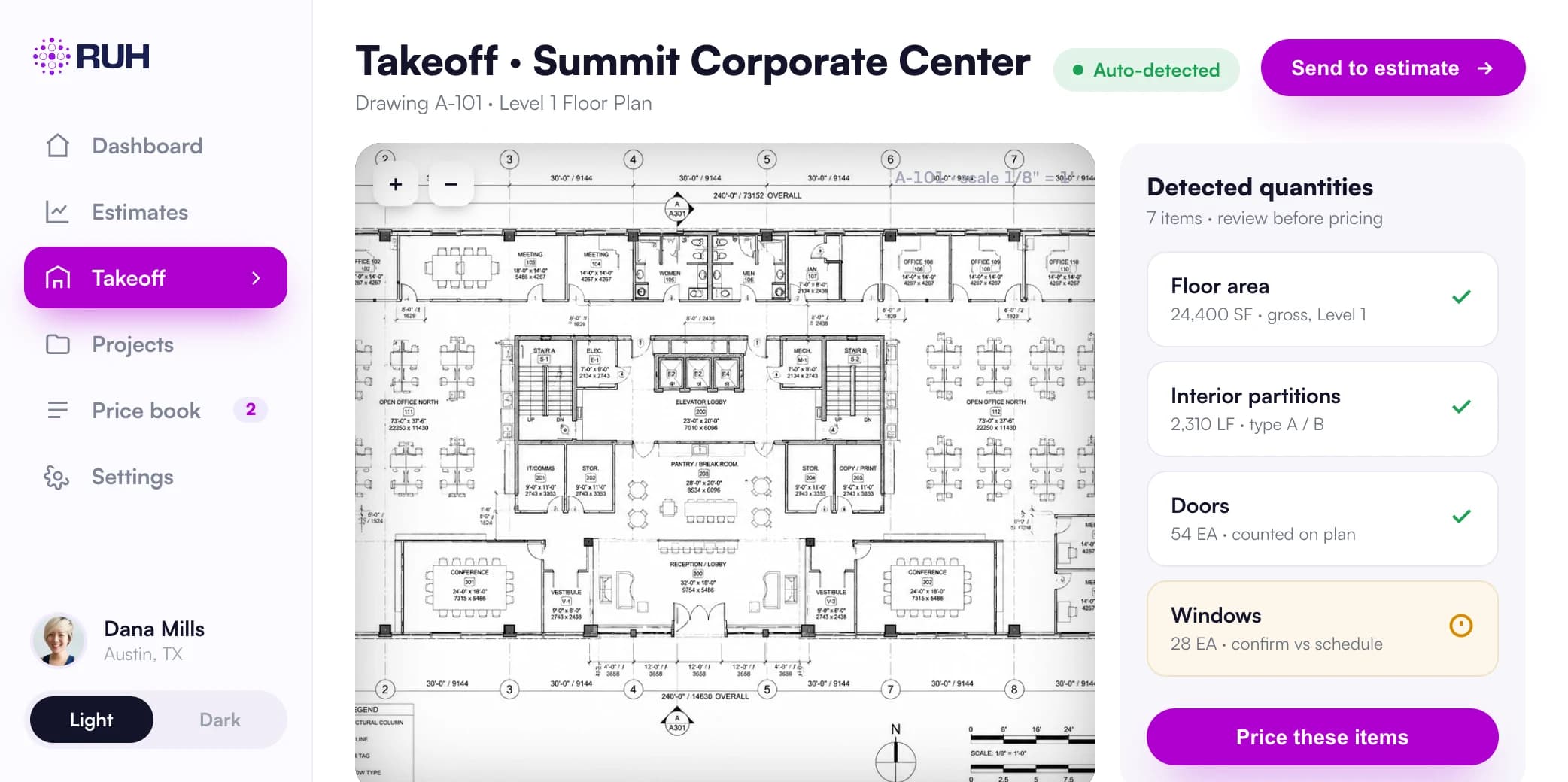
Ruh takes the device counts off the FA plans by type, picks up the panel gear, and measures the wiring in lf, then extends everything against the contractor's own price book rather than generic cost data. The draft estimate goes to the estimator, who verifies the interface points (dampers, elevators, flow switches) and signs off on the numbers.

See AI construction takeoff and estimating software

Fire alarm: frequently asked questions

What is counted in a fire alarm takeoff?+

Every initiating and notification device, each by type: pull stations, smoke and heat detectors, duct detectors, horn/strobes, and strobe-only units, plus monitor and relay modules for each interface point (sprinkler flow and tamper, elevator recall, smoke dampers, door holders). The FACP, remote annunciator, and NAC power supplies are counted each, and the wiring is measured in linear feet. Programming, testing, and the acceptance test show up as labor lines, not devices, and they are real money.

Does the electrician or a specialty contractor install the fire alarm?+

Both models are common. On many jobs the electrical subcontractor carries fire alarm as a second-tier scope, subbing the design, programming, and final connections to a specialty alarm house while self-performing the rough wiring and device mounting. Other specs require a single licensed fire alarm contractor end to end. Either way, the NFPA 72 shop drawings and the acceptance test sit with the licensed alarm contractor, so the estimator should verify whose number includes them.

What is the difference between addressable and conventional fire alarm systems?+

An addressable system gives every device a unique address on a signaling loop, so the panel reports exactly which detector tripped and supervises each point individually; nearly all new commercial systems are addressable. A conventional system wires devices into zones and only knows that something in zone 3 activated. Addressable hardware costs more per device but saves wire, since devices daisy-chain on loops, and it slashes troubleshooting time, which is why it wins on anything beyond a small tenant space.

Still measuring by hand? Your next takeoff can run while you review this one.

See it on your plans

Related terms

Keep going: read the full guide or explore AI construction takeoff and estimating software.

The MEP estimating cheat sheet
Every unit, waste factor, and conversion on one page. Free PDF.

See Ruh price a bid from your own drawings.

AI takeoff and estimating on your price book, your estimator signs off.

Figures on this page are illustrative. Construction estimates depend on project-specific conditions, source documents, market pricing, and professional judgment. Ruh's AI assists the estimator and does not replace professional review: your team reviews, validates, and approves every estimate, bid, and pricing decision.