100% money-backBook a walkthrough
Construction glossary · Sitework

What is geotextilein construction?

Geotextile in construction is a permeable synthetic fabric, woven or nonwoven, placed against soil to perform one or more of five jobs: separation, stabilization, filtration, drainage, and reinforcement. On commercial sitework it shows up under aggregate base on soft subgrade, wrapped around underdrains, beneath riprap, and behind retaining walls. Estimators measure it in square yards (sy) by type, because a woven stabilization fabric and a nonwoven filter fabric are different products at different prices.

Free 30-minute walkthrough on your own drawings. No card.

Updated June 2026 · Reviewed by the Ruh construction team

Measured in square yardsLap allowance 5 to 15 pctLives in civil detailsCost driver woven vs nonwoven

How geotextile is measured in a road section

Aggregate baseWoven stabilization geotextileSoft subgrade18 in laps600 ft x 24 ft = 1,600 sy
The definition

Geotextile, explained.

Geotextile is a scope that hides in details rather than plan views. The geotech report recommends it (typically over soft or pumping subgrade), the civil details show it (under riprap aprons, around french drain pipe, beneath construction entrances), and the Division 31 specs name the class or property requirements. The sitework contractor installs most of it as part of whatever assembly it belongs to: the grading crew rolls out stabilization fabric ahead of aggregate base, the pipe crew wraps underdrains, the erosion crew places filter fabric under stone. New estimators make two reliable mistakes. First, they carry one blended unit price for fabric when the project actually has two or three different products; woven stabilization fabric and nonwoven filtration fabric are not interchangeable and do not cost the same. Second, they take off the neat covered area and forget laps; specs commonly require 12 to 24 inch overlaps (wider on soft subgrade), which adds 5 to 15 percent to the buy quantity.

How it is measured

Geotextile is measured in square yards of covered area, taken off by function and type: separation or stabilization fabric under pavement sections and entrances, filtration fabric under riprap and around drains, reinforcement where the geotech calls for it. Compute the neat sf from the plan dimensions of the assembly the fabric belongs to, convert to sy by dividing by 9, then add the lap and waste allowance the spec drives. Cost drivers are the fabric class and weight, woven versus nonwoven, and the installation conditions (a flat pad rolls fast, a riprap slope or trench wrap is slower). The quantities live in the civil details and sections, not on the plan sheet, so search the detail callouts.

Worked example

A worked geotextile example.

Worked example

Neat area600 ft x 24 ft = 14,400 sf / 9 = 1,600 sy
With laps1,600 sy x 1.10 = 1,760 sy
Fabric cost (illustrative)1,760 sy x $1.60 = $2,816
Geotextile line (illustrative)1,760 sy x $1.60 = $2,816
How Ruh handles it

How Ruh handles geotextile.

100%

Try Ruh on a real bid. 100% money-back guarantee if you are not satisfied.*

*Scoped delivery, terms apply. Read the guarantee terms

Start with a walkthrough

Geotextile: frequently asked questions

What is the difference between woven and nonwoven geotextile?+

Woven geotextiles are made of interlaced tapes or yarns, giving high tensile strength and limited flow-through, so they serve separation, stabilization, and reinforcement under roads and pads. Nonwoven geotextiles are needle-punched felts with lower strength but high permeability, so they serve filtration and drainage: under riprap, around underdrain pipe, and as cushion layers. Specs name the function and minimum properties; substituting one for the other is a spec violation, not value engineering.

Does geotextile reduce how much aggregate base you need?+

It can, but only when the designer says so. Stabilization fabric over soft subgrade lets some designs carry a thinner aggregate section than they would over unprotected soil, and the geotech report is where that trade gets made. The estimator's job is to price the section as drawn, fabric plus the specified stone depth, never to thin the stone on their own because fabric is present.

How much overlap does geotextile need?+

Typical specs call for 12 to 24 inches of overlap between adjacent panels, with the wider laps (or sewn seams) reserved for soft or pumping subgrade where panels can separate under load. That lap is real material: on a wide area it adds roughly 5 to 15 percent to the neat square yardage depending on roll width and layout, so carry it as a visible allowance in the takeoff rather than hoping the waste factor covers it.

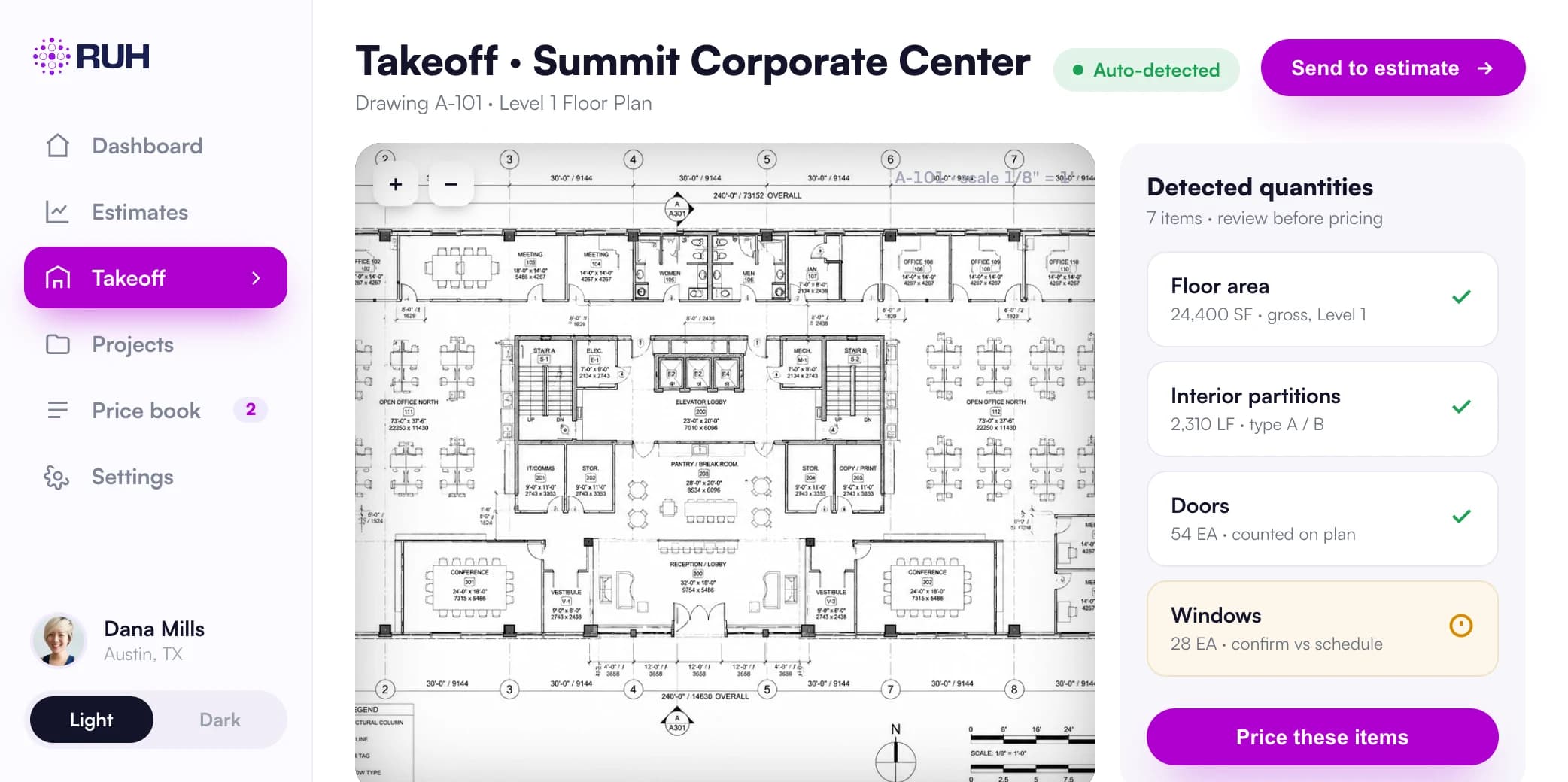
Still measuring by hand? Your next takeoff can run while you review this one.

See it on your plans

Related terms

Keep going: read the full guide or explore AI construction takeoff and estimating software.

The Sitework estimating cheat sheet
Every unit, waste factor, and conversion on one page. Free PDF.

Figures on this page are illustrative. Construction estimates depend on project-specific conditions, source documents, market pricing, and professional judgment. Ruh's AI assists the estimator and does not replace professional review: your team reviews, validates, and approves every estimate, bid, and pricing decision.
100% money-back guarantee

Try Ruh on a bid you are pricing now.

Put your next takeoff on Ruh.