
Try Ruh on a real bid. 100% money-back guarantee if you are not satisfied.*
*Scoped delivery, terms apply. Read the guarantee terms
Soil stabilization: frequently asked questions
When is lime used versus cement for soil stabilization?+
Lime works on high plasticity clays: it reacts with the clay minerals, drops the plasticity index, and dries wet soil quickly, which is why it doubles as a wet weather rescue. Cement suits sandier, low plasticity soils where there is little clay to react with. The geotech engineer selects from lab testing, and sulfate content matters: lime treatment of sulfate bearing soils can cause expansive heave, so high sulfate sites need a different approach.
Is soil stabilization cheaper than removing and replacing bad soil?+
Usually yes on large areas, because it eliminates both the haul-off of the bad material and the purchase of import, the two costs that make over-excavation expensive. The math flips on small areas: the specialty equipment carries a mobilization cost that has to amortize over the square yardage, so a few hundred square yards of treatment can cost more than digging and replacing. Run both numbers before committing the bid.
How deep does soil stabilization go?+
The geotech report sets the depth. Pavement subgrade treatment is commonly specified in the 8 to 16 inch range, with 12 inches a frequent call, because that is what a single pass of mixing equipment can blend uniformly. Deeper improvement generally means multiple lifts of treatment or a different technique entirely, and the estimator should price added depth as added chemical tonnage, added mixing time, and slower production.
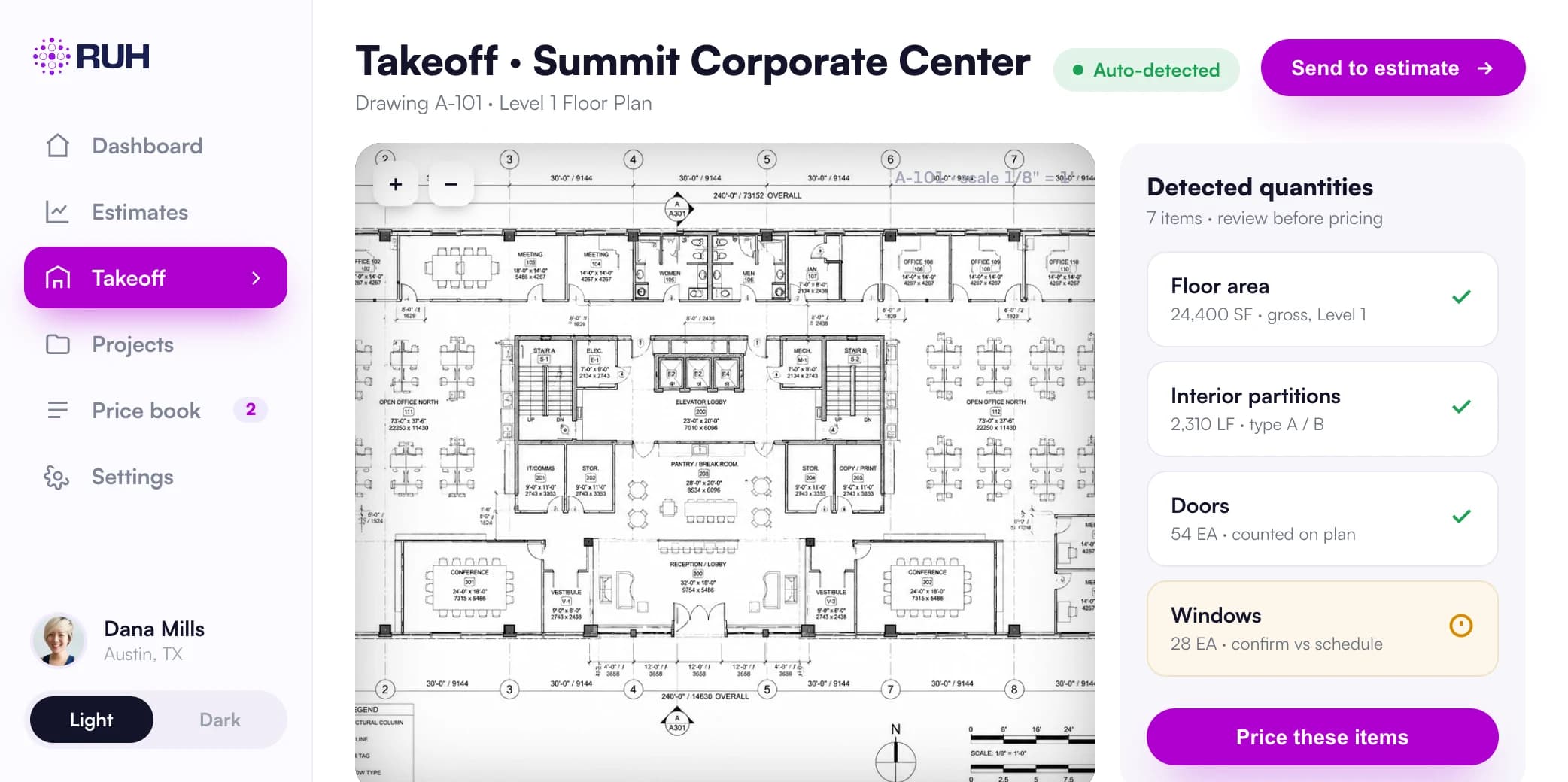
Still measuring by hand? Your next takeoff can run while you review this one.
See it on your plansRelated terms
Keep going: How much does lime soil stabilization cost? A worked comparison, read the full guide or explore AI construction takeoff and estimating software.
Figures on this page are illustrative. Construction estimates depend on project-specific conditions, source documents, market pricing, and professional judgment. Ruh's AI assists the estimator and does not replace professional review: your team reviews, validates, and approves every estimate, bid, and pricing decision.