Construction glossary · MEP
What is water heater in construction?
A water heater in construction is the plumbing equipment that produces a building's domestic hot water, supplied either as a storage tank unit or a tankless on-demand unit, fueled by gas or electricity. On commercial projects it appears on the plumbing equipment schedule and is counted each in the takeoff. The unit itself is only part of the scope: venting, gas piping, electrical connections, drain pans, expansion tanks, and condensate drains follow every heater.
Updated June 2026 · Reviewed by the Ruh construction team
How water heaters are counted
Estimating mep scope this week? Watch Ruh take off a real plan in 30 minutes.
Book a walkthroughWater heaters live on the plumbing equipment schedule (usually tagged WH-1, WH-2), on the plumbing plans at their mechanical room or closet locations, and in Division 22 specs. The plumbing contractor owns the set and connect, but the scope touches other trades: gas piping to a gas unit, a dedicated circuit and disconnect for an electric one, and flue venting that may route through rated shafts or sidewall terminations. Tank units store hot water and recover over time; tankless units heat on demand and trade the storage footprint for high instantaneous gas or electrical input. Condensing gas units are efficient but produce acidic condensate that needs a neutralizer and a drain route. What new estimators get wrong is pricing the heater as a box: the each count is right, but the venting lf, the pan and indirect drain, the thermal expansion tank, the seismic strapping, and the mixing valve are where the assembly cost hides. On the schedule, check recovery and storage against the fixture count, because an undersized substitution becomes the estimator's problem at submittal review.
Water heaters are counted each from the plumbing equipment schedule, with capacity (gallons of storage, Btu/h input or kW) and fuel type pulled from the schedule columns. The follow-on items are measured separately: flue and combustion air venting in lf by material and diameter, gas pipe in lf with valves and regulators each, condensate and pan drains in lf, and the expansion tank, mixing valve, and recirculation pump each. Cost drivers: fuel type, tank versus tankless, venting material (polypropylene or stainless for condensing units), and how far the flue has to travel to daylight. Location matters too; a heater in a penthouse mechanical room prices differently from one in a slab-level closet because of rigging and vent length.
Worked example
Size a tankless gas unit first. A unit rated 199,000 Btu/h input at 95 percent thermal efficiency delivers 199,000 x 0.95 = 189,050 Btu/h to the water. Heating water takes 8.33 Btu per gallon per degree F, so a 70 degree F temperature rise needs 8.33 x 70 = about 583 Btu per gallon, and 189,050 / 583 = about 324 gallons per hour, roughly 5.4 gpm of continuous hot water. Now the takeoff. Heater: 1 ea at an illustrative $6,800 furnished and set. Venting: 40 lf of polypropylene flue at $32 per lf = $1,280. Drain pan with 20 lf of indirect drain: $400. Condensate neutralizer: $180. Total: $6,800 + $1,280 + $400 + $180 = $8,660. The follow-ons add $1,860, about 27 percent over the bare unit, which is the gap between a catalog price and an installed line item.
Try Ruh on a real bid. 100% money-back guarantee if you are not satisfied.*
*Scoped delivery, terms apply. Read the guarantee terms
How Ruh handles water heater
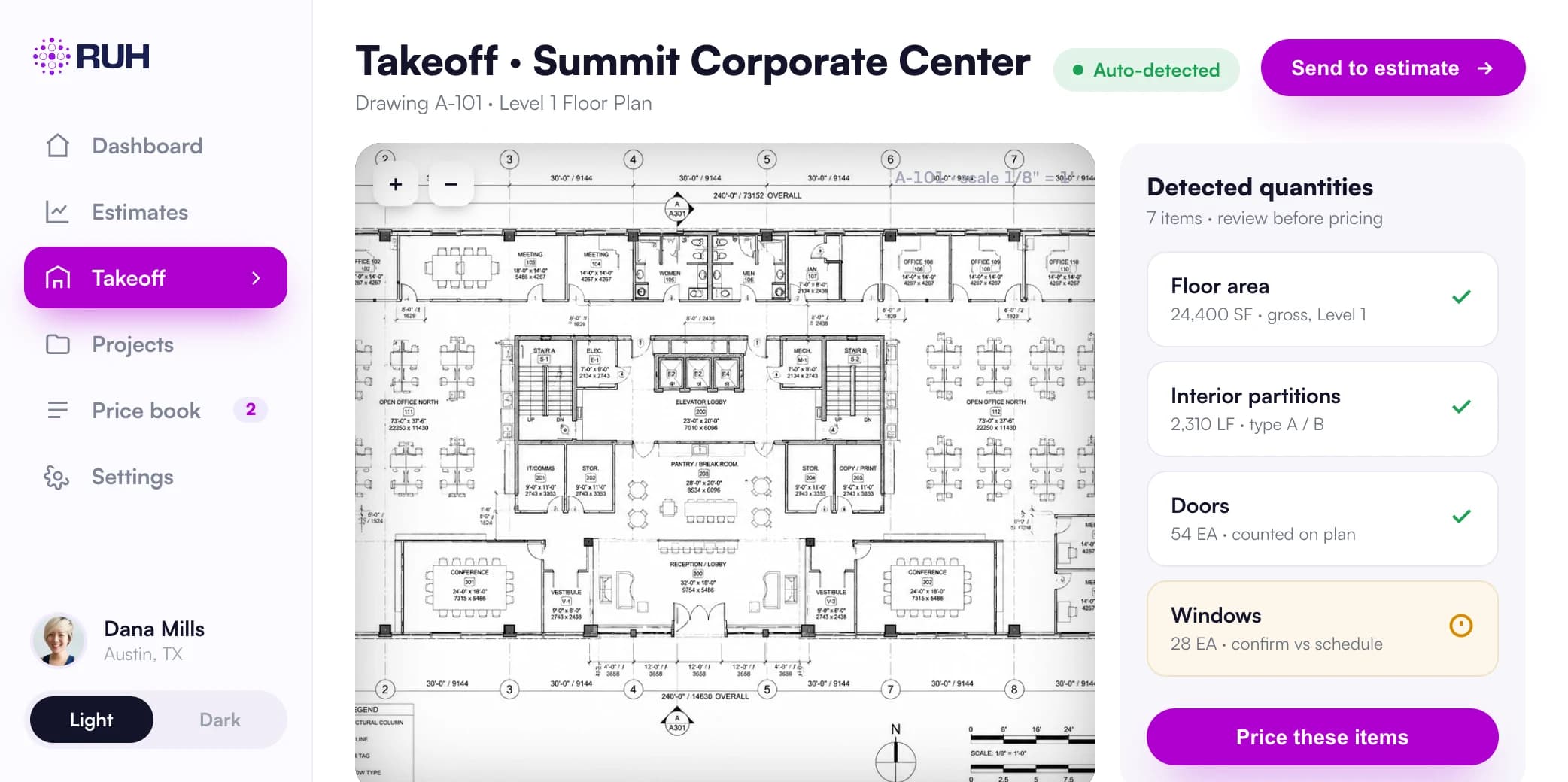
Ruh pulls the water heaters off the plumbing equipment schedule, counts them each with their capacities and fuel types, measures the venting and drain runs around them, and prices everything from the contractor's own price book. The estimator reviews the drafted assembly, adjusts for rigging or vent routing the drawings only hint at, and signs off on the final lines.
See AI construction takeoff and estimating softwareWater heater: frequently asked questions
Tank or tankless water heater for a commercial building?+
It depends on the demand profile, and the estimator's job is to price what the schedule shows. Tankless banks suit steady or peaky demand without dedicating floor space to storage, while tank and storage systems handle large simultaneous draws like gang showers. Swapping one for the other is an engineering decision, not a bid-day substitution, because venting, gas pipe size, and electrical loads all change with the swap.
Does a commercial water heater need a drain pan?+
Plumbing codes generally require a pan with an indirect drain wherever a leaking heater would damage the building, which in practice covers most heaters above slab or in finished areas. The pan drains to a floor sink or other approved receptor through an indirect connection. The pan itself is cheap; the drain routing is the cost, especially when the nearest receptor is rooms away. Condensing units add a separate condensate drain with a neutralizer for the acidic discharge.
What trades connect a commercial water heater?+
The plumber sets the heater and runs the water, vent, and drain connections. Gas piping is usually the plumber or a mechanical sub depending on local practice, and the electrician provides the circuit, disconnect, and controls power even on gas units. Flue routing can pull in sheet metal for shaft work. Buyout tip: make sure exactly one sub carries the flue and one carries final connections, because heater closets are a classic scope gap.
Still measuring by hand? Your next takeoff can run while you review this one.
See it on your plansRelated terms
Keep going: read the full guide or explore AI construction takeoff and estimating software.
See Ruh price a bid from your own drawings.
AI takeoff and estimating on your price book, your estimator signs off.
Figures on this page are illustrative. Construction estimates depend on project-specific conditions, source documents, market pricing, and professional judgment. Ruh's AI assists the estimator and does not replace professional review: your team reviews, validates, and approves every estimate, bid, and pricing decision.