100% money-backBook a walkthrough

Construction glossary · MEP

What is backflow preventer in construction?

A backflow preventer in construction is a plumbing assembly installed on a building water service to keep water from flowing backward into the public drinking supply when pressure drops or reverses. The two common commercial types are the reduced pressure zone (RPZ) assembly for high hazard connections and the double check valve assembly for lower hazard ones. Each device is counted each in the takeoff, sized to the service it protects, and in most jurisdictions must be tested by a certified tester every year.

Updated June 2026 · Reviewed by the Ruh construction team

Stops reverse contamination flowSized by pipe diameterNeeds annual testing

How backflow preventers are counted

3 EABackflow preventerplumbing riser/schedule

Estimating mep scope this week? Watch Ruh take off a real plan in 30 minutes.

Book a walkthrough
Definition

Backflow preventers show up wherever a building system could contaminate the potable supply: the domestic water service, the fire line, irrigation, boiler makeup water, and process connections. They live on the plumbing site plan and water riser diagram, on the plumbing schedules, and in Division 22 specs, with the local water purveyor's cross-connection control program dictating the device type. The plumbing contractor installs the domestic and irrigation devices; the fire protection sub usually furnishes the one on the fire service. RPZ assemblies protect high hazard connections and dump water through a relief port when they operate, so they need an air-gapped drain sized for the discharge, which is a real piece of scope. Double check assemblies suit lower hazards and do not discharge. New estimators miss three things: the floor drain and drain piping an interior RPZ requires, the heated enclosure an exterior assembly needs in freezing climates, and the fact that every assembly must be tested at installation and then annually, a recurring owner cost. The device itself is the easy part of the line item.

How it is measured

Backflow preventers are counted each, by type (RPZ, double check, detector assembly on fire services) and by line size, which follows the service: a 2 inch domestic service gets a 2 inch assembly, a 6 inch fire line a 6 inch one. They appear on the plumbing schedule, the site utility plan, and the riser diagram near the point of entry. Cost climbs steeply with diameter, and the follow-on scope drives the installed price: isolation valves on both sides, a drain receptor for RPZ relief discharge, supports for the larger assemblies, and an enclosure if mounted outside. Test cocks and initial certification testing belong in the install; annual recertification is an owner operating cost worth flagging.

Worked example

Worked example

A small commercial building needs three assemblies. Fire service: 6 inch double check detector assembly at an illustrative $8,500 installed. Domestic service: 3 inch RPZ at an illustrative $4,200 installed, plus 25 lf of indirect drain piping to a floor sink at an illustrative $20 per lf = $500 for the relief discharge. Irrigation: 2 inch RPZ at an illustrative $2,600 installed. Direct cost: $8,500 + $4,200 + $500 + $2,600 = $15,800. Now the part owners forget: each device needs certified testing every year. At an illustrative $150 per device per test, 3 x $150 = $450 per year, and over a 20 year life that is $450 x 20 = $9,000 of testing, more than the purchase price of two of the three devices. The takeoff is three lines counted ea, but the lifecycle math is what the owner's facilities team will live with.

100%

Try Ruh on a real bid. 100% money-back guarantee if you are not satisfied.*

*Scoped delivery, terms apply. Read the guarantee terms

Start with a walkthrough
How Ruh handles it

How Ruh handles backflow preventer

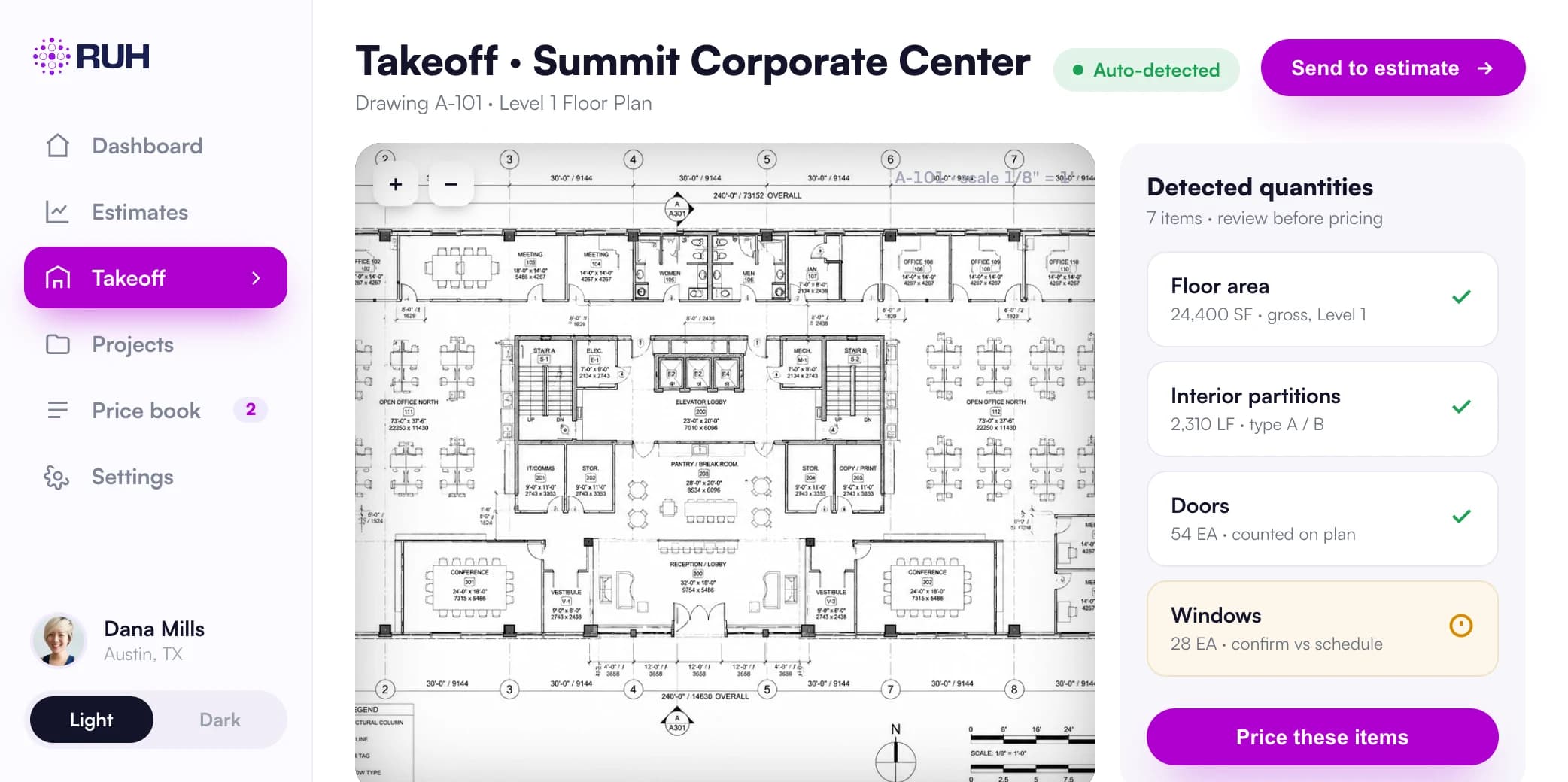
Ruh picks the backflow assemblies off the plumbing schedules and riser diagrams during the takeoff, counts them each by type and size, and prices them against the contractor's own price book along with the drains and valves around them. The draft then goes to the estimator, who checks device types against the water purveyor's requirements and signs off.

See AI construction takeoff and estimating software

Backflow preventer: frequently asked questions

What is the difference between an RPZ and a double check valve assembly?+

An RPZ (reduced pressure zone) assembly has two check valves with a monitored pressure zone between them and a relief valve that discharges water if either check leaks, so it protects against high hazard cross connections, the ones that could make people sick. A double check valve assembly has the two checks but no relief port, so it is limited to low hazard connections. Because an RPZ can dump water when it operates, it must drain to an air-gapped receptor, which a double check does not need.

Do backflow preventers really need to be tested every year?+

In most US jurisdictions, yes. Cross-connection control programs run by the water purveyor typically require testing at installation, after any repair, and annually thereafter, performed by a certified backflow tester who files results with the purveyor. It is a recurring owner cost that scales with the device count, so a campus with dozens of assemblies carries a meaningful annual testing line. Include initial certification in the bid and flag the annual obligation to the owner.

Who installs the backflow preventer on a commercial project?+

It splits by service. The plumbing contractor typically furnishes and installs the assemblies on the domestic and irrigation lines, while the fire protection subcontractor handles the detector assembly on the fire service. A site utility contractor may set an exterior assembly in a vault or enclosure. At bid time, check each sub's scope letter, because the fire line device is a classic gap where two subs each assume the other carried it.

Still measuring by hand? Your next takeoff can run while you review this one.

See it on your plans

Related terms

Keep going: read the full guide or explore AI construction takeoff and estimating software.

The MEP estimating cheat sheet
Every unit, waste factor, and conversion on one page. Free PDF.

See Ruh price a bid from your own drawings.

AI takeoff and estimating on your price book, your estimator signs off.

Figures on this page are illustrative. Construction estimates depend on project-specific conditions, source documents, market pricing, and professional judgment. Ruh's AI assists the estimator and does not replace professional review: your team reviews, validates, and approves every estimate, bid, and pricing decision.