100% money-backBook a walkthrough
Construction glossary · Sitework

What is compactionin construction?

Compaction in construction is the mechanical densification of soil or aggregate with rollers, plate compactors, or rammers, squeezing out air voids so the material can carry structural loads without settling. Specifications state the requirement as a percentage of the maximum dry density from a laboratory Proctor test, with 95 percent of Standard Proctor a common value for structural fill. The work is placed and compacted in layers called lifts, with 8 to 12 inch loose lifts typical spec language.

Free 30-minute walkthrough on your own drawings. No card.

Updated August 2026 · Reviewed by the Ruh construction team

Measured in compacted cyTypical target 95% Standard ProctorLives in geotech + Division 31Cost driver lift count + shrink

How compaction percent is specified

The definition

Compaction, explained.

Compaction is the densification step that turns placed soil into something you can build on. In a US commercial drawing set it lives in three places: the geotech report, which sets the required percent of maximum dry density and the acceptable fill materials; the Division 31 earthwork specification, which carries lift thickness and testing frequency; and the civil C-sheets, where the grading plan establishes how much fill needs compacting. The sitework contractor owns the means and methods, while an independent testing firm hired by the owner verifies density lift by lift. New estimators get two things wrong. First, they treat compaction as free, buried inside a fill unit cost, and miss what actually drives it: lift count, equipment passes, and moisture conditioning with a water truck when the borrow is dry or discing when it is wet. Second, they forget shrink. A compacted cubic yard takes more than one loose cubic yard of delivered material, so the trucking line under-buys whenever it is priced off the neat fill volume.

How it is measured

Compaction is rarely its own pay item. It rides inside the unit cost per compacted cy of structural fill or backfill, or per sf or sy of subgrade preparation under slabs and pavement. The spec language drives the cost: required density (95 percent Standard Proctor is typical for structural fill), loose lift thickness (8 to 12 inches is common spec language), and density testing frequency per lift. The geotech report and Division 31 specs carry those requirements; the grading plan and sections carry the volumes. The estimator also carries the conversion between loose and compacted volume, because the material is bought loose and paid for compacted, and the gap between the two is real money.

Worked example

A worked compaction example.

Worked example

Neat compacted volume12,000 sf x 3 ft = 36,000 cf; 36,000 / 27 = 1,333 cy
Lift count36 inches / 6 inches per lift = 6 lifts
Material import order1,333 x 1.25 = 1,666 loose cy
Material and work (illustrative)1,666 x $18 = $29,988; 1,333 x $6.50 = $8,665
Loose cy to buy1,333 x 1.25 = 1,666 loose cy
How Ruh handles it

How Ruh handles compaction.

100%

Try Ruh on a real bid. 100% money-back guarantee if you are not satisfied.*

*Scoped delivery, terms apply. Read the guarantee terms

Start with a walkthrough

Compaction: frequently asked questions

What does 95 percent compaction mean?+

It means the field dry density of the placed soil must reach at least 95 percent of the maximum dry density established for that soil in a laboratory Proctor test. A testing technician verifies it lift by lift, usually with a nuclear density gauge. Always check which Proctor the spec references: 95 percent of Modified Proctor is a tougher target than 95 percent of Standard Proctor, because the Modified test produces a higher maximum density.

Why is soil compacted in lifts?+

Compaction equipment only densifies a limited depth of soil. Place fill 3 ft at a time and the roller tightens the top while the bottom stays loose, which is exactly where the density probe finds it. Specs therefore limit loose lifts, commonly to 8 to 12 inches, so each layer gets full compactive effort before the next goes down. Thinner lifts mean more passes and more cost, which is why lift thickness belongs in the estimate.

What happens when a compaction test fails?+

The contractor reworks the lift: scarify, adjust moisture (water if dry, disc and aerate if wet), recompact, and call for a retest. No further fill goes down until the lift passes. The estimator's exposure is the rework labor and equipment time plus retest fees, which many testing agreements bill back to the contractor after a failure. Soil well wet of optimum will pump under the roller, and more passes make it worse, not better.

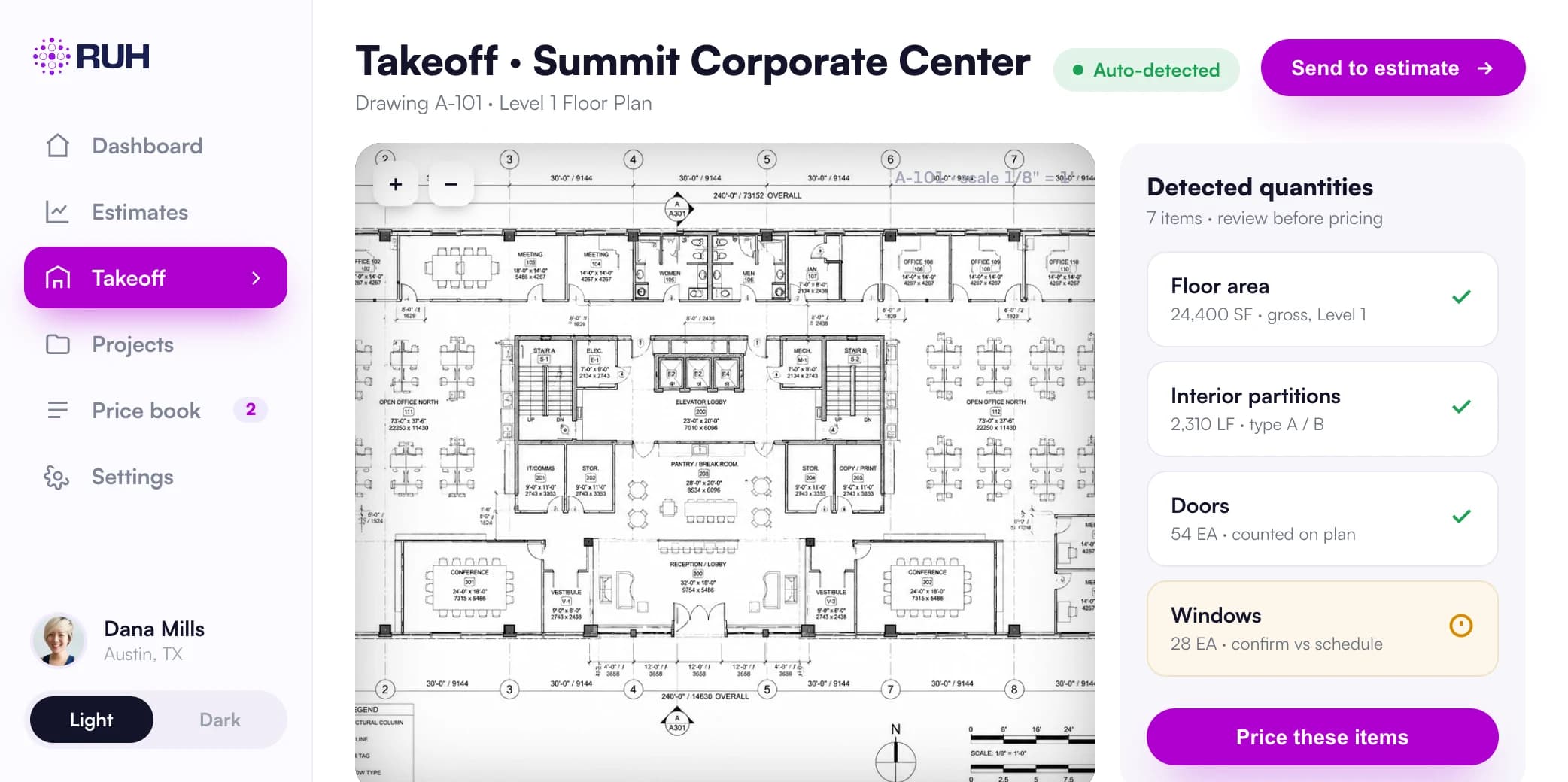
Still measuring by hand? Your next takeoff can run while you review this one.

See it on your plans

Related terms

Keep going: read the full guide or explore AI construction takeoff and estimating software.

The Sitework estimating cheat sheet
Every unit, waste factor, and conversion on one page. Free PDF.

Figures on this page are illustrative. Construction estimates depend on project-specific conditions, source documents, market pricing, and professional judgment. Ruh's AI assists the estimator and does not replace professional review: your team reviews, validates, and approves every estimate, bid, and pricing decision.
100% money-back guarantee

Try Ruh on a bid you are pricing now.

Put your next takeoff on Ruh.