
Quick Answer
Here is how to become a construction estimator: learn to read drawings and specifications, learn how the work is built, practice takeoff and pricing on real jobs, and start in a role close to estimating, such as estimating assistant, project engineer or a trade position, then move up to running your own bids. There is no single degree or license. Pay is solid: the U.S. Bureau of Labor Statistics put the median annual wage for cost estimators at $78,740 in May 2025. Below are what the job involves, the skills employers hire for, the training paths, a step-by-step route in, certifications, what shapes pay, the career path and how AI is changing the work.
What you'll find below:
- What a construction estimator does, and what a bid week looks like
- The skills employers hire for, in order of how hard they are to teach
- Degree, trade experience or both: the paths into estimating
- A seven-step route from beginner to running your own bids
- Construction estimator salary by percentile and by construction sector, from BLS May 2025 data
- How AI is moving the job from counting toward judgment
What Does a Construction Estimator Do?
A construction estimator works out what a project or a trade's scope will cost to build, from the drawings and specifications, and turns that into a number a contractor can bid and stand behind. The estimate decides whether the company wins the job and whether it makes money on it.
The work has four parts:
- Reading the documents. The drawings, specifications, addenda and bid form, to understand the scope.
- Quantity takeoff. Counting and measuring everything in the scope, from the drawings, in the units it is priced in. Our takeoff glossary entry covers the basics.
- Pricing. Labor, material, equipment and subcontractor costs, from the company's own rates, supplier quotes and history.
- Bid day. Reviewing the number, writing the scope and exclusions, and getting the bid in on time.
Estimators work for general contractors, trade contractors, owners and consultants. A general contractor's estimator prices the whole job and collects trade quotes. A trade contractor's estimator prices one scope in depth, such as electrical, concrete or drywall.
What Does a Bid Week Look Like?
A bid week runs from reading the documents to submitting the number, with most of the time going into takeoff and pricing, and the last day going into checking, scope letters and late quotes. The rhythm repeats on every bid.
A typical sequence for a trade contractor's estimator:
- Early in the week: download the set, check the sheet index, read the specs for the trade and list questions for the designer.
- Middle of the week: take off quantities, set up pricing, request supplier quotes and track addenda.
- The day before: price everything, review the number against similar jobs and draft the scope letter.
- Bid day: take in late quotes and final addenda, adjust the number, get it approved and submit it before the deadline.
Addenda can arrive at any point, which is why tracking them is part of the job. Our post on addenda tracking for estimators covers how to log each one and reprice only what changed.
What Skills Does a Construction Estimator Need?
A construction estimator needs to read drawings and specs, understand how work is built in the field, take off quantities carefully, price labor and material, and explain a number under deadline pressure. The first two are the hardest to teach, which is why employers value field experience.
| Skill | What it means in practice | How you build it |
|---|---|---|
| Reading drawings and specs | Finding the scope across every sheet and spec section | Read full sets, not just your trade's sheets |
| Knowing how work is built | Seeing the labor and sequence behind a line on a drawing | Field time, site walks, asking crews |
| Quantity takeoff | Counting and measuring without missing or double counting | Practice on real sets, then check against actual quantities |
| Pricing | Turning quantities into labor hours, material and equipment cost | Learning your company's rates and job history |
| Judgment under pressure | Deciding what to carry, what to exclude and when to ask | Bid days, mentoring, reviewing past bids |
| Communication | Writing clear scope letters and explaining the number | Writing every exclusion down |
Math matters, but it is mostly arithmetic done carefully. The harder part is knowing what the drawings leave out. Our guide on how to read construction blueprints walks through reading a set in the order an estimator works.
Degree, Trade Experience or Both?
You can become a construction estimator through a construction management or engineering degree, through years in a trade, or through a mix of both, and each path has a gap to fill. No single route is required.
- Degree path. Construction management, civil engineering or a related program teaches documents, cost and scheduling. Graduates often lack field sense, so they need site time.
- Trade path. Electricians, carpenters, pipefitters and other trades workers already know how the work is built. They often need to learn formal takeoff, pricing structure and software.
- Office path. Project engineers, project coordinators and estimating assistants learn the documents and the bid process from inside a contractor, then move into estimating.
Many estimators mix paths: a trade background with evening courses, or a degree with a few years as a project engineer. Employers care most about whether you can read a set and stand behind a number.
Step by Step: How to Become a Construction Estimator
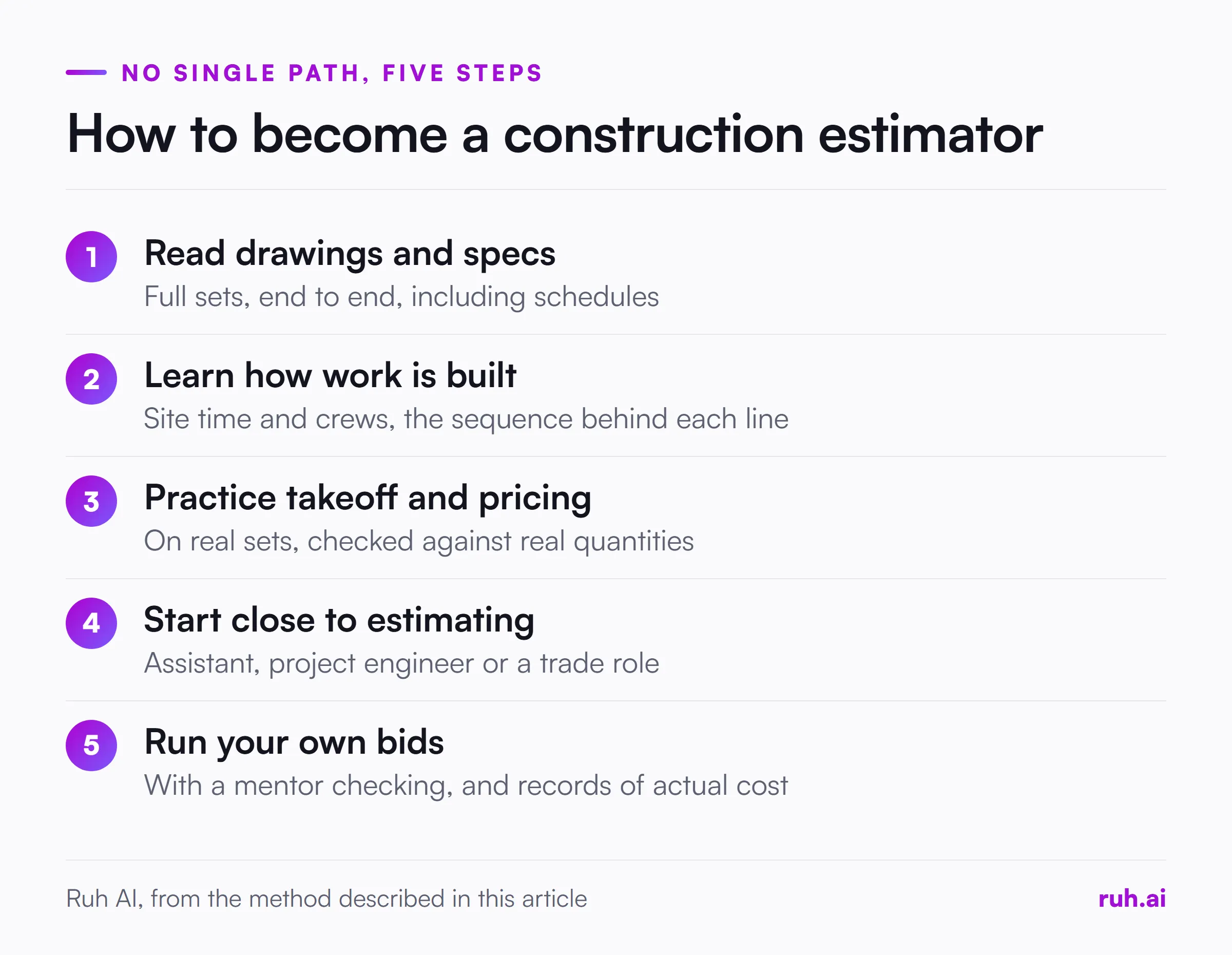
The route into estimating has seven steps, from learning the documents to running your own bids, and you can start most of them before your first estimating job. Each step builds on the last.
- Learn to read drawings and specifications. Get full drawing sets and read them end to end, including the general notes and schedules.
- Learn how the work is built. Spend time on site, ask crews how they install things, and learn the sequence behind each trade.
- Pick a lane. General contractor or trade contractor, and which trade or sector. Focus speeds up learning.
- Practice takeoff and pricing. Take off quantities from real sets, then compare them with what the job actually used. Our guide on how to do a construction takeoff covers the method step by step.
- Get into a role close to estimating. Estimating assistant, project engineer, project coordinator or a trade role with bid work.
- Price bids with a mentor. Have an experienced estimator check your takeoffs and pricing, and learn why their numbers differ from yours.
- Run your own bids. Start with smaller jobs, keep records of how your estimates compared with the actual cost, and use them to improve your rates.
Keeping those records is what turns a beginner into a trusted estimator. Our post on keeping estimating know-how covers how contractors write down the rules and history that new estimators learn from.
Certifications and Software Worth Learning
Certifications are not required to work as a construction estimator, but they can show employers that you know the methods, and AACE International offers estimating and cost certifications at more than one level. Software skills matter more day to day.
AACE International lists the Certified Cost Technician (CCT) at its technician level, and the Certified Estimating Professional (CEP) and Certified Cost Professional (CCP) at its professional level, aimed at mid-career practitioners. Some trade associations also run estimating courses for their own trades.
For software, learn at least one on-screen takeoff tool, a spreadsheet well, and whatever estimating system your target employers use. The software changes. The ability to check its output against the drawings doesn't.
Construction Estimator Salary: What Shapes Your Pay
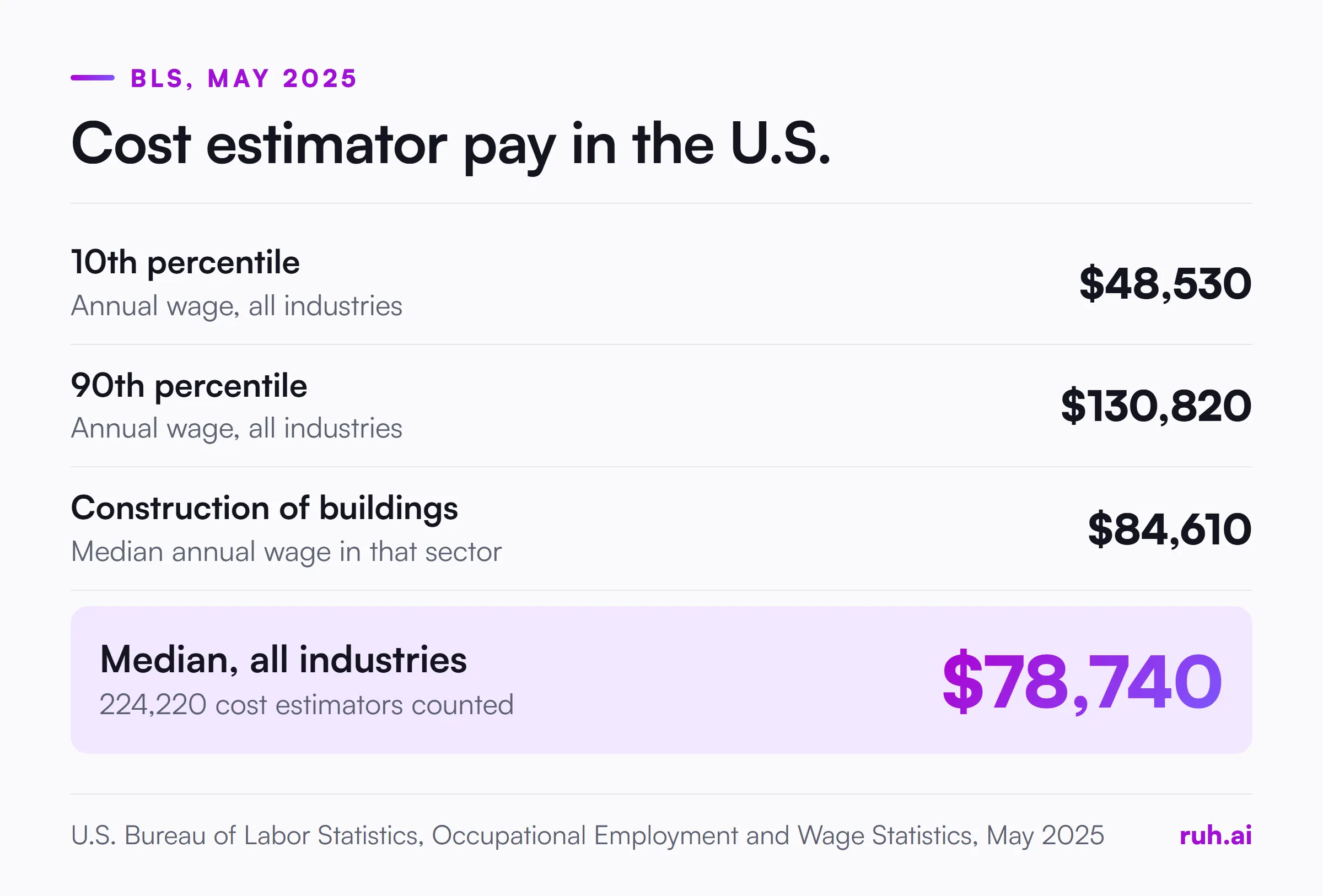
Construction estimator pay depends on experience, sector, region, the size of the jobs you price and how much of the number you own, and the median for cost estimators was $78,740 a year in May 2025, according to the U.S. Bureau of Labor Statistics. The range is wide.
The BLS Occupational Employment and Wage Statistics for cost estimators, May 2025, show this spread of annual wages:
| Point in the range (BLS, 2025) | Annual wage |
|---|---|
| 10th percentile | $48,530 |
| 25th percentile | $61,150 |
| Median | $78,740 |
| 75th percentile | $101,850 |
| 90th percentile | $130,820 |
| Mean | $85,390 |
The same BLS 2025 data counted 224,220 cost estimators across all industries, not only construction. Within construction, the BLS 2025 medians were $84,610 for construction of buildings, $99,910 for heavy and civil engineering construction and $80,330 for specialty trade contractors.
What moves you up the range:
- Experience and track record. Estimators whose numbers hold up on the job are trusted with bigger bids.
- Sector. Heavy and civil work had the highest construction median in the BLS 2025 figures above.
- Scope of responsibility. Running whole bids, leading other estimators or owning preconstruction pays more than taking off one trade.
- Region. Pay differs by local market and cost of living. BLS publishes state and metro figures for the same occupation.
Career Path: From Junior Estimator to Chief Estimator
The estimating career path runs from estimating assistant or junior estimator to estimator, senior estimator and chief estimator, with some estimators moving into preconstruction management or project management. Each step adds responsibility for the number.
| Role | What you own |
|---|---|
| Estimating assistant or junior estimator | Takeoffs, quote requests, document tracking |
| Estimator | Full estimates for a trade or smaller jobs |
| Senior estimator | Large or complex bids, checking others' work |
| Chief estimator | The estimating team, standards and final numbers |
| Preconstruction manager | Estimating, planning and client work before construction |
Some estimators move sideways into project management, where they manage the jobs they once priced. Others stay in estimating for their whole career, because good estimators are hard to replace.
Becoming an Estimator: A Self-Check
Run this before you apply for your first estimating role:
- You have read at least one full drawing set end to end, including specs and schedules.
- You can explain how the main work in your chosen trade is installed.
- You have done a practice takeoff and checked it against real quantities.
- You can price a line item from labor hours, material and equipment.
- You know the difference between markup and margin.
- You can write a scope letter with clear inclusions and exclusions.
- You know at least one takeoff tool and can check its output against the drawings.
- You have someone experienced who will review your work.
How Is AI Changing the Estimator's Job?
AI is taking over more of the counting and measuring in takeoff, which shifts the estimator's time toward checking quantities, pricing judgment, scope decisions and client conversations. The judgment parts of the job are growing, not shrinking.
What that means for someone entering the field:
- Checking replaces counting. You'll spend more time confirming quantities against the drawings than producing them from scratch.
- Pricing knowledge matters more. Knowing why a rate is right for a job, and when to change it, is the part software can't own.
- Scope judgment stays human. Deciding what to carry, what to exclude and what to ask the designer is still the estimator's call.
- Records become an asset. Estimators who keep clean job history make every tool more useful.
Learn the fundamentals first. An estimator who can't read a set can't check what a tool produces.
What New Estimators Get Wrong
Four positions on starting a career in estimating, argued as our view, not as data.
Software is not the skill. Employers can teach you their tools in weeks. Reading a set and knowing how work is built takes years.
Speed comes after accuracy. New estimators who rush takeoffs learn the hard way that a fast wrong number costs more than a slow right one.
Field time is never wasted. Every hour on site makes every hour at the desk better.
Your record is your résumé. Estimates you can compare with actual costs are the best proof that you're ready for bigger bids.
The Honest Assessment: What Still Falls Short
Estimating has no standard training path, so beginners depend on finding a good mentor. Many companies hire estimators for experience they can't get without first being hired.
Pay figures are averages across many industries and markets, so a specific offer can sit well above or below them. And the job can be stressful: bid deadlines don't move, and a missed item can cost the company money on a job it won.
How Ruh Fits
Ruh AI's Estimating Agent carries takeoff quantities into a priced estimate using your company's own rate book, so estimators spend less time keying numbers and more time on the judgment. Any trade with nothing priced gets a labelled allowance line instead of a silent zero.
A person on your team approves every scope line, your team can edit every quantity and price, and a person on your team approves the budget before it moves on. Ruh AI's Takeoff Agent reads the drawing PDFs and won't give a length or area for a sheet with no scale. Ruh works with your stack, built per customer.
Frequently Asked Questions
Q: How do I become a construction estimator with no experience? A: Learn to read drawings and specs, practice takeoff on real sets, and get a role close to estimating, such as estimating assistant or project coordinator. A trade background or a construction management course helps, and a mentor who reviews your work speeds things up.
Q: Do you need a degree to be a construction estimator? A: No single degree is required. Many estimators have construction management or engineering degrees, and many came up through the trades. Employers mainly look for the ability to read documents, understand how work is built and price it accurately.
Q: How much does a construction estimator make? A: The U.S. Bureau of Labor Statistics reported a median annual wage of $78,740 for cost estimators in May 2025, with the 10th percentile at $48,530 and the 90th at $130,820. Pay varies by experience, sector, region and responsibility.
Q: What skills does a construction estimator need? A: Reading drawings and specifications, knowing how work is built, careful quantity takeoff, pricing labor and material, judgment under deadline pressure, and clear written communication of scope and exclusions.
Q: Are there certifications for construction estimators? A: Yes, though none is required. AACE International offers the Certified Cost Technician, Certified Estimating Professional and Certified Cost Professional certifications, and some trade associations run estimating courses.
Q: Will AI replace construction estimators? A: AI is taking over more of the counting and measuring, but scope decisions, pricing judgment and checking quantities against the drawings still need an estimator. The job is shifting toward judgment rather than disappearing.
See how Ruh prices your takeoff from your own rate book on the construction estimating software page.