

Quick Answer
Estimating standard operating procedures are the rules a contractor uses to price work, such as which quotes to trust, how assemblies are built and who signs off each stage, kept where every estimator can use them, so the method stays when a senior estimator leaves. Below are AGC and NCCER's 2025 hiring figures, a map of where estimating know-how hides, what an estimating SOP should cover, a worked example of one undocumented pricing rule, a key-person risk checklist and our view on what owners get wrong.
What you'll find below:
- How hard estimating staff were to hire in 2025, from the AGC and NCCER workforce survey
- Six places estimating know-how hides, and what leaves with the person
- The eight areas an estimating SOP should cover
- One unwritten drywall rule worth $6,800 on a single bid
- A key-person risk checklist for your estimating department
What Is Key Person Risk in an Estimating Department?
Key person risk in construction estimating is the exposure a contractor carries when the judgment behind its prices sits with one or two people, so their absence slows bids, changes numbers or stops work outright. It shows up as a bid that nobody else can finish, or a number nobody else can explain.
Every estimating department has someone like this. They know which supplier quotes run light, how the bid tracker actually works, and why certain line items always get adjusted. Very little of it is written down.
Replacing that person is slow, and the hiring market makes it slower. In the AGC and NCCER 2025 Workforce Survey, 77% of firms seeking estimating personnel reported difficulty filling those positions. The same AGC and NCCER 2025 survey found that 84% of firms with salaried openings said those workers were as hard or harder to find than a year earlier.
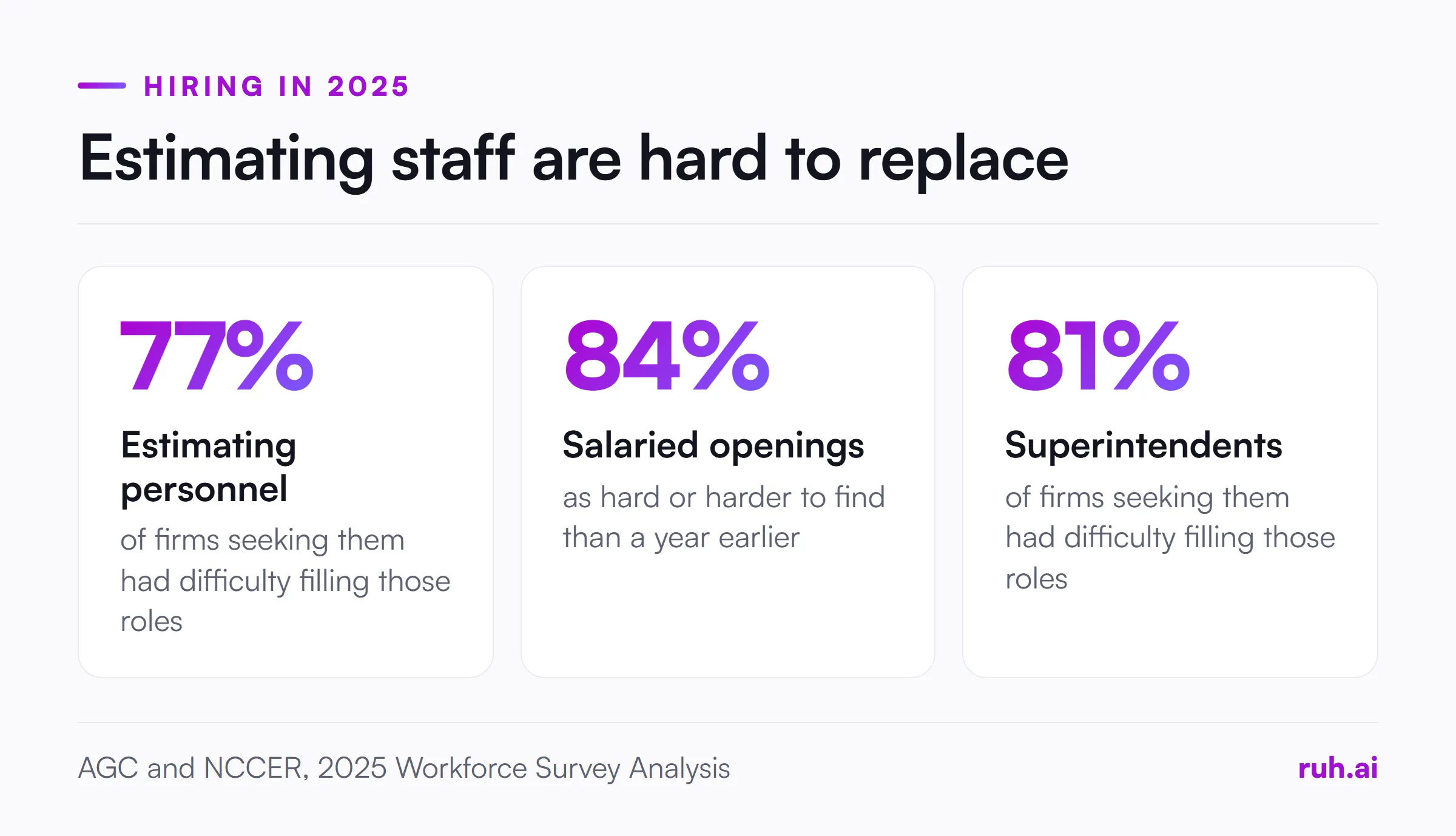
The same survey found superintendents the hardest salaried role to fill, listed by 81% of firms seeking them. Estimating sits right behind it. When a senior estimator leaves, the search for a replacement starts in that market, and the know-how doesn't wait for it to finish.
Where Does Estimating Know-How Actually Hide?
Estimating know-how hides in six places: people's heads, personal spreadsheets, private folders, email threads, a bid tracker one person maintains, and marked-up drawing sets. Each one holds part of the method, and each one leaves with the person who keeps it.
Six places estimating know-how hides, and what happens when the person leaves:
| Where it lives | What it holds | What leaves with the person | How to capture it |
|---|---|---|---|
| A senior estimator's head | Which subs and suppliers to trust, job-type adjustments, scope habits | The reasons behind every adjustment | Write the rule into the rate book or assembly as a note, with conditions |
| Personal spreadsheets | Rate sheets, markups, production factors | The latest rates and the logic in the formulas | Move confirmed rates into a shared, dated rate book |
| Private folders | Old bids, award history, quotes | The record of what was bid and won | Store bids and quotes against the job, not the person |
| Email threads | Sub relationships, quote clarifications, exclusions agreed | Who agreed to what, and when | Log exclusions and clarifications on the bid itself |
| A bid tracker one person maintains | Due dates, invites, status | The pipeline and its follow-ups | Make the tracker shared and give it a backup owner |
| Marked-up drawing sets | Takeoff decisions and assumptions | Why a quantity was measured the way it was | Keep takeoff notes and assumptions with the measurement |
Our post on building a unit cost database for contractors goes deeper on turning old bids and quotes into reusable prices.
Which Moments Expose the Gap?
Three moments expose missing estimating know-how: turnover, retirement and expansion into a new market. Each one asks the company to price work without the person who used to carry the method.
Turnover is the sudden version. A two-week notice in the middle of bid season leaves live estimates half built, with assumptions nobody else can see. The replacement inherits files, not reasons.
Retirement is the slow version. Everyone knows it's coming, so it gets put off. The handoff ends up as a few weeks of shadowing and a memo, and the rules that only come up on certain job types never get mentioned.
Expansion is the version people miss. Opening an office or entering a new trade means the same judgment is needed in two places at once. If the method lives in one person, the second office starts from scratch. Our post on construction labor shortage solutions covers the wider hiring pressure behind all three.
Why Do SOP Binders and Handoff Memos Fail?
SOP binders and handoff memos fail because they sit outside the work: nobody opens them during a busy bid, so they go stale while the real method keeps changing in people's heads. A binder written once describes how the department worked the year it was written.
Three things break them. They're written at the end, during an exit, when the person leaving has the least time and the most to hand over. They describe steps but not judgment, so they say "apply markup" without saying when the markup changes. And they have no owner, so nobody updates them when a rate, a supplier or a rule changes.
The fix is to put the rule where the estimator already works. A rate with its reason attached gets read every time it's used. A rule in a binder gets read when someone remembers the binder.
What Should Estimating Standard Operating Procedures Cover?
Estimating standard operating procedures should cover the decisions that change a number: which prices to trust, how assemblies are built, what's included and excluded, how gaps are handled, and who approves each stage. Steps are easy to learn. Judgment is what leaves.
The eight areas an estimating SOP should cover:
| SOP area | The rule to write down | Where it should live |
|---|---|---|
| Quote acceptance | Which subs and suppliers to trust, when a quote needs a second one, how long a quote stays valid | With the quote and the vendor record |
| Rate book | Where each rate came from, the date, who confirmed it, when to review it | In a shared rate book, one line per rate |
| Assemblies | What each assembly includes, and what changed in each version | In the assembly itself, versioned |
| Job-type adjustments | Rules like occupied buildings, night work or remote sites, with the conditions | As notes on the rates and assemblies they change |
| Scope inclusions and exclusions | The standard list per trade, and how exceptions are recorded | On the estimate, line by line |
| Gaps and allowances | How an unpriced trade is carried, so nothing hides as a zero | On the estimate, labelled |
| Takeoff assumptions | How unclear or unscaled sheets are handled | With the measurement |
| Approvals | Who signs off the takeoff, the budget and the final number | In the workflow, recorded per stage |
Notice what's missing: a step-by-step of the estimating process. That's the part a new estimator learns fastest. The table above is the part they can't learn from anyone who isn't there.
How Do You Capture Know-How as Part of the Work?
Capture know-how at the moment a decision is made, on a live bid, by recording the price, the reason and the person who confirmed it in the same place the next estimator will look. Captured that way, it costs seconds instead of an exit interview.
Four habits do most of the work:
- Confirm prices into a shared rate book. When an estimator accepts a rate, it goes into the rate book with the date, the source and their name. The next bid starts from it.
- Build and version standard assemblies. A wall type, a fixture package or a slab detail lives as a company assembly. When it changes, it becomes a new version, and old estimates keep the version they used.
- Make every number traceable. A quantity points to its drawing or spec. A price points to its rate book line or quote. A reviewer can see where any figure came from without asking.
- Record sign-offs. Each stage, from takeoff to budget to final number, shows who approved it and when.
A rate, assembly or rule that lives in the workflow survives a resignation. One that lives in a person doesn't.
Worked Example: One Unwritten Rule
One unwritten pricing rule can move a bid by thousands of dollars, as this illustrative example shows with every assumption stated inline. Redo it with your own rates and quantities.
A senior estimator always adds 10% to drywall sub quotes on occupied hospital work, to cover infection-control barriers and after-hours access. It isn't in any spreadsheet. She just does it.
She retires. A new estimator bids a 20,000 square foot occupied hospital fit-out using the sub's quote of $3.40 per square foot.
- Without the rule: 20,000 x $3.40 = $68,000.
- With the rule: $3.40 x 1.10 = $3.74 per square foot, so 20,000 x $3.74 = $74,800.
- The gap: $74,800 minus $68,000 = $6,800, or 20,000 x $0.34.
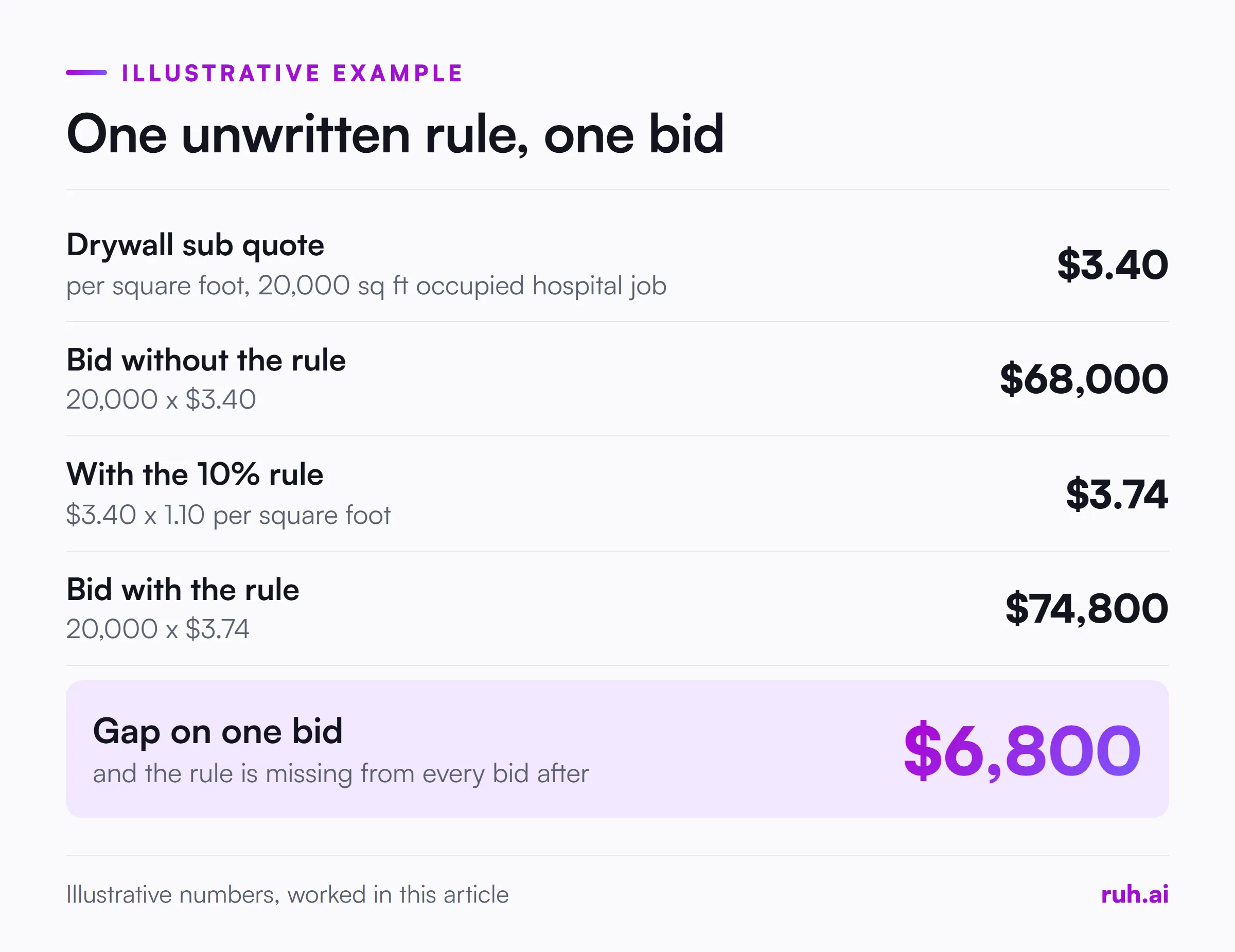
The $6,800 isn't the real cost. The real cost is that the rule is now gone, so it's missing from every hospital bid after this one. Written as a note on the drywall rate, with the condition "occupied healthcare", it would have been there the first time the new estimator priced the scope.
Key-Person Risk Checklist for Your Estimating Department
Run this once a quarter:
- Every rate used on the last ten bids is in a shared rate book, with a date and a source.
- Every rate book line shows who confirmed it.
- Standard assemblies exist for your most-bid scopes, and changes create new versions.
- Job-type adjustments are written as notes on the rates or assemblies they change.
- Scope inclusions and exclusions per trade are written down, and each bid records its exceptions.
- Unpriced trades are carried as labelled allowances, never as zeros.
- Every live bid could be finished by a second estimator from what's in the file.
- The bid tracker has a second person who can run it.
- Quotes and sub clarifications are stored with the job, not in personal email.
- Each stage of an estimate records who approved it.
Score one point per yes. Anything under eight means at least one bid would stall if your senior estimator left this week.
What Owners Get Wrong About Estimating Know-How
Four positions on estimating know-how, argued as our view, not as data.
A binder is not a system. Writing the method down feels like progress. A document nobody opens during a bid is a record of the past, not a procedure.
The senior estimator is not the problem. The risk comes from where their judgment is kept, not from them. Ask them to help build the rate book and assemblies, and most will, because it means fewer interruptions.
Exit interviews are the worst time to capture knowledge. The person leaving is busy, tired and guessing at what matters. Capture during live bids, when the decision is in front of them.
A spreadsheet only one person can open is a liability. If a rate sheet needs its author to explain it, it's part of the risk, not the cure.
The Honest Assessment: What Still Falls Short
No procedure captures all of an experienced estimator's judgment. Some of it is pattern recognition built over years, such as spotting a scope gap in a set of drawings, and the best you can do is record the decisions it produces.
Building a rate book and assemblies takes time from the same people who are busiest. It's easier on slow weeks, and slow weeks are rare. And a rule written down still needs someone to review it, because a rate that was right two years ago can be wrong today.
Software doesn't remove the need for a senior estimator either. It moves their judgment from their head into a place others can use and check.
How Ruh Fits
Ruh AI's Estimating Agent prices from your company's own rate book and history. The rate book is built from prices your people confirmed, and from your company's own price files.
Your company keeps its own assemblies, copied from Ruh's library. Edits create a new version, and a budget line keeps the version it was built from. AI-written scope lines cite the drawing or spec. A trade with nothing priced gets a labelled allowance line, never a silent zero, and a missing price blocks approval.
Your estimator approves every scope line before Ruh measures it, can edit every quantity and price, and each stage is approved before the next one opens. Upstream, Ruh AI's Takeoff Agent measures the drawing PDFs. Ruh works with your stack, built per customer.
Frequently Asked Questions
Q: What is key person risk in construction estimating? A: It is the exposure a contractor carries when the judgment behind its prices sits with one or two people. If they leave, bids slow down, numbers change or work stops, because nobody else knows the rules they applied.
Q: What should an estimating SOP include? A: It should cover the decisions that change a number: quote acceptance, the rate book, assemblies, job-type adjustments, scope inclusions and exclusions, how gaps are carried, takeoff assumptions and who approves each stage. Steps matter less than judgment.
Q: How do you document estimating knowledge without slowing bids? A: Record each decision when it's made, on a live bid: the price, the reason and who confirmed it, in the shared rate book or assembly. It takes seconds per decision and builds the record without a separate documentation project.
Q: How do you train a new estimator faster? A: Give them the company's rate book, standard assemblies and written job-type rules, then have them price real bids that a senior estimator reviews. They learn the method from the record instead of waiting for someone to remember it.
Q: How often should a contractor review its rate book? A: Set a review date on every rate, shorter for volatile materials and longer for labour-heavy work. Our glossary entry on unit cost explains why every rate needs a date and a source.
Q: Is an SOP binder enough to protect against key person risk? A: No. A binder sits outside the work, so it goes stale. Rules last when they live where estimators already work, attached to the rates, assemblies and approvals they use on every bid.
See how Ruh keeps your rates, assemblies and approvals in one estimating workflow on the construction estimating software page.