
Quick Answer
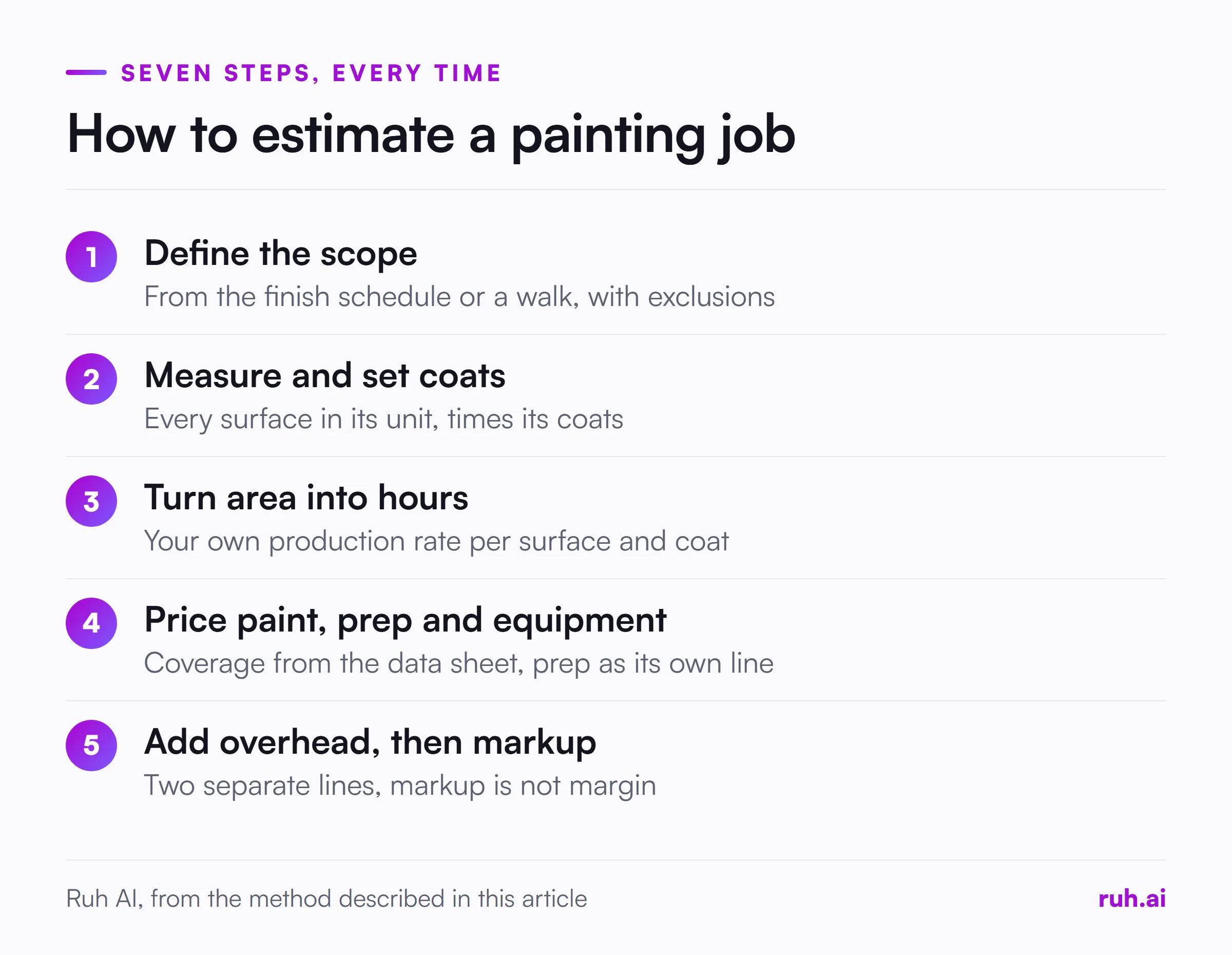
To learn how to estimate painting jobs, work in seven steps: define the scope from the finish schedule or a walk, measure every surface, set the coats for each one, turn area into hours with your own production rates, price paint and sundries from coverage, add prep and equipment, then add overhead and markup. Below, one sample commercial job is estimated line by line with every number shown, from a finish schedule to a price of $16,814, followed by how a missed primer coat takes $3,775 out of it, what changes on residential work, a checklist and what to put in the proposal.
What you'll find below:
- The sample job and its finish schedule
- Each step of the estimate, with the arithmetic shown
- The full estimate on one sheet, from hours to the final price
- How assuming two coats on new drywall leaves the bid $3,775 short
- What changes on residential repaints, including the federal lead-safe rule
- What to write into the proposal: inclusions, exclusions and allowances
The Sample Job: A Tenant Suite From the Finish Schedule
The job is a new commercial tenant suite with new drywall, priced from the drawings and the room finish schedule, and every number in it is illustrative. Redo it with your own measurements, rates and prices.
The finish schedule and specs say:
| Surface | Finish | Coats |
|---|---|---|
| Interior walls, new drywall | Eggshell latex | 1 primer, 2 finish |
| Gypsum board ceilings in restrooms and corridor | Flat latex | 1 primer, 2 finish |
| Hollow metal door frames, 24 | Semi-gloss enamel | Primed by the supplier, 2 finish |
| Wood doors | Factory finished | Not in painting scope |
| Lay-in ceiling tile | Not painted | Not in painting scope |
Reading the finish schedule and door schedule first is what sets the scope. Our guide on how to read construction blueprints covers matching every room tag and door tag to its schedule row.
For the concepts behind each step, such as what drives painting cost, labor burden and waste, see our guide to estimating painting cost. This post puts them to work on one job.
Step 1: What Does the Painter Own?
Define the scope by listing every surface the documents give to the painter, and every surface they give to someone else, before you measure anything. What you leave out matters as much as what you include.
From the sample job's schedules, the painter owns the walls, the gypsum ceilings and the door frames. The wood doors are factory finished, and the lay-in ceilings aren't painted. Write both lists down now, because they become the inclusions and exclusions in the proposal.
Also check the specs for the paint system, the finish level of the drywall and any testing or mock-up requirement. A higher drywall finish, such as a Level 5 finish, changes how much prep the surface needs and who does it.
Step 2: How Do You Measure Every Surface?
Measure every surface by type, in the unit you price it in: square feet for walls and ceilings, and a count for frames, doors and other items priced each. Deduct large openings and keep small ones in.
For the sample job:
- Walls: the wall lengths from the floor plans times the height from the sections, less large openings, give 6,400 square feet net.
- Ceilings: the gypsum ceiling areas from the reflected ceiling plan give 600 square feet.
- Frames: the door schedule lists 24 hollow metal frames.
Measure from the drawings at a confirmed scale, or on site with a tape for a repaint. If a sheet has no scale you can trust, don't measure from it.
Step 3: How Many Coats Does Each Surface Need?
Set the coats for each surface from the finish schedule and specs, and multiply the measured area by the number of coats to get the area to be painted. Coats are where a quick estimate goes wrong first.
For the sample job:
- Walls: 6,400 square feet of primer, plus 2 finish coats, or 6,400 x 2 = 12,800 square feet of finish.
- Ceilings: 600 square feet x 3 coats = 1,800 square feet.
- Frames: priced each, with 2 finish coats included in the per-frame rate.
New drywall needs a primer coat. A repaint over sound, similar paint can skip it when the specs allow. Read the specs, not your habit.
Step 4: How Do You Turn Area Into Labor Hours?
Turn painted area into labor hours by dividing each surface's area by your own production rate for that surface and coat, taken from your finished jobs. Published rates are a starting point, and your crew's history is the price.
The sample job uses these illustrative production rates:
| Surface and coat | Area or count | Production rate | Hours |
|---|---|---|---|
| Wall primer | 6,400 sf | 200 sf per hour | 32.0 |
| Wall finish, 2 coats | 12,800 sf | 160 sf per hour | 80.0 |
| Ceilings, 3 coats | 1,800 sf | 125 sf per hour | 14.4 |
| Door frames | 24 each | 0.75 hours each | 18.0 |
| Painting hours | 144.4 |
Ceilings and frames are slower than walls, which is why each surface gets its own rate. A single blended rate hides that.
Step 5: How Do You Price Paint and Sundries?
Price paint from the area to be painted divided by the coverage on the product data sheet, rounded up to whole gallons, then add sundries such as tape, plastic, caulk, rollers and brushes. The paint calculator works out gallons from area, coats and coverage.
For the sample job, with illustrative coverage and prices:
- Primer: walls and ceilings, 6,400 + 600 = 7,000 square feet at 300 square feet per gallon is 23.3 gallons, rounded up to 24 gallons x $28 = $672.
- Finish: 7,000 square feet x 2 coats = 14,000 square feet at 350 square feet per gallon = 40 gallons x $42 = $1,680.
- Frame enamel: 2 gallons x $55 = $110.
- Sundries: $350.
Coverage changes with the surface and the product. Use the data sheet for the product in the specs, not a general figure.
Step 6: Where Do Prep and Equipment Go?
Add prep as its own line in hours, and equipment as its own line in dollars, so neither hides inside a production rate. Prep is where two painters pricing the same job differ most.
For the sample job, prep is caulking, spot patching and sanding, and masking the frames and floors: an illustrative 20 hours. Equipment is a rolling scaffold for the corridor ceilings: $150.
Paint, sundries and equipment come to $672 + $1,680 + $110 + $350 + $150 = $2,962.
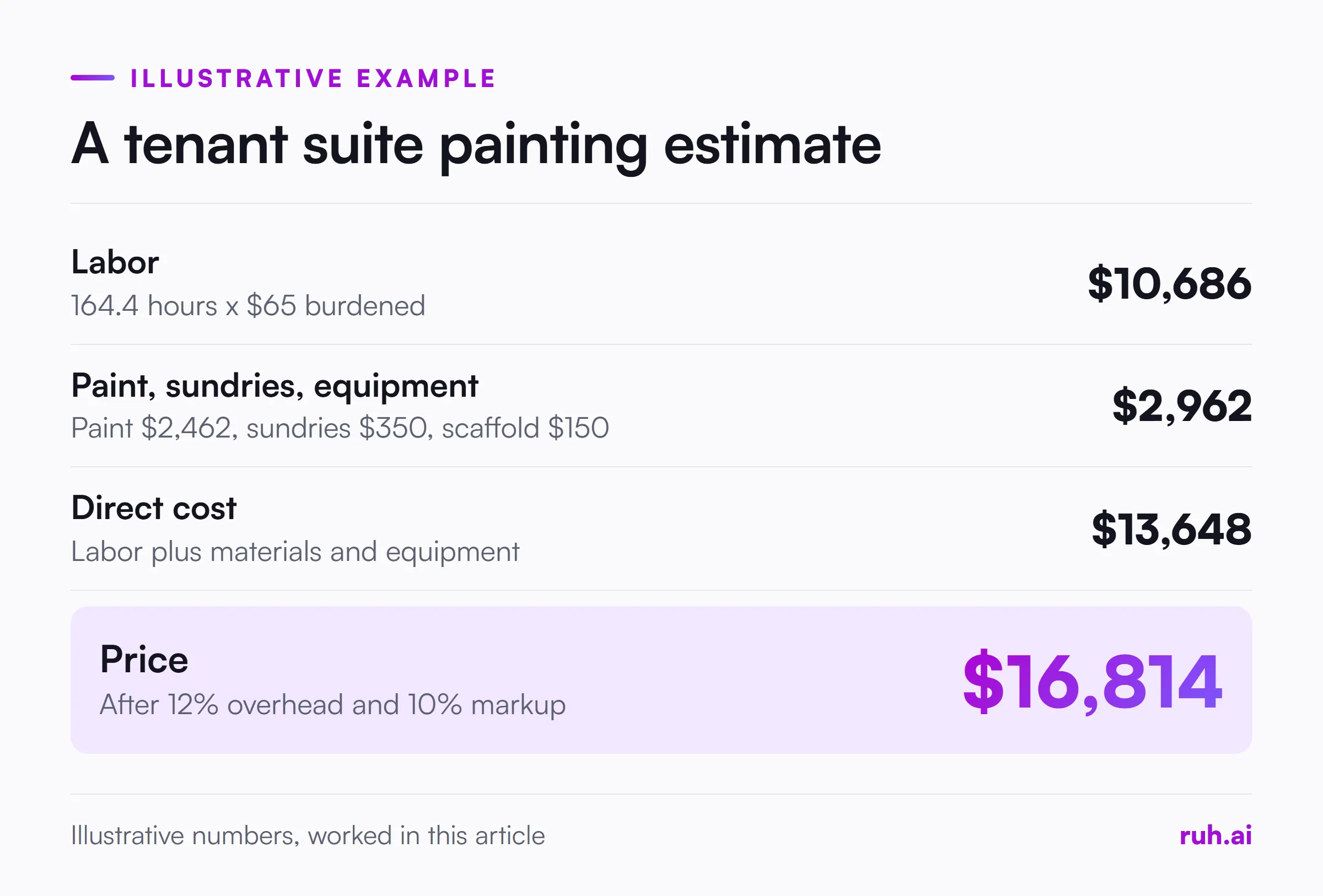
That brings labor to 144.4 painting hours + 20 prep hours = 164.4 hours. At an illustrative burdened rate of $65 an hour, labor is 164.4 x $65 = $10,686. The rate should include labor burden, such as payroll taxes and insurance, not just the wage.
Step 7: How Do You Add Overhead and Markup?
Add overhead to the direct cost to cover the costs of running the company, then add markup on the total for profit, and keep the two as separate lines. Markup and margin are not the same number.
For the sample job:
- Direct cost: labor $10,686 + paint $2,462 + sundries $350 + equipment $150 = $13,648.
- Overhead at an illustrative 12%: $13,648 x 0.12 = $1,637.76, for a cost of $15,285.76.
- Markup at an illustrative 10%: $15,285.76 x 0.10 = $1,528.58.
- Price: $15,285.76 + $1,528.58 = $16,814.34, or about $16,814.
A 10% markup on cost is not a 10% margin on the price. Our guide on markup versus margin shows how to convert one to the other.
The Full Estimate on One Sheet
Here is the whole sample estimate in one table, so each line can be checked against the steps above. All numbers are illustrative.
| Line | Quantity | Rate | Amount |
|---|---|---|---|
| Wall primer labor | 32.0 hours | $65 | $2,080 |
| Wall finish labor, 2 coats | 80.0 hours | $65 | $5,200 |
| Ceiling labor, 3 coats | 14.4 hours | $65 | $936 |
| Door frame labor | 18.0 hours | $65 | $1,170 |
| Prep labor | 20.0 hours | $65 | $1,300 |
| Primer | 24 gallons | $28 | $672 |
| Finish paint | 40 gallons | $42 | $1,680 |
| Frame enamel | 2 gallons | $55 | $110 |
| Sundries | $350 | ||
| Equipment | $150 | ||
| Direct cost | $13,648 | ||
| Overhead | 12% | $1,637.76 | |
| Markup | 10% | $1,528.58 | |
| Price | $16,814.34 |
What Does One Assumed Coat Cost?
Assuming two coats on new drywall, instead of a primer and two finish coats, leaves this sample bid about $3,775 short. The missed coat takes labor, paint, overhead and markup with it.
Without the primer, the estimate loses the wall primer hours (32) and one of the three ceiling coats (600 / 125 = 4.8 hours), or 36.8 hours x $65 = $2,392 of labor, plus the $672 of primer. That is $3,064 of direct cost, or $3,064 x 1.12 x 1.10 = $3,774.85 at the price, about $3,775. The painter still has to prime the walls to get the finish the specs require.
What Changes Between Residential and Commercial Painting Estimates?
Residential estimates are usually measured on a walk and priced by the room, while commercial estimates are measured from drawings and priced from a finish schedule and specs, but the seven steps are the same. The inputs change, not the method.
On residential work, the walk sets the scope: room by room, with furniture moving, protection and the condition of existing surfaces. Repaints need more prep and less primer than new work, and color changes may need an extra coat.
Older homes add a federal rule. The EPA's Renovation, Repair and Painting Rule requires anyone paid to do work that disturbs painted surfaces in homes, childcare facilities and preschools built before 1978 to be certified, with workers trained in lead-safe work practices. Check the build year before you price prep on a repaint, because lead-safe practices change the prep, containment and cleanup lines.
On commercial work, the documents set the scope. Read the finish schedule, the specs and the bid form, and price to them. Our guide on how to bid painting as a subcontractor covers the prep standard and what the GC checks when comparing painting bids.
Painting Estimate Checklist
Run this before the estimate goes out:
- Every surface in the finish schedule or walk is either in scope or excluded in writing.
- Every surface is measured in its pricing unit, with large openings deducted.
- Coats come from the finish schedule and specs, with primer on new surfaces.
- Each surface and coat has its own production rate from your job history.
- Paint gallons come from the product data sheet coverage, rounded up.
- Prep is its own line in hours.
- Equipment, such as lifts or scaffolding, is its own line.
- The labor rate includes burden.
- Overhead and markup are separate lines, and markup is not confused with margin.
- On residential repaints, the build year is checked for the lead-safe rule.
- Anything without a price is a labelled allowance, never a zero.
What Should the Painting Proposal Say?
Write the proposal so a client can see exactly what the price includes: the surfaces, the coats, the paint system, the prep standard and what is excluded. Most painting disputes start with a scope nobody wrote down.
For the sample job, the proposal would list:
- Included: walls and gypsum ceilings, primer and 2 finish coats, 24 hollow metal frames with 2 finish coats, caulking and spot patching, masking and cleanup.
- Excluded: wood doors (factory finished), lay-in ceilings, drywall finishing beyond spot patching, wallcovering and any work outside the suite.
- Assumptions: the drywall is finished to the specified level before painting starts, the space is clear and heated, and work is during normal hours.
- Allowances: any surface or color not yet decided, carried as a labelled allowance.
The Honest Assessment: What Still Falls Short
A painting estimate is only as good as its production rates, and those come from your own job history. A new crew, a new product or a different site can make last year's rates wrong.
Prep is also hard to price from drawings alone, because the condition of the surfaces is only clear on site. And schedules change: a painter who expected an empty building and finds trades working around them will lose hours no estimate showed.
How Ruh Fits
Ruh AI's Estimating Agent carries your takeoff quantities into a priced estimate using your company's own rate book and assemblies. Any trade with nothing priced gets a labelled allowance line instead of a silent zero.
A person on your team approves every scope line, your team can edit every quantity and price, and a person on your team approves the budget before it moves on. Ruh AI's Takeoff Agent reads the drawing PDFs and won't give a length or area for a sheet with no scale. Ruh works with your stack, built per customer.
Frequently Asked Questions
Q: How do you estimate a painting job? A: Define the scope, measure every surface, set the coats for each one, divide the painted area by your production rates to get hours, price paint from coverage plus sundries, add prep and equipment, then add overhead and markup as separate lines.
Q: How do you calculate labor for a painting job? A: Divide each surface's painted area, the measured area times the coats, by your own production rate for that surface, add prep hours, and multiply the total hours by a labor rate that includes burden.
Q: How do you figure how much paint a job needs? A: Multiply the area by the number of coats, divide by the coverage on the product data sheet, and round up to whole gallons. Coverage changes with the surface and the product.
Q: What markup should a painting contractor use? A: It depends on your overhead, the job and the market. Price overhead as its own line from your own costs, then add markup for profit, and remember that a markup on cost is not the same as a margin on the price.
Q: What is the difference between residential and commercial painting estimates? A: Residential estimates are usually measured on a walk and priced room by room. Commercial estimates are measured from drawings and priced from a finish schedule and specs. The steps are the same.
Q: What should a painting proposal include? A: The surfaces included, the coats and paint system, the prep standard, the exclusions, the assumptions about site conditions and any allowances. A written scope prevents most painting disputes.
See how Ruh prices your takeoff from your own rate book on the construction estimating software page.