
Construction glossary · Estimating concepts
What is takeoff in construction?
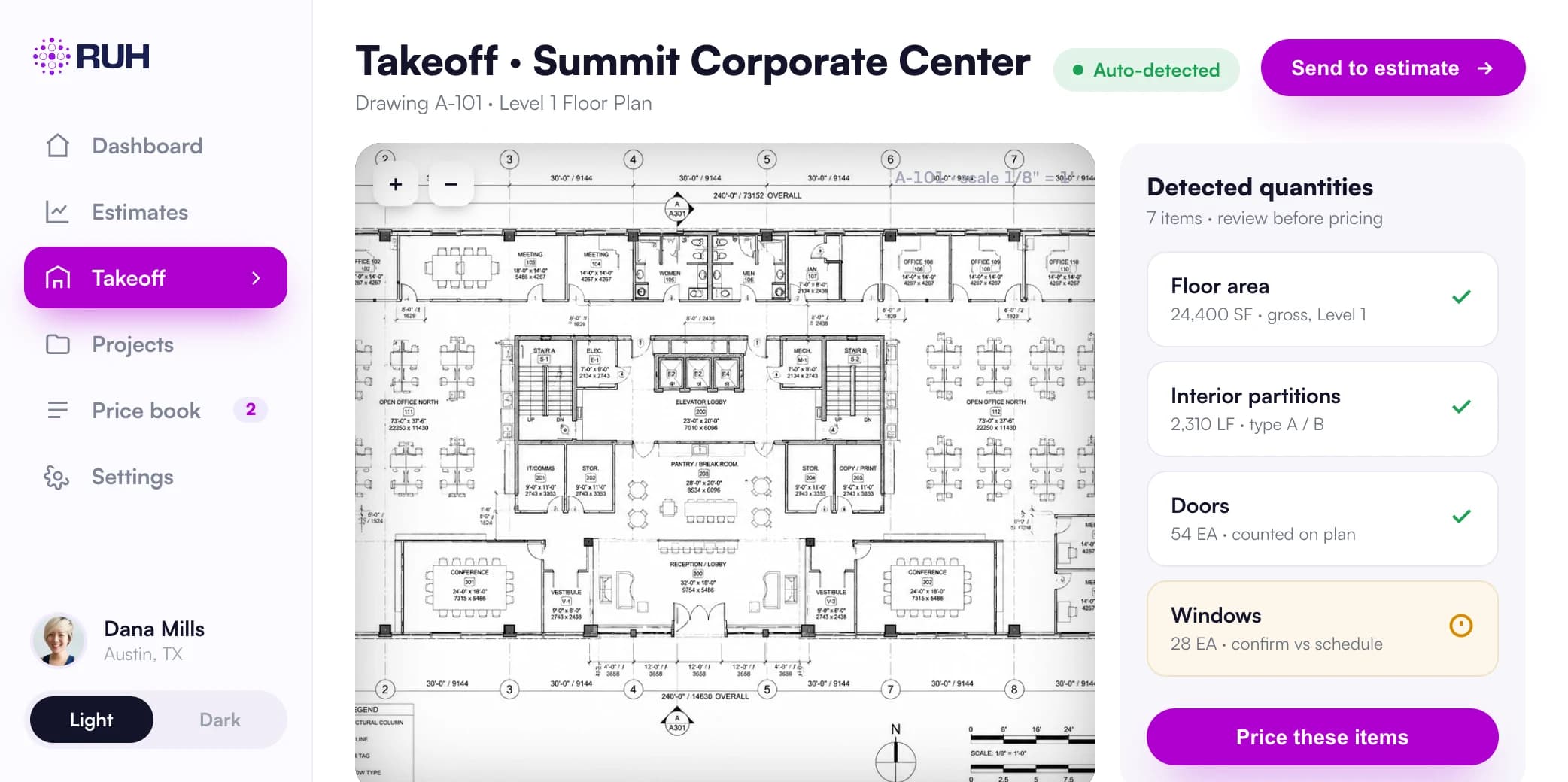
A takeoff in construction is the process of measuring and counting every item of work from the project drawings, producing quantities such as 14 doors, 240 lf of partition, or 1,800 sf of slab. It is the first step in building an estimate: the takeoff establishes how much work there is, and the estimator then applies unit costs to those quantities to price the job. It is also called a quantity takeoff (QTO) or material takeoff (MTO).
Updated June 2026 · Reviewed by the Ruh construction team
The takeoff process
Estimating estimating concepts scope this week? Watch Ruh take off a real plan in 30 minutes.
Book a walkthroughA takeoff is the systematic measurement of every scope item in a drawing set so it can be priced. Estimators perform takeoffs from plans, elevations, sections, schedules, and details, working trade by trade and usually organized by CSI division. The term shows up everywhere in preconstruction: bid invitations ask subs to perform their own takeoff, scope sheets reference takeoff quantities, and buyout meetings compare the GC's takeoff against sub proposals. General contractors, subcontractors, and suppliers all run takeoffs, sometimes on the same drawing set, which is why quantities get compared and challenged. The mistakes new estimators make are predictable: scaling dimensions off sheets marked "do not scale" instead of using written dimensions, missing addenda that changed the drawings after the takeoff started, skipping waste factors, double counting work shown on both a plan and a detail, and quantifying only what the drawings show instead of what the specs also require. A clean takeoff is traceable, meaning every quantity points back to a sheet number and a measurement an auditor could repeat.
Takeoff quantities carry one of four measurement types: count (each, abbreviated ea), length (linear feet, lf), area (square feet, sf, or square yards, sy), and volume (cubic yards, cy). Weight (tons or lbs) covers structural steel and rebar. The estimator pulls counts from schedules (door, window, fixture), lengths and areas from scaled floor plans, and volumes by combining plan area with thicknesses from sections and details. Each quantity is logged against the sheet it came from, then extended with a waste factor where the material demands it (drywall, concrete, lumber). The finished takeoff lands in a spreadsheet or estimating platform as the quantity column that unit costs get applied to.
Worked example
Take a small tenant improvement. The floor plan shows 240 lf of new interior partition at 9 ft tall, the door schedule lists 14 doors, and the slab plan shows a 1,800 sf slab patch at 4 in thick. Partition drywall: 240 lf x 9 ft = 2,160 sf of wall, both faces = 4,320 sf, plus 10 percent waste = 4,752 sf, carried as 4,800 sf. Concrete: 1,800 sf x 0.333 ft = 600 cf, and 600 cf divided by 27 = 22.2 cy, carried as 24 cy to cover waste and grade variation. Doors: 14 ea, a straight count. At illustrative unit costs of $2.40 per sf for drywall hung and finished, $400 per cy for concrete in place, and $1,450 per door installed, the lines extend to 4,800 sf x $2.40 = $11,520, 24 cy x $400 = $9,600, and 14 x $1,450 = $20,300. Every one of those numbers traces back to a sheet in the set.
Try Ruh on a real bid. 100% money-back guarantee if you are not satisfied.*
*Scoped delivery, terms apply. Read the guarantee terms
How Ruh handles takeoff
Ruh automates the takeoff step itself: it reads the contractor's drawing set, counts and measures the scope (door counts, lf of partition, sf of slab), and prices those quantities against the contractor's own price book rather than generic cost data. The result is a line-item draft estimate handed to the estimator, who reviews the quantities, adjusts assumptions like waste factors and means and methods, and signs off. The measuring gets faster, but the professional judgment stays with the estimator.
See construction estimating softwareTakeoff: frequently asked questions
What is the difference between a takeoff and an estimate?+
The takeoff is the quantity step: it tells you how much work there is, in units like ea, lf, sf, and cy. The estimate is the pricing step: it applies labor, material, and equipment unit costs to those quantities, then adds markups such as overhead, profit, bond, and contingency. You cannot have a reliable estimate without a reliable takeoff, because every pricing error scales off the quantity beneath it.
What do QTO and MTO stand for?+
QTO is quantity takeoff and MTO is material takeoff, and in day-to-day use they overlap heavily. Strictly speaking, a material takeoff lists only physical materials (studs, sheets of drywall, yards of concrete), while a quantity takeoff measures all work items, including labor-only scopes like demolition or finishing. Most US commercial estimators just say takeoff and mean the full quantity survey.
Do digital and AI takeoffs still need to be checked?+
Yes. Software measures faster and more consistently than a scale ruler, but the estimator still has to confirm the right drawing revision was used, the scope matches the specs and addenda, and the waste factors fit the planned means and methods. Treat an AI takeoff as a strong first pass that you verify and own, the same way you would review a junior estimator's quantities.
Still measuring by hand? Your next takeoff can run while you review this one.
See it on your plansRelated terms
Keep going: read the full guide or explore construction estimating software.
See Ruh price a bid from your own drawings.
AI takeoff and estimating on your price book, your estimator signs off.
Figures on this page are illustrative. Construction estimates depend on project-specific conditions, source documents, market pricing, and professional judgment. Ruh's AI assists the estimator and does not replace professional review: your team reviews, validates, and approves every estimate, bid, and pricing decision.