

Quick Answer
Addenda tracking for estimators is the routine of logging every addendum issued during bidding, finding what each one changed in the drawings and specs, and re-measuring and re-pricing only the affected scope, so the number you submit matches the final bid set. Below are a map of where changes hide in a reissued set, three ways to compare revised drawings side by side, the fields a revision log needs, a worked addendum with the arithmetic shown, the federal rule on acknowledging amendments, a pre-submission checklist and our view on what estimators get wrong.
What you'll find below:
- Seven places a change hides in a revised set, and how to catch each one
- Sheet flipping, overlay compare and slip sheeting, compared side by side
- The 12 fields a revision log needs for every addendum
- A worked addendum where an unclouded note adds $2,100 of drywall
- What FAR 52.214-3 says about acknowledging amendments, and when a miss can be waived
- A pre-submission addenda checklist
Why Do Addenda Land at the Worst Point in a Bid?
Addenda arrive late because they answer the questions bidders raise while they price. The architect or owner collects those questions, fixes the documents, and issues the changes together, usually in the last stretch before the bid date. By then, most estimators have finished the takeoff and started pricing.
That timing is the whole problem. An addendum with a dozen reissued sheets doesn't take long to read. It takes long to prove what changed against the set you already measured, sheet by sheet, under a deadline.
A missed change rarely shows up on bid day. It shows up after award, when the crew builds what the final documents say and the number you carried came from the old ones.
What Makes an Addendum Binding on Your Bid?
An addendum is binding because it changes the bid documents themselves, so the bid you submit is priced against the documents as amended, not as first issued. Read what an addendum is in our glossary if you want the short definition first.
Federal sealed bidding writes the rule down plainly. FAR 14.208, on Acquisition.gov in the 2026 edition, says changes to quantity, specifications, delivery schedules or opening dates are made by amendment, and that a change mentioned at a pre-bid conference still needs an amendment. The same section has the contracting officer consider the time left before bid opening, and whether to extend it, before amending.
FAR 52.214-3, a provision dated December 2016 and still current in 2026, also says the terms an amendment doesn't touch stay unchanged. That's the estimator's job in one line: find the parts that moved, and leave everything else as measured.
State, local and private owners set their own rules in the instructions to bidders. Read those for every job, because the deadline for questions, the last date for addenda and the acknowledgement method all live there.
Where Do Changes Hide in a Revised Set?
Changes hide anywhere the addendum touches, and revision clouds only mark the ones the designer chose to mark. A complete review covers seven places, and the cheapest misses come from the ones estimators check least.
Seven places a change can sit in an addendum, and how to catch each:
| Where the change sits | Why it gets missed | How to catch it |
|---|---|---|
| Clouded revision on a reissued sheet | Rarely missed, but the cloud can be tighter than the change | Read the revision delta and check the area around the cloud |
| Unclouded revision | Nothing on the sheet flags it | Compare the whole sheet against the prior issue, not just the clouds |
| Reissued sheet with the same number | Looks identical in a sheet list | Check the revision block date and number on every sheet in the addendum |
| New or deleted sheets | A sheet list scan skips what isn't there | Rebuild the sheet index from the addendum and diff it against yours |
| Replaced spec section | Reviewers focus on drawings | Read the addendum narrative and compare the section's edition date |
| General or schedule notes | Notes change scope without changing geometry | Re-read general notes, door, finish and fixture schedules on reissued sheets |
| Answers to bidder questions | They sit in the narrative, not on a sheet | Turn each answer that touches scope into a line in your revision log |
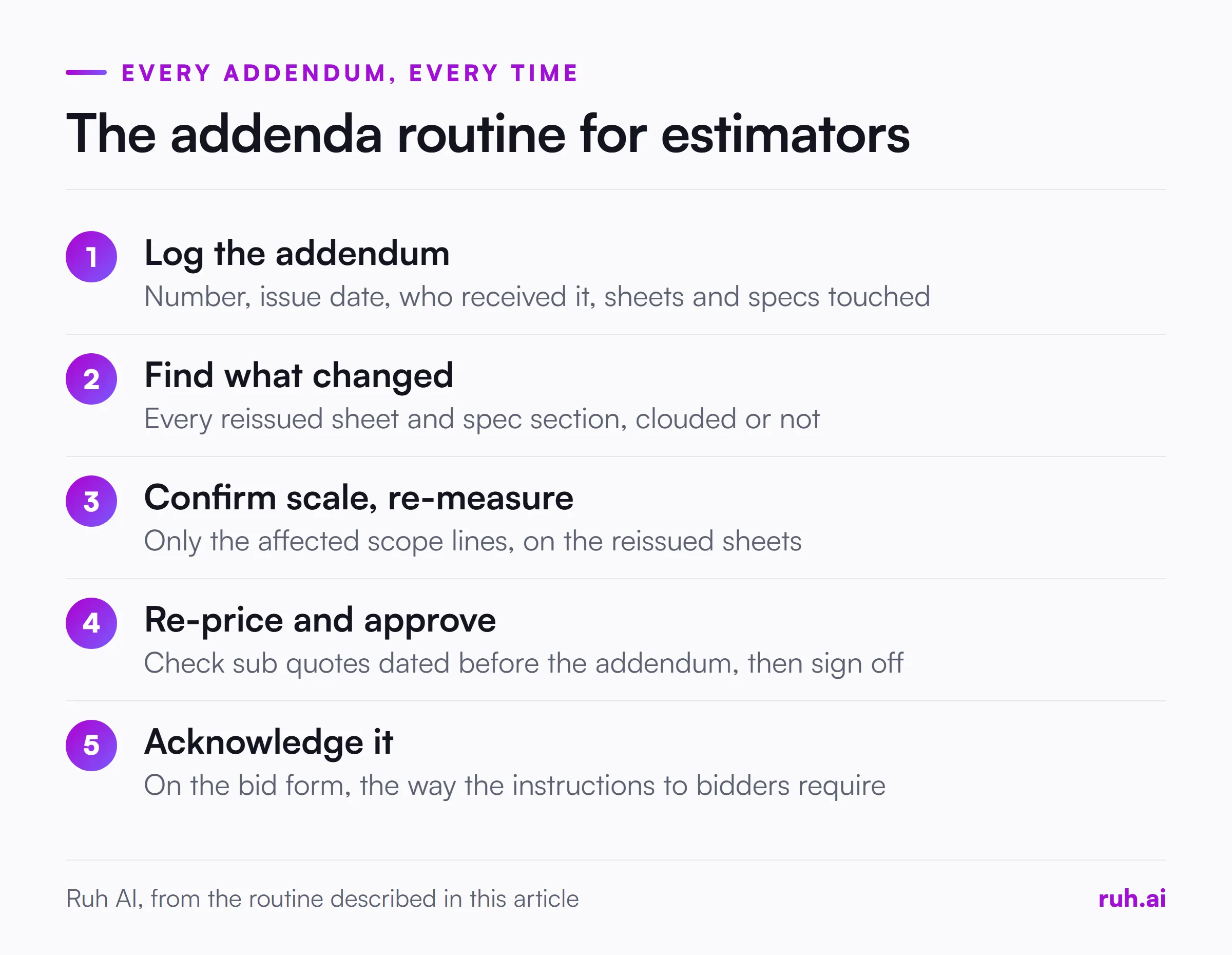
The routine that catches all seven is the same every time. It starts with logging the addendum and ends with acknowledging it on the bid form.
How Do Estimators Compare Revised Drawings?
Estimators compare revised drawings in three manual ways: flipping between old and new sheets, overlaying them, and slip sheeting the new sheets into the old set. Each catches a different kind of change, and each has a blind spot, which is why a log matters more than the method.
How the three comparison methods stack up:
| Method | What it catches | What it misses | Best for |
|---|---|---|---|
| Sheet-by-sheet flip | Obvious moves and added elements | Small dimension or note changes, which the eye skips | A few reissued sheets with clear clouds |
| Overlay compare | Any line that moved, clouded or not, shown in contrasting colours | Spec changes, schedule text and anything not on the drawing | Plans and elevations where geometry changed |
| Slip sheeting | Keeps one current set, so nobody measures from a superseded sheet | Doesn't show what changed, only which sheet is current | Keeping the working set clean after the review |
Overlay compare is the best of the three for geometry, because it shows unclouded moves. It needs both issues of the same sheet at the same scale and alignment, and it says nothing about a replaced spec section.
Slip sheeting is housekeeping, not review. Some document tools slip sheet drawings automatically by matching sheet numbers, which keeps the set current, but a current set is not the same as a checked one. Someone still has to decide which quantities moved.
What Should a Revision Log Track for Each Addendum?
A revision log is one row per addendum, and sometimes one row per changed sheet, that records what changed, which scope lines it touched, and who re-measured, re-priced and approved each one. It's the estimator's proof that the number matches the final set.
The 12 fields a revision log needs:
| Field | What goes in it |
|---|---|
| Addendum number | As issued, for example Addendum 2 |
| Issue date | The date on the addendum |
| Received | Date, time and who on your team received it |
| Sheets reissued | Every sheet number and its new revision |
| Sheets added or deleted | Compared against your sheet index |
| Spec sections changed | Section number and the new edition date |
| What changed | One line per change, in plain words |
| Scope lines affected | The takeoff and estimate lines it touches |
| Re-measured by | Name and date |
| Re-priced by | Name and date |
| Approved by | The person who signs off the revised lines |
| Acknowledged | How and when it went on the bid form |
Keep the log with the estimate, not in someone's inbox. If the bid is questioned after award, the log shows what you priced and when.
How Do You Re-Measure Changed Sheets Without Redoing the Takeoff?
Re-measure only the scope lines the addendum touched, on the reissued sheets, and leave every other line as measured. Start from the "scope lines affected" column of the log, open the matching takeoff lines, and measure them again on the new sheet.
Three rules keep the re-measure honest:
- Confirm the scale before you measure anything. Reissued sheets sometimes come back reduced, cropped or with the scale bar missing on an enlarged plan. If a sheet has no scale you can trust, count what you can and leave lengths and areas blank until the designer confirms it.
- Replace, don't add. Delete or supersede the old measurement on a changed sheet, so the estimate never carries both versions.
- Mark every re-measured line with the addendum number. Anyone reading the estimate can see which quantities changed and why.
The same logic answers a question estimators ask about software: how does takeoff software handle changes and revisions? It depends on whether the tool ties each measurement to a sheet and a revision. If it does, the reissued sheets tell you exactly which lines to redo. If it doesn't, you are back to redoing the takeoff for every addendum.
Which Quantities Should You Re-Check First?
Re-check first the quantities with the most dollars behind them and the least certainty in them, not the newest sheets. A small change on a high-value line costs more than a big change on a cheap one, and a quantity you measured quickly is more likely to be wrong after an addendum.
Order the review like this:
- Lines the addendum touches directly, highest dollar value first.
- Lines on reissued sheets with no clouds, because the change may be invisible.
- Lines where the original measurement was uncertain: a dense area, a poor scan, a detail you had to infer.
- Everything else on the reissued sheets.
If the addendum is big and the bid date is close, ask for more time early. Federal rules already have the contracting officer weigh an extension before amending, under FAR 14.208.
Worked Example: One Addendum, Two Days Before Bid
An unclouded change can carry nearly as many dollars as the clouded one, as this illustrative example shows with every assumption stated inline. Use your own quantities and rates to redo it.
Addendum 2 arrives two days before bid on a tenant fit-out. It reissues 7 sheets and replaces one spec section. Here is what the review finds.
- A-101, clouded: a corridor wall moves and adds 40 linear feet of partition, 10 feet high, with board on both sides. That is 40 x 10 x 2 = 800 square feet of board.
- A-501, unclouded: a general note raises partitions from 9 to 10 feet on 300 linear feet of wall, board on both sides. That is 300 x 1 x 2 = 600 square feet.
- A-502, reissued: no clouds, and the scale bar is missing on the enlarged plan. Counts of doors and fixtures are fine. Lengths wait until the architect confirms the scale.
Added board totals 800 + 600 = 1,400 square feet. At an illustrative installed rate of $3.50 per square foot, the addendum adds 1,400 x $3.50 = $4,900. Of that, the unclouded note alone is 600 x $3.50 = $2,100.
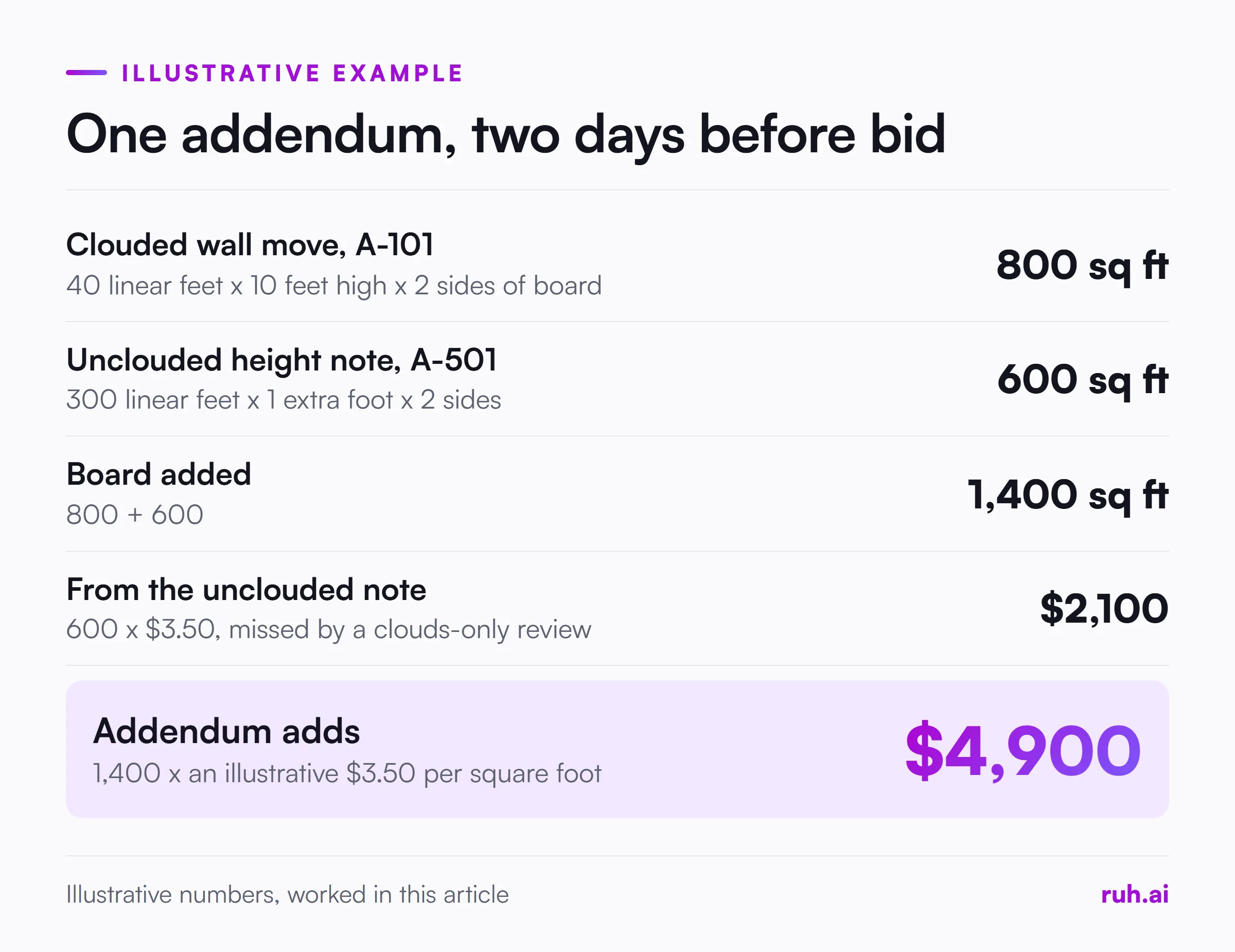
A reviewer who only read the clouds would have carried $2,800 and missed $2,100. Neither number is big on its own, but the miss is the kind that repeats on every addendum of every bid.
Do You Have to Acknowledge Every Addendum?
On federal sealed bids, yes: FAR 52.214-3 says bidders shall acknowledge receipt of any amendment, and the government must receive the acknowledgement by the time and at the place set for receipt of bids. Other owners set their own rule in the instructions to bidders, and most bid forms have a line for it.
The provision, dated December 2016 and current in the 2026 FAR, lists 5 ways to acknowledge: sign and return the amendment, write its number and date on the bid form, send a letter, or use fax or email only if the solicitation allows bids that way.
A missed acknowledgement is waivable only in narrow cases. FAR 14.405(d), on Acquisition.gov in the 2026 edition, lets the contracting officer treat it as a minor informality only if the bid clearly shows you received the amendment, or the amendment is a matter of form or has no effect or a negligible effect on price, quantity, quality or delivery. An addendum that changes scope is rarely negligible.
Acknowledging is the last step, not the review. Writing "Addenda 1 to 3" on the form says you received them. Only the log says you priced them.
Pre-Submission Addenda Checklist
Run this before the number goes out:
- Every addendum issued is in the log, numbered with no gaps.
- The sheet index matches the latest addendum, including added and deleted sheets.
- Every reissued sheet has been compared against its prior issue, clouded or not.
- Every replaced spec section has been read against the old one.
- Every answer to a bidder question that touches scope is a line in the log.
- Every changed sheet's scale has been confirmed before any length or area was taken.
- Every affected scope line has been re-measured, and the old measurement replaced.
- Every re-measured line has been re-priced, and sub quotes received before the addendum have been checked against it.
- A person has approved the revised lines.
- Every addendum is acknowledged in the way the instructions to bidders require.
Sub quotes are the easiest item to forget. A drywall or electrical quote dated before Addendum 2 may not include it, so ask the sub to confirm in writing. Our post on construction bid accuracy covers more of the checks that keep a number honest.
What Estimators Get Wrong About Addenda
Four positions on addenda, argued as our view, not as data.
Clouds are a courtesy, not a promise. Designers cloud what they remember to cloud. Treat every reissued sheet as changed until you've compared it, because the unclouded edit is the one nobody else in the bid room priced either.
Newest sheets first is the wrong order. It feels natural to start where the addendum starts. Start where the money is and where your first count was weakest instead.
Acknowledging an addendum is not the same as pricing it. The acknowledgement line on the bid form is a receipt. It's easy to treat it as the finish line, and it isn't.
One person owns the log. An addendum that lands in a shared inbox belongs to nobody. Name the person who logs it, and the person who approves the revised lines, before bid week starts.
Changes often hide where the drawings and specs disagree, which our post on drawing and specification conflicts walks through in detail.
The Honest Assessment: What Still Falls Short
No routine or tool removes the need to read the addendum narrative. Answers to bidder questions, substitutions and clarifications live in text, and no drawing comparison will find them.
Overlay compare needs both issues at the same scale and alignment, and a reissued sheet that was re-plotted or re-cropped can fill the overlay with false differences. Late addenda can still leave too little time to price properly, and the only real fix is to ask for an extension early.
A revision log also only works if it's kept. It adds a few minutes to every addendum, and in bid week, the few minutes are what people skip.
How Ruh Fits
Ruh AI's Takeoff Agent reads drawing PDFs and measures them, and it won't give an area or length for a sheet that has no scale. It still counts, so a reissued sheet with a missing scale bar gets its counts and no guessed lengths.
Each measurement carries a confidence score that orders the review, so your estimator checks the least certain quantities first. Your estimator approves every scope line before Ruh measures it, can edit every quantity and price, and each stage is approved before the next one opens. Ruh doesn't compare drawing sets for you, so the revision log above still matters. Ruh works with your stack, built per customer.
Frequently Asked Questions
Q: What is an addendum in construction bidding? A: An addendum is a formal change to the bid documents issued before bids are due, such as reissued drawings, a replaced spec section or answers to bidder questions. Once issued, it is part of the documents your bid is priced against.
Q: How do estimators track addenda during bidding? A: They keep a revision log with one row per addendum, recording the sheets and spec sections changed, the scope lines affected, and who re-measured, re-priced and approved each change. The log is checked against the bid form before submission.
Q: How does takeoff software handle drawing changes and revisions? A: It depends on whether the software ties each measurement to a sheet and its revision. If it does, reissued sheets show exactly which quantities to re-measure. If it doesn't, the estimator has to find the affected lines by hand.
Q: What happens if you don't acknowledge an addendum? A: On a federal sealed bid, the bid can be rejected. Under FAR 14.405(d), a missed acknowledgement is waivable only if the bid shows you received the amendment or its effect on price, quantity, quality or delivery is negligible. Other owners set their own rules.
Q: What is slip sheeting in construction drawings? A: Slip sheeting is replacing superseded sheets in the working set with the reissued ones, so everyone measures from the current revision. It keeps the set clean but doesn't show what changed, so it comes after the comparison, not instead of it.
Q: Do you have to redo the whole takeoff for every addendum? A: No. Re-measure only the scope lines the addendum touched, on the reissued sheets, after confirming each sheet's scale. Replace the old measurements instead of adding to them, and mark each re-measured line with the addendum number.
See how Ruh AI's Takeoff Agent measures drawing PDFs and flags unscaled sheets for your review.